
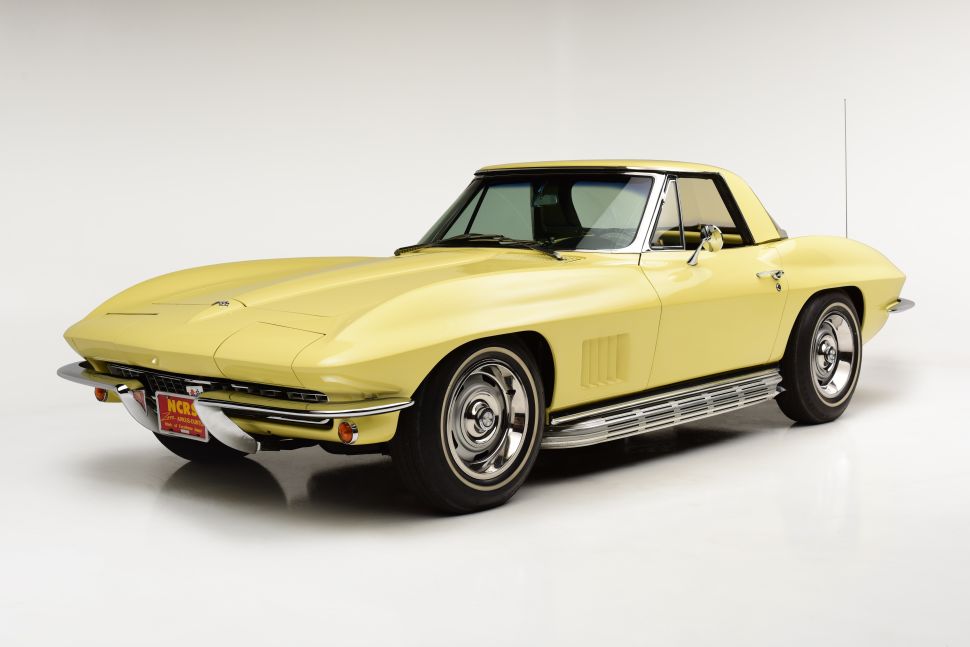
Chevrolet Corvette” width=”970″ height=”647″ data-caption=’Cars like the 1967 Chevrolet Corvette have transcended nostalgia and become genuine investment metal. <span class=”lazyload media-credit”>Photo by Barrett-Jackson via Getty Images</span>’>
The U.S. did not invent the automobile, but it perfected a deep cultural love of cars. Since Henry Ford fired up his assembly lines, before Route 66 was a glimmer in the eye, Americans looked on cars as more than mere transportation. An assemblage of steel and rubber could become desired objects of precious history, cultural identity and self-expression.
In the 21st Century, anything rare becomes a commodity. That means American cars relegated to limited supplies by history and advancing engineering can emerge as more than highly desired stars of nostalgia, transforming into investment metal on the auction circuit. While going under the gavel isn’t the only way to determine a car’s emotional appeal, secondary market prices remain the most useful method to track the value of something precious.
American cars rarely draw the same kinds of vault-shattering prices the European favorites from Italy and Germany demand. For example, the 1955 Mercedes Benz 300 SLR “Uhlenhaut Coupe” is universally recognized as the most expensive car ever auctioned, selling in 2022 via RM Sotheby’s for $142 million. The 1962-1964 Ferrari 250 GTOs remain hot with Bonhams bringing the hammer down on a 250 for $38,115,000 in 2014, and Sotheby’s selling another in 2023 for $51,705,000.
The American enthusiast looks to push stratospheric German and Italian prices aside and get a more down home “bargain” with a proper, patriotic muscle car. For the red, white and blue gearhead looking to spend the green, mention of a Shelby Cobra will always draw attention. Conceived as a road-going racer by Carroll Shelby and produced in starts and stops from 1962 to 1967, several Cobra builds pulled in north of $10 million over the years. The very first 1962 Shelby 260 Cobra (chassis CSX 2000) went for $13,750,000 at Sotheby’s in 2016, while Mecum moved a 1965 Shelby Daytona Cobra Coupe in 2009 for $7,865,000.
The other most sought after auction target in the muscle car realm is any of the 20 1967 Chevrolet Corvette L88 run. Built expressly for the track, each version carried a rare Chevy big block V8 capable of well more than 500 horsepower (a startling number in 1967 and not exactly slow for 2026). One of the 20 Corvettes moved for $3.85 million in 2014, before heading up for auction again in 2024 and claiming $3.2 million.
Lesser known in popular culture than a Cobra or a Corvette, the Plymouth Hemi Barracuda is widely considered the purest incarnation of the American muscle machine. Each vehicle carried the 7-liter “Elephant” V8 developed for NASCAR, an engine capable of 425 horsepower. Plymouth produced 780 Hemi ‘Cudas between 1970 and 1971, and collectible car wisdom says that’s potentially too many to drive up seven figure prices. However, the automaker only rolled out 26 convertibles in those years. Mecum sold off just such a 1971 soft top in 2014 for $3.5 million.
It’s unjust to talk about muscle cars in demand without picking out an original pony car. The 1965 Shelby Mustang GT350R took the common man’s sports car and amped it up into a racing star. The same man behind the desirable Cobra headed up development of the GT350R, with Shelby making it into a purely track-spec coupe with reduced weight and a 360 horsepower V8.
Often seen in original white with Ford blue racing stripes, Shelby GT350Rs don’t stick around long on the auction block. Only 34 were ever built, and the first one off the line claimed $4.07 million at the Mecum Auctions Kissimmee Event in 2022.
A controversial entrant in the American collectible scene is the Ford GT40. Made famous in the Matt Damon film Ford v. Ferrari, the Dearborn automaker developed the 24 Hours of LeMans racing machine in the 1960s specifically to knock Enzo Ferrari off the podium. The GT40 did just that, dominating LeMans from 1966 to 1969, with 105 cars emerging as racers or high-end consumer sports cars before total production ended.
The highest auction sale for GT40 fell in 2025 when a 1966 MK II cruised out of RM Sotheby’s Miami for $13,205,000. That should easily qualify a GT40 as a holy grail of U.S. collector cars. The trouble is, while Ford paid the bills, the machines were engineered and built in Slough outside London—leaving the debate open as to how much British blood and sweat went into this American racing star.
The hardcore collectors looking to reach beyond trendy 1960s relics most often turn back to the 1930s and the Duesenbergs. The automaker died out in 1937, but not before building the era’s most sought after luxury coupes. Duesenbergs often drive off as yearly champions on the Concours d’Elegance circuit, and their king remains the 1935 SSJ. The company only built two of them, and the very same version Hollywood legend Gary Cooper owned sold for $22 million in 2018, setting a new record for a Duesenberg.
Finally, jumping ahead to one of the fresher faces in the American supercar world, the Hennessey Venom F5 goes for about $3 million brand new, so its auction prices for models just hitting the market now can top out around $3.5 million. The only strikes against the 1,817 horsepower hypercar are its too new a player to earn the charm of nostalgia—and, like the GT40, it was developed for the American company by Delta Motorsport in the U.K.
