
My long and varied media career includes a stint at LIFE magazine. Time Inc. had been trying to revive the property as a slideshow-oriented web 2.0 venture that paired new pictures with deep dives into the rich archives. Often we would present old photos alongside new interviews with the photographers or subjects of the photos. I couldn’t believe the stature the magazine still held for many Americans. One time Aretha Franklin called me from Detroit while she was making tortilla soup.
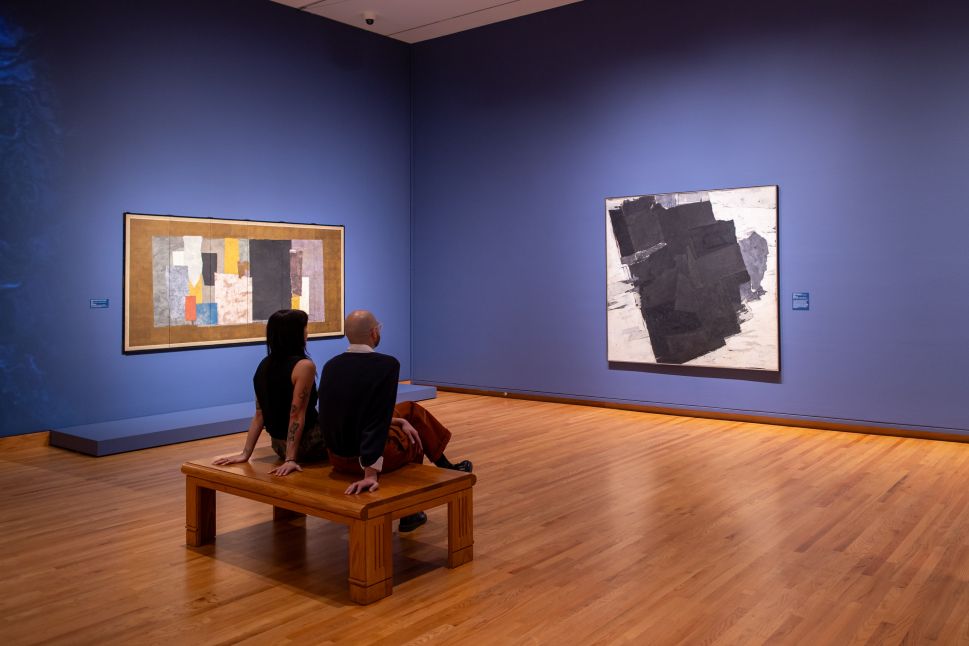
In 1953, LIFE ran a feature called “Mystic Painters of the Northwest,” the headline that serves as the inspiration for “Beyond Mysticism: The Modern Northwest,” a newly opened exhibition at the Seattle Art Museum that seeks to reframe a certain reputation that has followed the region ever since. LIFE’s story anointed four Seattle artists—Mark Tobey, Morris Graves, Kenneth Callahan and Guy Anderson—as the faces of a unique brand of Modernism that embraced the “overwhelming forces of nature which surround them,” as well as “the influence of the Orient whose cultures have seeped into the communities that line the U.S. Pacific Coast.” The Seattle Art Museum’s show, which features 150 paintings, drawings, photographs and sculptures, builds on the ideas of the LIFE article through the expansion of its ideas.
Its first good idea was to bring in some artists who are actually Asian. Kamekichi Tokita’s Bridge (1931) would seem to demonstrate the degree to which LIFE’s summary of the region’s styles was an oversimplification. Tokita said his goals were “found in Cézanne and developed through the methods used by Sesshū,” and all this is evident in Bridge. It shows the Seattle waterfront in early stages of strangulation by the new trusses thrown up to carry rail and road. It’s a formal experiment more than a seascape. His calligraphic training is evident in the ironwork and personifies the iron as an obnoxious neighbor.
The exhibition recasts the movement’s love of nature as closer to the contemporary green movement, seen well in the work of Callahan and Graves, two of LIFE’s four. Callahan’s Evening Mist in Mountains (c. 1940) has the feeling of Twin Peaks because it pairs a postcard Northwest landscape with a crime scene, in this case the untidy stumps of hewn trees. Graves’s Logged Mountains (ca. 1935-43) is even more didactic, and reminiscent of the show’s notorious black and white episode from The Return—a ruined landscape of black and grey ooze.
It’s too austere to be surreal, though the exhibition ties other artists to that movement, and to Abstract Expressionism, pairing them with real examples by Salvador Dalí and Georgia O’Keeffe. Drift No. 2 (1936) by Malcolm Roberts is a perfect representation of this part of the show because it feels like something Dalí would have painted had he visited the region. A weather vane pierces a pink, claw-footed bathtub through a fallen tree near a cracked pitcher in the sand. That sounds busy but it’s actually less complicated than the way Dalí would have done it, and demonstrates the clean way in which this group of artists was uniquely and locally deranged.
“Beyond Mysticism: The Modern Northwest” is on view at the Seattle Art Museum through August 2, 2026.
