
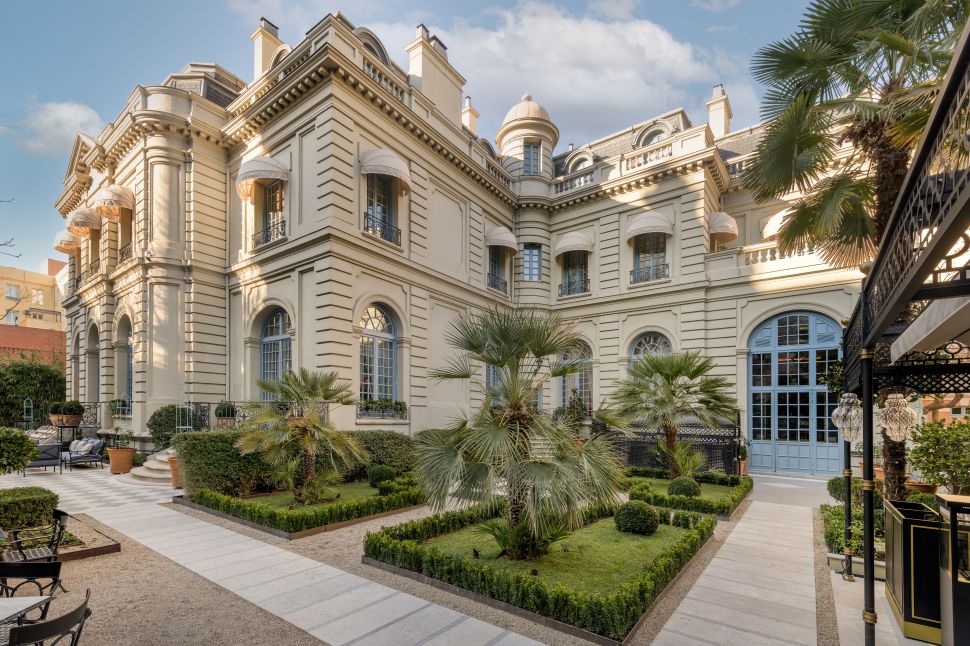
Nestled on a quiet side street in the largely residential neighborhood of Chamberi, Hotel Santo Mauro offers something of a respite from the bustling energy of Madrid’s more crowded enclaves. From the moment you enter the boutique hotel, it’s clear that this is a place for design lovers—it’s for the jet-setters who crave a specific type of luxury; one that is far removed from the swanky yet monotonous opulence of so many five-star hotels as of late, all fitted in the same sleek, modern and relentlessly beige color palette.
Santo Mauro embraces its niche qualities—it knows that it won’t appeal to every kind of traveler, and it doesn’t try to. It’s become increasingly rare for hotels in general, and particularly those that are part of much larger companies, to retain their uniqueness; to keep that singular quality where you don’t walk in and immediately feel like you’re inside just another one of a big hospitality brand’s plethora of hotels. Santo Mauro is, in fact, under the Marriott umbrella; it’s part of the ultra-upscale Luxury Collection, and its distinctive character serves as a testament to the brand’s dedication in preserving the identity of its Luxury Collection properties.
Santo Mauro dates back to the 19th century. Shortly after Mariano Fernández de Henestrosa received the title of Duke of Santo Mauro from the Spanish crown, he commissioned Juan Bautista Lázaro to build his family a rather lavish new home. The Spanish architect built Palacio de Santo Mauro between 1889 and 1902, showcasing French neoclassical influences and a decidedly aristocratic feel. The Duke of Santo Mauro’s family continued to reside at the home after his death, until the property was confiscated by the government during the Spanish Civil War. It was returned to the family a few years later, before it was eventually used as an embassy by several countries.
It was first converted into a hotel in the 1980s; over the years, it was part of NH Hotels and Marriott’s Autograph Collection. It was most recently closed in 2021 to undergo a renovation courtesy of Spanish designer Lorenzo Castillo. The entire property is a heritage site, so any updates must be carried out meticulously. It emerged a year later as part of Marriott’s Luxury Collection, showcasing freshly updated interiors that emphasize rather than hide the buildings’ historic details and bones.
A gated courtyard leads to the front entrance of the boutique hotel; inside, the ornate lobby, with its gilded wall moldings and glittering mirrors, is outfitted in shades of blue, white, yellow and gold. Despite its unapologetic opulence, the hotel still retains the feeling of a personal residence—the lobby is typical of a 19th-century Spanish palace home, connecting to all the different hotel spaces. It’s not hard to get a little lost within the winding corridors and various lounges, but it’s not like losing your way in a big, impersonal business hotel—instead, it’s more akin to losing your bearings when visiting someone’s (rather grand) home for the first time.
Santo Mauro is made up of a trio of buildings, with 49 guest rooms sprinkled throughout. The main building, formerly the duke’s primary abode, houses all of the public spaces, as well as 18 rooms. A second “small palace” building, where the duke’s parents resided, is now home to 17 additional accommodations, and the former stables currently house the final 14 keys.
The hotel rooms are all uniquely designed and decorated; no two are identical. On a recent visit to the hotel, I was booked into a room in the duke’s parents’ former home; the building is accessed via a short, ascending staircase, almost akin to that of a New York City brownstone, but with decidedly European flair. My room was outfitted primarily in blues and reds, with wood and gold accents throughout. The bed’s light blue toile headboard nicely contrasted with the red-and-deeper-blue toile wallpaper panel it was pushed up against; there were additional matching toile panels on the other walls, along with patterned curtains. A printed upholstered couch and cushioned chair were set around a coffee table in one corner of the room, with a small breakfast table by the window.
The bathroom was bedecked in white-and-blue wallpaper in another pattern, with a freestanding clawfoot tub separate from the shower and mosaic tiled floors. The entire decor scheme was a much-appreciated departure from the bland minimalism prevalent in so many hotels—not to mention homes and restaurants—as of late. There are some quirks at a genuinely historic boutique hotel—the water, for example, takes a second to warm up, and you have to fuss with the shower a bit. While no two rooms at Santo Mauro are identical, they all showcase a broader thematic scheme, with a penchant for wallpaper in various hues and prints, grounded by earth tones and wood details.
That interior style extends to the public spaces, like the La Biblioteca Restaurant, which occupies what was once the Duke’s private library. The decor stays true to the room’s original purpose, with books lining shelves surrounding the marble-bedecked fireplace, and cozy, plushly upholstered couches and armchairs throughout. Some of the Duke of Santo Mauro’s personal books and antiques from his private collection still adorn the shelves. Breakfast is served here, but dinner is a more formal experience, with a Spanish-Mediterranean tasting menu led by chef Rafa Peña—think fresh fish with white escabeche, caviar-topped crab salad and duck à la crapaudine.
The more casual Gresca Wine Bar concept, with dishes like the famous Iberian pork “bikini” sandwich, isn’t confined to one space; the menu can be ordered in the Red Room (“Salon Rouge”), opulently outfitted with Louis XIV-style decor, and in the particularly lavish Chinese Lounge, with furnishings including a pair of Qing Dynasty cabinets and 1930s Murano glass pine cone sconces. Or, when the weather’s agreeable, dine outside in the garden.
It’s not just the actual building and interiors that are historic at Santo Mauro—the garden is equally significant; in particular, the chestnut trees throughout the property, many of which are over 100 years old and also hold heritage status. It was a touch too chilly to linger in the gardens when I visited Santo Mauro, but on my last evening at the hotel, I went for a brief stroll among the chestnut trees before heading back inside to peek at the bar one final time. The bartender asked if we’d tried the hotel’s signature Casilda cocktail, which neither I nor anyone I was traveling with had.
At first glance, it didn’t seem like my kind of drink—chestnut syrup, vodka, Campari, fresh orange juice and fresh lemon juice. But then I was told the history behind the drink (I was fast learning that at Santo Mauro, there’s a story to everything): it’s an homage to the Duchess of Santo Mauro, and the syrup is made from the chestnut trees right on the grounds. Because I cannot resist a homemade syrup nor a good history tidbit, I promptly ordered the Casilda. It was, in fact, delicious.
There’s a whole lot of history at this hotel, and while a house cocktail is only a small, fanciful homage to a handed-down story, it’s indicative of Santo Mauro as a whole: a place that steadfastly honors its past while also happily embracing the new, with a healthy dose of whimsy.
