
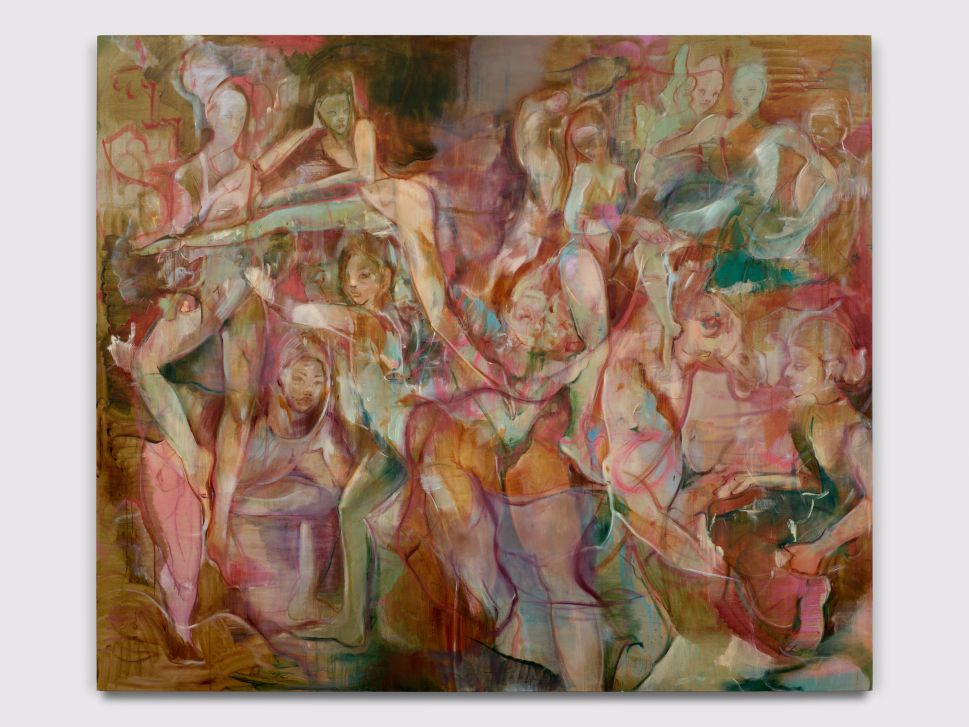
Konstantina Krikzoni’s work has always inhabited the liminal yet generative threshold between figuration and abstraction, her characters finding their archetypal and mythological shape in the movement and gesturality of her body, channeled and projected onto the canvas.
Both her technique and her subjects deal with women’s bodies, identity and sexuality, intersecting with ancient Greek mythology, ancient Western knowledge and literature. Proceeding with organically fluid, continuous lines and delicate washes of translucent oil paint, she builds magmatic, non-hierarchical compositions that test the limits of painting not only as a medium but also as a conduit for her self-expression.
Her latest solo show at Jarvis Art showcased a new level of awareness for the artist—of her position as a woman, as a body and soul made of irreparable dualities. Her exploration of femininity has always taken physical form: voluptuous bodies that appear and dissolve fluidly, unapologetically reclaiming their feminine sensuality and power as they fluctuate freely in space, resisting shame and the scrutinizing expectations imposed on female behavior by patriarchal society. In her newer works, the bodies become both more graphically defined in their anatomies and more androgynous, most often defying gender identification. These are warriors, as the title of the show suggests—cohorts of Amazons standing together against the world, with their fiercely gentle feminine force.
“Warriors“
Artist: Konstantina Krikzoni
Venue: Jarvis Art
Address: 96 Bowery, 2nd floor, New York City
Through: June 20, 2026
The more condensed gestural rhythm and more rigorous structure make it clear that the artist is in a very different mental space from the one that produced her earlier, more visceral works. After her father’s recent death, Krikzoni experienced what she describes as a major breakthrough in her painting. “I wanted to disrupt everything and give more emphasis to female agency, but in terms of the mental space of these figures and how they occupy the surfaces with meaningfulness,” she told Observer after the exhibition’s opening. “That was how I wanted to process my own pain, in a way. They gave me a sense of company.” The figures now suggest feminine solidarity and collective energy.
Returning to Greece, her home country, for a period, Krikzoni found herself drawing ancient Greek statues of youths—the male Kouroi and female Korai—in the National Archaeological Museum in Athens: hybrid, androgynous, austerely neutral and idealized characters meant to crystallize an ideal of timeless beauty. “They have something very otherworldly and a very intense presence, and it was important for me to remember that these sculptures were protecting graves. There was something about that,” she said. Back in the studio, she used these drawings to restore their suspended, dignified presence as symbols of resistance and resilience, sheltered from grief and pain in their immutable, archaic and archetypal form. That they seemed to combine male and female qualities also offered her a way to find balance rather than erasure. “I think what we ask for as women in the art industry, or in general, is to be equal, not for men to disappear. There needs to be some sort of balance.”
In Jungian terms, the psyche contains both masculine and feminine principles—the animus and the anima, not as fixed gender identities but as complementary psychic energies that must be acknowledged and integrated for the self to move toward wholeness. If Konstantina’s earlier paintings often seemed charged by conflict, as if trying to wrest feminine agency back from the structures that had contained or distorted it, these new works feel less combative and more reconciliatory. They do not abandon the feminine but allow it to coexist with a renewed, solemn masculine energy. The result is a body of work in which the self appears less divided than assembled from two necessary forces, held in tension but no longer at war.
Most importantly, this inspiration allowed Krikzoni to find a notion of the body that remains young, hybrid and open to possibility. “I feel there is something in me that has been stuck at that age of being younger, being excited about life and thinking about possibilities,” she reflected. “I think that is also what happens metaphorically with painting.” For Krikzoni, this is also a way to think about the male gaze and how to subvert the sexualization of the female body. “You can do it without making overly sexualized bodies. It can be less literal, in a way, but still give you a lot of strength and dynamic.”
The color palette has shifted just as decisively: the earlier red and pink palette, associated with blood, bodily interiors and other liquids, has given way to blues, greens and more electric or earthy tones. “I think I let myself be free to choose the colors that instinctively come to my mind,” she says, acknowledging how many of the colors remind her of the Greek landscape and bring a watery or organic quality to the surface. “It is more about embodying nature than showing it directly or being literal,” she clarified—a way to embody both a physical and emotional landscape through color and atmosphere. More fluid, blue-toned compositions like Agalmata (2026) evoke the luminous atmosphere of waves crashing and water shimmering on the Aegean coast, while suggesting the possibility of continuous metamorphosis.
More generally, the objects and motifs that appeared in earlier work now operate more metaphorically, allowing her work to transcend the viscerally intimate personal narrative that once accompanied it, opening it up to the universal. “If you want the works to be open, free and inclusive, they also need to be inclusive with color and with the possibilities of paint,” she argued, acknowledging how everything started to feel freer once she moved away from her red and pink palette to embrace a new space of experimentation.
The painting process itself has also changed: the shifting gesturality already suggests how the artist must have continuously moved in and out of the canvas, almost like a dance, rather than being wholly inside it. Krikzoni said she hadn’t thought of it that way but recognized that, in the early months after returning to the studio, the space felt suffocating. “I felt I needed less time in the studio, to work faster, spend less time inside and be more outside.” Over time, that shifted, but the change in temporality had already entered the work. “The process has become more intuitive and more meditative.” Drawing was crucial during this period because it created a direct connection between mind and hand. “When you draw, there are moments when you forget about everything. There are nerves in the fingers, and they say that when you are sewing or knitting, they connect you to parts of your brain that help you heal.”
This latest body of work clearly emerged as part of a cathartic process: processing loss, overcoming grief and, within that time and journey, finding herself and reconciling with who she is and where she comes from. Krikzoni feels that whatever comes next from the studio will be exciting. She is trying to maintain that openness, embracing ambivalence as a possibility while reaching a necessary rapprochement with her own background. “I was not expecting it. It was very organic, and it brought something back that has to do with my identity and where I come from.”
