
In 1985, Christo and Jeanne-Claude wrapped the Pont Neuf in Paris in one of their iconic installations, covering the bridge with approximately 40,000 square meters of golden-beige woven polyamide fabric, secured with rope. The work emphasized the bridge’s shape, arches and sculptural qualities and, through its erasure, highlighted the importance of historical presence in the urban landscape.
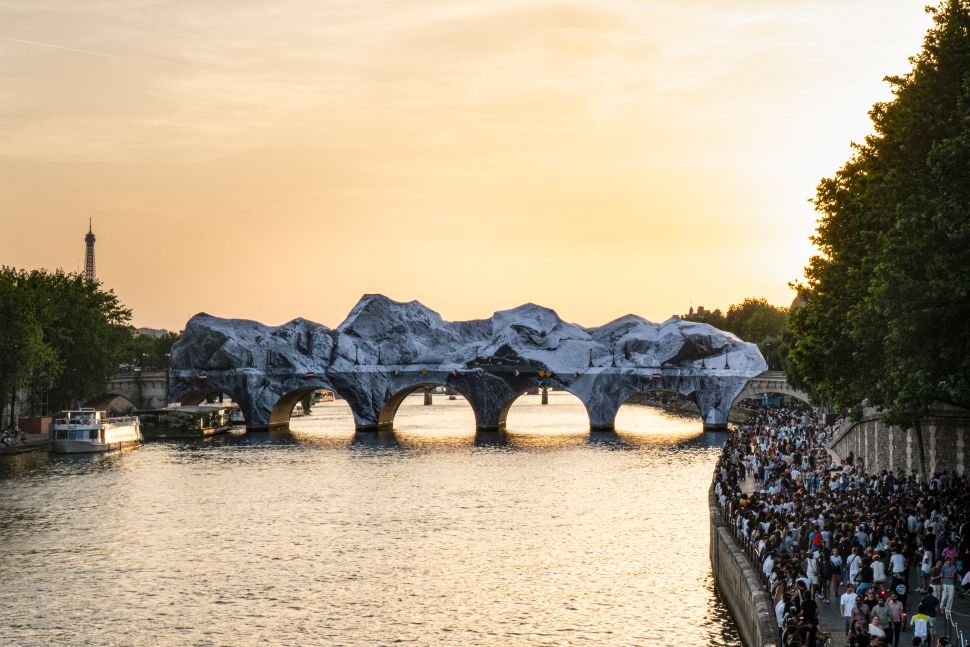
Forty years later, artist JR is honoring that legacy with his own takeover of the Parisian monument. La Caverne du Pont Neuf, on view through June 28, transforms the city’s oldest bridge into a giant grotto in an immersive multimedia and olfactory experience that serves as an emotional memorial. The aim is to draw attention to the bridge’s material origins—stones tied to the local landscape and geology—while bearing witness to the city’s stratified history. Juxtaposing the raw and wild with the refined elegance of the City of Light, it creates a dialogue between past and present.
While some Parisians have complained about the disruption to daily commutes and traffic, traversing the installation has been for many more a powerful experience. Known for such disruptive urban interventions, JR accepts that the debate a public art project will provoke is of equal value to its realization. For him, art is a way of refreshing how we look at the world around us, and we spoke to him after the unveiling of La Caverne du Pont Neuf to better understand the vision and intentions behind the monumental project.
Moving fluidly between photography, public art, social intervention and relational art, JR’s colossal black-and-white images, pasted directly onto buildings, streets, rooftops and monuments, turn urban space into both canvas and stage, reactivating imagination and awe through visual storytelling. But he built his reputation with eye-catching trompe l’oeil installations that interrupt and redesign iconic structures, landscapes and charged spaces. Often, they carry a political message or extend some form of community invitation.
In what could easily be described as a context-specific public performance, he works with scale, visibility and public participation to transform a city into a site of shared memory and imagination. In Paris in 2016, for example, he took over the Louvre’s iconic pyramid with the memorable Le secret de la Grande Pyramide, made for the iconic glass pyramid’s 30th anniversary. With La Caverne du Pont Neuf, he adds another layer to his work: the homage.
JR tells us, with some candor, that he would never have dared touch the Pont Neuf on his own. It was the Fondation Christo et Jeanne-Claude and the Amicale des Ponts de Paris who came to him, asking him to imagine something for the 40th anniversary of The Pont Neuf Wrapped. “This project begins as an invitation and as an act of respect,” he says, and the artistic duo was an inspiration for this new work in a very literal way. Vladimir Yavachev, who worked at Christo et Jeanne-Claude’s side for 35 years, helped JR dream it up and find ways to build it: “What I took from them isn’t a style, it’s a philosophy. They worked at this scale with no public money and no logos, because that independence is what keeps the work pure. That’s exactly how I’ve always tried to work, and it’s what made this legacy feel natural.”
What he wanted to carry forward with the Pont Neuf intervention was the pair’s radical idea that one can build something useless in any practical sense and transient, and yet that work can make thousands of people stop and look again. “They always said these projects were about freedom, about joy and beauty,” JR reflects. “I’ve spent 20 years asking how art can bring people together rather than separate them, and a temporary work in the middle of the city is the most generous way I know to do that. It’s free, it belongs to no one and then it’s gone.” Like Christo et Jeanne-Claude, JR is not interested in leaving a physical trace. “The work disappears; what stays is what it changed in people’s heads. I don’t look at the Arc de Triomphe the same way since Christo wrapped it. If La Caverne does that for even some of the people who walk through it, then we’ve carried the idea into a new century.”
At the same time, he wanted to reveal a hidden material history, opening a raw, mineral breach in the middle of the city and allowing people to sense the quarry from which the bridge literally came. The installation emphasizes the bridge’s geological, material and social history, anchoring it in the cityscape. Conceived as an invitation to reconnect with our origins, it functions almost as a Situationist intervention, redirecting attention to the lived experience of place. In doing so, it momentarily disrupts the increasingly dissociated modes of urban circulation that characterize contemporary life, restoring a heightened awareness of one’s surroundings and of the city as a space to be experienced rather than merely crossed, triggering attention amid urban alienation and distraction, asking people to look again, much as Christo and Jeanne-Claude did.
Particularly resonant is the tension La Caverne du Pont Neuf stages between human history and geological time, and how stone both embodies and transmits that history. Completed in 1607, the Pont Neuf—the “New Bridge”—was the first bridge in Paris built entirely of stone rather than wood. “It’s the oldest bridge in Paris,” he points out, and the stone came from the limestone quarries of the city basin—the “stone of Paris,” from which much of the city is made, from the Louvre to the Panthéon. “We don’t think about it, but under Paris and all around it, there are these enormous quarries of building stone. The catacombs, the quarries, the métro tunnels, there’s a whole world underneath the one we walk on.” It may be why this city has a strange coherence in its tones and its stone across centuries, he considers. “I find that fascinating: a bridge is human history, but the material it’s made of is geological time, millions of years older than anyone who has ever crossed it.” It is an idea he has touched on in interventions at the Trocadéro, at the Palazzo Farnese, at the Palazzo Strozzi in Italy and at the Opéra Garnier.
JR readily admits he is equally interested in the illusion itself and in interrupting the way people move through Paris. “The work is an allusion to Plato’s cave: the shadows on the wall and the feeds scrolling on our phones aren’t so different,” he explains, noting that for the length of a crossing, people are pulled out of that noise, and the advertising that constantly grabs the eye, and returned to something much older than all of us. “Every civilization, even ones that never met, shared the same myth: that humans came out of the cracks in the earth. When you enter a cave, you feel that mix of fear and fascination, almost a return to the womb. Revealing the stone and creating the illusion are the same gesture for me: both are ways of making people look again.”
Most of JR’s recent works have kept the illusion on the surface. With La Ferita in Florence, in Rome and at the Louvre pyramid, he tore openings into façades so one could see into a building, but the audience always stayed outside, looking in. With La Caverne du Pont Neuf, which from without resembles a span of mountainous terrain, the public physically enters the illusion’s 120-meter length. He hopes that with that shift, the audience will stop being spectators and become participants. “When you’re only looking, you stay in your own world,” he says. “When you cross through, the daylight almost disappears, the walls turn rough and uneven, the rhythm of the city drops away, and for a few minutes, something in you resets. I always say that changing the way you perceive the world is a way of changing the world, and you can’t really do that from the outside. You have to be in it.”
He designed the cave as a total experience, with sound design by Thomas Bangalter. “He calls it ‘sonic matter, without being music,’ and it follows the light, the shifts in space, your own progression through the tunnel, so the sound becomes something you walk through too,” he explains. With Snap’s AR Studio in Paris, they then built a digital layer inspired by Étienne-Jules Marey’s 19th-century chronophotography, allowing visitors to “see beyond the cave” on a phone or with glasses lent on-site. Light, here, is a medium, as is scent. Sarah Bouasse designed the olfactory element of the installation—the smell of earth after rain, something primordial that everyone connects to. “You have stone, sound, light, scent and image all working on you at once. You step into the shadow in order to come back out into the light, and hopefully you leave looking at the world, at others, and at yourself a little differently.”
In this remarkable gesamtkunstwerk, what could not be scripted were the natural events that became part of the history of the piece. The Caverne was raised just before a heatwave Paris had rarely experienced so early in the season, and then a violent storm hit, damaging the installation and pushing back the opening originally scheduled for June 6. JR saw something fitting in that: “We bring the raw force of nature back into the heart of the city, in a shape we’ve given it, but nature is also what sets the terms. It dictates how we have to live in the world, and what we owe our respect to.”
The monument was quickly repaired and is now accessible through June 28. Meanwhile, its presence extends beyond the site. Perrotin is presenting the free exhibition “Les esquisses de La Caverne” at its gallery in the Marais until July 25, while Paris Aéroport, one of the project partners, has developed a special souvenir passport, designed as an invitation to explore Paris by visiting the iconic locations where JR has left his mark over the years.
