
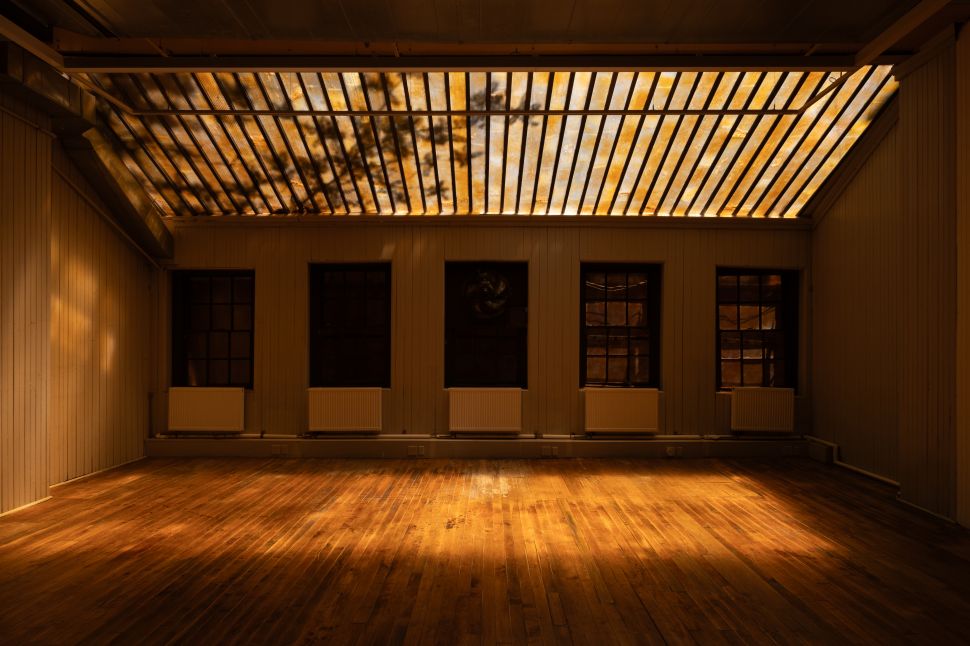
Among the more ambitious shows on the busy May art calendar in New York, “Ghost Stones,” by Kansas City-born, San Francisco-based artist Stephen Lichty, on view at YveYANG Gallery, particularly stood out. Lichty pursues a singular investigation into the sculptural medium, beginning with the material intelligence of nature itself and moving from there into the geological and human histories embedded within it. At the center of the show is what a press release describes as ongoing research into quartz and its implications in a history of expansionism and extraction linking back to the Gold Rush. Lichty’s practice might first be understood as a profoundly materialist approach to the geological and physical essence of the elements around us, which precede and often exceed what language can encapsulate or contain—an investigation of matter in space that is physical, sociological and philosophical at once.
Lichty’s fascination with this specific material began more than a decade ago, when he encountered an enigmatic boulder while briefly employed as a stonemason’s assistant in the Bay Area. That genuine interest in understanding the composition of the material world still informs all his work and his relationship with his surroundings. He tracked the quartz boulder to its source, Liberty Hill Diggings, a defunct mine near the historic Gold Rush-era community of Dutch Flat, surrounded by the Tahoe National Forest in the western foothills of the Sierra Nevada Mountains. In the mid-1800s, small-scale panning operations in nearby rivers gave way to massive extraction through dynamite blasting and hydraulic mining. Before regulation, these practices caused environmental devastation, choking rivers with debris and toxic mercury, endangering agriculture and leaving behind a scarred landscape. The materials still tell this story in their composition and textures, which is why what appears to be a “simple” raw stone can become one of three presences anchoring the entire exhibition.
“Ghost Stone“
Artist: Stephen Lichty
Venue: YveYANG Gallery
Address: 2 Wooster St, New York, New York
Through: July 7, 2026
Notably, Lichty’s path to sculpture wove through media theory rather than a traditional fine arts education. While some of his peers moved in more experimental directions, he found himself drawn toward existing forms and sculptural tropes, often approached on a semiotic and philosophical level. “One of the pleasures of sculpture is that you can walk around the world and just enjoy relationships between things in the material world from a sculptural lens,” Lichty tells Observer. He resists describing the YveYANG show as a single environmental installation, even though it has clearly reshaped the entire gallery’s atmosphere with a multi-sensorial sensibility akin to Land art or Minimalism.
For Lichty, the works in the show are sculptures, but they require installation and spatial relations to assume different stances. That relationship, he explains, was not difficult to determine because it emerged from what he called the “emotional infrastructure” of having worked on the show for so long. He made several site visits before the installation, but the configuration was already internally clear.
The bell, for instance, requires action to sound. It announces arrival and departure while also signaling the presence of someone in the space. At the same time, because it is such a familiar object, it can almost pass as something that was already there, not necessarily art. Behind this apparently simple sculpture, produced in an edition of 30, lies a dense accumulation of material, craft, social networks, research and experimental archaeology. Lichty spent four months collecting roughly 15 gallons of black iron sand from San Francisco’s Ocean Beach, then refined it in the studio through alternating blasts of heat and passes with a roofer’s magnet to separate the ore from the sand. With metallurgist Jeff Pringle, one of the few contemporary practitioners working with preindustrial smelting techniques, he transformed a portion of the purified iron into ingots, then melted them again and poured the molten metal into clay molds packed with carved foam bell forms. The bells were later polished, waxed and fitted with quartz clappers from the Liberty Hill site, tied with hand-braided cords. The bell’s apparent simplicity conceals a complex, evolving and contingent process in which material history, manual labor and inherited knowledge remain deeply entangled.
The exhibition’s central piece, Stone, emerges from the semi-darkened central room. The quartz appears upright and almost bodily, its faceted surface faintly shining, but its mass and raw linen color are offset by abundant voids, crevices and interconnected holes, some suggesting liquid movement and the ancient pressures that shaped the rock across geological time.
Stone originated from Lichty’s observation of this type of rock; its structure fascinated him. “I saw one of these stones out here in California and began wondering about its physical construction. How did this happen? Why does it look so organic and dynamic? I had never seen anything like it. It was already very sculptural,” he recounts. He was drawn in by this world, enchanted by parts of it already offered to him as he moved through it. “Working with givens, and maybe editing or finding relationships to what is given, helps integrate art and life in a way that is not fantastic, but embodied and materialist. If I’m working, I like to know what things are made of, where they come from and how they’re situated.”
Sometimes he might also work with objects or materials deeply integrated into human technological history, even synthetic ones, but for him, there is a clear difference between going to a facility to look at manufactured plastic components and going to gather a natural resin or polymer. “You get to take some responsibility and feel the consequences of production,” he explains. “Those consequences can inform the relationship to scale, quantity and time.”
The choice to include this raw geological element suggests an affinity with the Chinese tradition of scholar’s rocks. Yet while scholar’s rocks were sometimes enhanced by hand, Stone is entirely the result of such intervention, even as the labor remains invisible, muted and concealed within its fabric. There are years of trial, observation and minute decisions behind this apparently simple result. While working on it, Lichty found what he first thought was a soft opal, but which turned out to be old, melted pine resin—a discovery that opened another layer of material, history and metaphor, suggesting to him a kind of “reparative bloodletting.”
Working the stone was a long, slow and technical process. Employing the boulder’s own material logic, Lichty accelerated the natural process of differential erosion, removing softer mudstone, chlorite and other minerals to reveal the fractured quartz structure beneath. “They erode at different rates. Nature started that process, and I just accelerated it,” he says. Using delicate hand tools, dental scrapers, water guns, a glass-bead micro-blaster and tiny vacuums, he intensified what nature had already begun. “To take eight months on a stone, I could push it forward 50,000 years. There is a kind of exchange, but it’s also fantastic. I am like a new weather, but I am not the weather. If something is fractured, sometimes I just remove it all the way. I remove components that feel too conflicted or theatrical.” Other areas remain hands-off because the boundary between quartz and mudstone is too unstable. Thus, the work requires both intervention and refusal, acceleration and restraint.
The same dynamics and dense history of human and natural events are embedded in the resin panels that cover the gallery’s rear room. In encountering the aforementioned pine resin while working the stone, Lichty “started to see how there was a kind of shower of reparative bloodletting happening here,” as if nature were already trying to mend, through its own processes, the gaps and fractures left by human extraction. Fresh pine resin is a viscous substance secreted by conifers as a protective mechanism: its potent antiseptic, antibacterial and anti-inflammatory properties seal wounds and protect trees against infection and infestation by fungus or insects.
A herbalist and perfumer taught him how to gather this material without harming the trees, foraging fallen resin and sustainably harvesting cured, fully hardened resin from healed wounds at the Liberty Hill Diggings site. In the studio, he heated, filtered, ground and sieved it into a fine rosin powder, removing volatile oils and moisture. Borrowing a technique from mezzotint, he then warmed glass panels over a bed of more than 100 candles, sifting the powdered rosin across their surfaces until it fused with the glass. Installed across the narrow gridded windows and skylights, the resultant warm orange-to-amber panels recreate the feeling of a fortress in the middle of Tribeca.
Lichty sees a technical and social entanglement that accumulates in the works’ essence and informs them: conversations with metallurgists, people in gem-cleaning communities and specialists in stone. For him, technical knowledge is never separate from politics: “The material capabilities and technical approaches are also political and ideological. What gets done to the material of the world is social.”
His exploration is quite personal, though he acknowledges that a dense historical field surrounds and accompanies any material presence. “As a sculptor with the desire to relate to and find a working relationship with the world, I ask myself: what would be an interesting contribution to the field that nourishes me, and how do I want to relate to the field? I tend to follow my desires and explore them.”
The title “Ghost Stones,” he says, addresses the difficulty of naming and disentangling the social and the remembered from the given world, which human intervention has inevitably already colonized. The acceptance of limited visibility was, in this context, a decisive moment. Rather than dramatizing darkness as an effect, Lichty saw it as acknowledging the limits of our sensorial understanding and the contingency of any phenomenological experience through which we try to frame and explain the world. “It was about affirming the limit or accepting the limit.”
The show is not theater but remains actual, material and non-representational, while still heightening the viewer’s phenomenological awareness of light, space and the body encountering the matter of the world. “My approach to sculpture is probably observational. That is probably the simplest way to describe it. It has been a slow path,” he states when asked how he describes his sculptural practice. “The scale of observation can be variable,” he adds, explaining how this applies from an industrial container he saw years earlier in a parking lot to the shape of a stone. The decision of what to touch, or the bodily awareness of whether something is working, becomes part of the same inquiry. Sculpture questions its own position in relation to what the world is already giving.
As this elegiac choreography of ecological disaster and human greed unfolds in the gallery, these ghostly sculptural presences already carry histories of labor, ecology and exploitation within both their materiality and metaphorical function. The artist continuously connects sculpture to craft, experimental archaeology and the elemental processes of the earth itself. Geological and archaeological time, in this sense, finds resolution and conjunction in the very process of recreation. “It is about questioning your position in relation to what the world is giving,” he concludes.
