
It happens all the time: a New Yorker who relies on federal benefits to feed their family swipes their Electronic Benefits Transfer card at the grocery store, only to find that their money for the month has disappeared. In a deep look at the problem, we discovered:
New York’s outdated EBT cards are especially vulnerable to fraudulent charges
Untold numbers of New Yorkers face hunger because the government won’t replace the stolen funds
Solutions exist—and California has implemented them
Here’s what more to know from our investigation, which you can read in full here:
People are losing their month’s food benefits to online fraud, and unlike for credit and debit card holders, no one replaces the money.
A single mom in Borough Park, a retired grocery store worker in Flatbush, a dad of teens in Flushing, to a Holocaust survivor in her nineties — all across town, people who rely on federal food benefits for nutrition are facing empty fridges. It’s because of fraudulent charges that wipe their accounts, the kind readily prevented by modern credit and debit cards.
Electronic Benefits Transfer cards, which deliver food benefits, don’t have the standard fraud protection technology that those cards do. They look like simple gift cards, with just a magnetic stripe and no chip, and there are no notifications or freezes for suspicious charges. Unlike for credit and debit cards, there is also no reimbursement for unauthorized charges, leaving EBT users high and dry.
This is happening to an unknown number of people in New York — but we think it’s a lot.
The social service providers who people call when their card is rejected say the problem is getting worse. We heard from a dozen groups who say people are coming in with the problem all the time.
The city and state do not collect data on this, but there are some indicators that point to the scale. Cash assistance claims, which are reimbursed, were at their highest number in a year in April. This winter, the nonprofit Community Service Society surveyed 827 current Supplemental Nutrition Assistance Program recipients citywide. Asked if they had been a victim of this type of benefit theft in the past three years, 31% said yes.
Back when the city was collecting claims in 2024, they got an average of 7,000 a month, totaling more than 86,000 that year. And the department says that’s surely an undercount, since not everyone reported.
The technology to prevent this kind of fraud exists, but New York isn’t using it.
California reduced reported benefits theft by 76% since the 2024 peak by implementing chip-and-tap cards and other changes. They even put an astrophysicist on the case, whose team developed a machine-learning model for cash-assistance fraud that identifies suspicious transactions. In individual accounts, the racket often shows up as a series of impossible purchases — such as simultaneous charges hundreds of miles apart in the middle of the night — that are readily detected by anti-fraud measures used in other cards. Charges like these are often flagged or blocked by credit card companies.
California and New York contract the same company to administer EBT cards, Fidelity National Information Services, a fintech giant for whom advanced fraud protection for commercial cards is a core product.
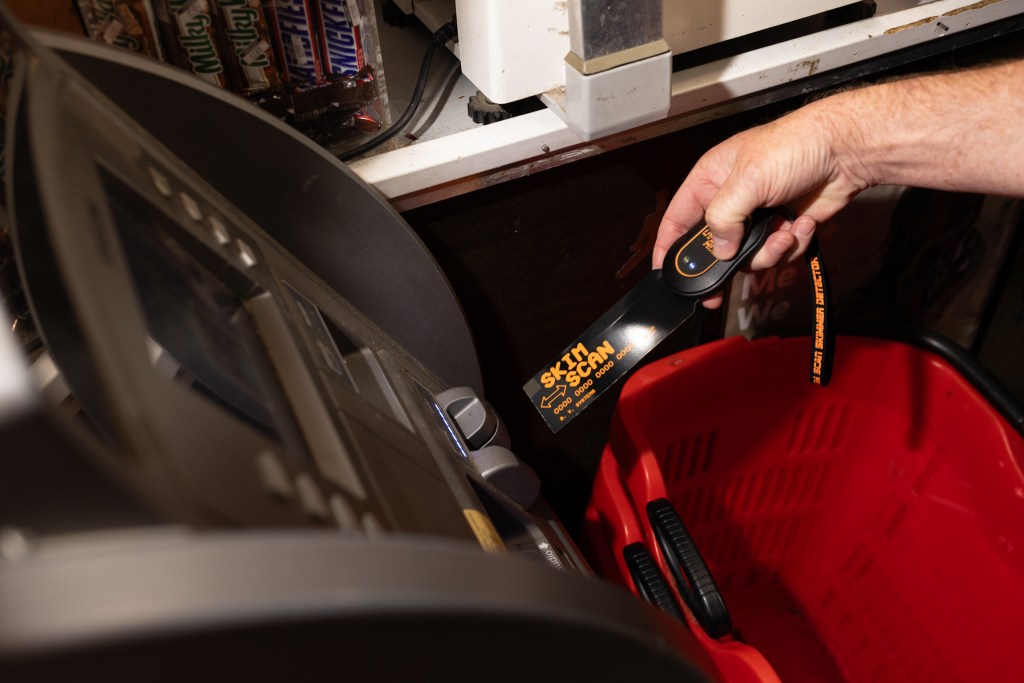
The City Reporter also found lower-tech interventions that could help in the meantime. For one, the state benefits hotline requires only card number and pin — the exact information easily extracted from secretly installed skimmers and traded en masse — in order to access transaction history, which reveals deposit dates and amounts. Some extra verification on the hotline could potentially “ruin” the scheme, one source familiar with it suggested, although law enforcement noted that skimmers tend to adapt fast to changes.
The city and state offer nothing to replace the benefits and food pantries cannot fill the gap.
The federal government did replace lost benefits for about two years through 2024, but then they stopped. Legislation to create a victim’s compensation fund exists, but it stalled in Albany this year and money to reimburse people for the losses did not make it into the new state budget. There is no emergency fund or private charity that replaces the lost benefits when people lose it, “nothing like that to point people to.”
All these small stipends are actually going to a very small number of people at the top of transnational crime rings.
Hierarchical organized crime teams, originating mostly out of Eastern Europe, have learned to exploit this outdated payment system and are living large off the scam, renting $10,000 a month apartments and Lamborghinis, according to the Secret Service, which investigates counterfeit crimes. They estimate that nationwide, approximately $1 billion from the benefits of hundreds of thousands of people is consolidated mostly in the hands of fewer than 200 senior organized crime leaders. The profits leave the country as crypto or bricks of bulk cash.
“I think it’s getting worse,” said Matt McCool, Special Agent in Charge for the Secret Service’s New York Field Office. ”It’s tough to get to the makers.”
Our nonprofit newsroom relies on donations from readers to sustain our local reporting and keep it free for all New Yorkers. Donate to THE CITY today.
The post Five Things to Know From Our Big Story on NY’s Broken Benefits Card System appeared first on The City Reporter.
