
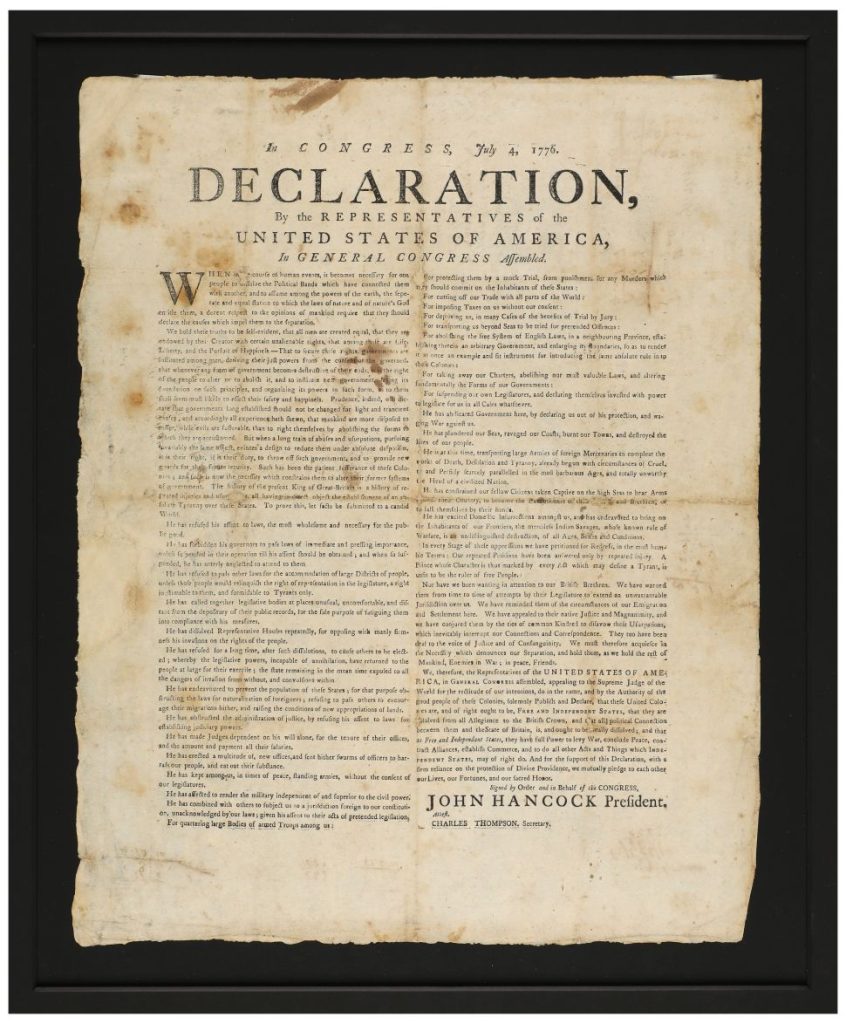
On the night of July 4, 1776, a Philadelphia printer named John Dunlap was handed a draft of what is arguably the most consequential document in American history and told to get it into print. He set type through the night, printing around 200 broadside copies of the manuscript that would be read aloud at town gatherings, nailed to posts and passed from hand to hand. Some went to local printers across the colonies, who produced their own editions. One of those was Robert Luist Fowle in Exeter, New Hampshire, whose Exeter broadside, which hit the presses on July 16, was one of 13 contemporary broadsides produced in July and August of 1776. Of those 13 editions, only around 120 broadsides survive, with the majority now held by institutions. According to Goldin Auctions, “surviving, legible broadside copies are so incredibly scarce that the concept of owning one as a collector’s item is a nearly impossible endeavor.”
Just 10 copies of the Exeter broadside exist today. One of them is currently the star lot in Goldin’s 2026 USA 250th Anniversary Historical Auction, which closes July 8. Bidding has already climbed to $1.2 million, and there is every reason to expect that figure to rise before the auction closes. An Exeter broadside in comparable condition sold at Christie’s earlier this year for just under $5.7 million. But the auction record for any Declaration of Independence broadside was set at Sotheby’s in June 2000, when an original Dunlap printing—famously discovered hidden behind a $4 flea market painting in Adamstown, Pennsylvania—achieved $8.1 million.
The broadside currently on the block—known as the Goodspeed-Sang-Streeter copy—is one of five known July 1776 broadsides that don’t identify a printer or place of publication, but attribution to Fowle was established in 1947, when Frederick Goff of the Library of Congress compared the text with known regional newspaper printings and confirmed a match. Printed before the official engrossed Declaration of Independence was signed on August 2, 1776, the copy passed through the hands of Americana collector Thomas W. Streeter (1883-1965) and manuscript collector Philip David Sang (1902-1975). In 2021, it landed at Christie’s New York, where it hammered for $930,000; last year, it sold at Sotheby’s for $2.4 million.
But who was Robert Luist Fowle? Not a patriot rebel, according to Barbara Rimkunas, executive co-director of the Exeter Historical Society, which has his printing press on display in its museum room. Rimkunas wrote in the Portsmouth Herald in 2010 that Fowle had to keep “his political inclinations under cover” to establish himself in Exeter, then a hub of rebellious sentiment. New Hampshire had already declared itself independent of Britain in January of 1776, and “one can only imagine what was going through his mind as he set the type. As a loyalist, or ‘Tory,’ he would have been quite uncomfortable with the idea of revolution against Great Britain.”
