
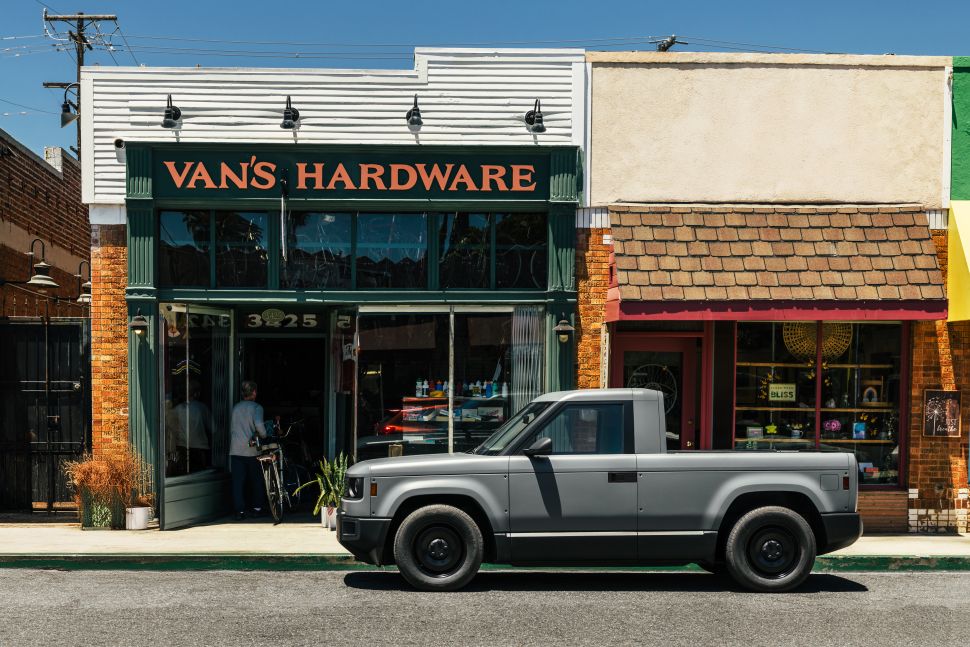
Slate Auto’s bare-bones EV truck tests demand for ultra-low-cost vehicles built on a new model.”>
Last week, Slate Auto, an electric car startup backed by Jeff Bezos and led by a group of former Amazon executives, announced the price tag of the most affordable electric pickup truck in America: $24,950. It’s extremely bare-bones, but its pricing and design have captured headlines and, according to the company, 180,000 reservations since its April 2025 debut and 10,000 pre-orders since pricing was unveiled.
The extremely basic Blank Slate pickup has only two doors and two seats. It does not come with a stereo or infotainment system, has no adaptive cruise control, and is not painted. The body is composite, so Slate offers wraps for an upcharge. Door armrests, pockets, center consoles and other features typically standard on modern vehicles are all additional costs and can be installed either by the owner (Slate offers instructions for DIY installation) or at a RepairPal-certified shop (also for an additional fee). The Slate gets an estimated 205 miles of electric range and can be charged on the Tesla Supercharger network. The $25K price tag is commendable, considering that even Tesla, the largest EV maker in the U.S., has never been able to build a car at this price point.
While there are plenty of questions about demand for a low-cost vehicle among lower-income consumers increasingly strained by inflation, Slate Auto appears to have the business and manufacturing chops, increasing its chances of success. That’s in large part thanks to the contingent of ex-Amazon leaders throughout the organization and a unique “manufacturing-constrained design” approach to building the new Slate from the ground up, which has enabled significant cost savings that the company hopes will attract consumers.
Slate emerged from Re:Build Manufacturing, a project launched in 2020 by former Amazon retail chief Jeff Wilke and investor Miles Arnone with a mission to “ensure the next generation of important products are built and made at scale in America.” They began with aerospace and defense projects like the XRAE-1 drone, a purported “show pony” for the Pentagon with a potential 8,000-mile range—long enough to reach targets in China and the Indo-Pacific region.
Wilke spent 22 years at Amazon, most recently serving as CEO of Amazon Worldwide Consumer, before retiring in 2021, at just 53. Arnone and Wilke met through an MIT graduate program called “Leaders for Manufacturing,” according to a blog post on Re:Build’s site. Arnone told Observer that as he watched the auto industry chase bigger, pricier, more complicated vehicles, he believed it was “leaving behind the average American.”
Slate Auto’s CEO, Peter Faricy, is also a former Amazon executive. He previously served as VP of Amazon Marketplace and spent 13 years at the company.
More than just another EV company
Re:Build’s pivot to automotive was unexpected, according to Wilke, but aligned with the company’s ethos of reshoring U.S. manufacturing for security purposes.
“We didn’t plan to build a car company; we just planned to begin to fill in some of the industrial capability that the U.S. has outsourced over the last 40 years—to the detriment of our democracy,” Wilke told Observer. “If we don’t do it, nobody’s going to do it, and then we might as well just hand the keys to China.
That philosophy now forms the backbone of Re:Build and Slate, and, as it turns out, fresh eyes on auto manufacturing have yielded a new approach to designing an affordable vehicle, according to Wilke and Arnone.
Most vehicles are designed from the ground up with consumer demands and profit at the center. Designers and product planners define the vehicle, engineers make it work, and the factory adapts to those constraints. Slate and Re:Build run that sequence in reverse.
“We call it manufacturing controlled design, as opposed to design for manufacturing,” Arnone told Observer. “The plant has an equal voice in the design of the product as the consumer.”
“Our whole ecosystem is capital-light and OpEx-light, and that’s not the way most companies—even most startups—operate,” CEO Faricy told Observer. “We don’t have a paint shop; we don’t have a stamping plant—that’s a half-billion-dollar savings right there. We’ve made a number of decisions across the company to live up to this principle of frugality.”
ork of two. An armrest doubles as the top of the center console, with one design serving three functions.
That so-called frugality “ripples throughout the organization,” Barman said, “because we need fewer engineers, fewer supplier quality people, fewer buyers, and fewer finance staff. And that ultimately reduces the overhead we have to carry. It’s the accumulation of small efficiencies over time that really adds up and brings costs down.”
Jeff Bezos’ manufacturing bet
Slate is backed by Bezos’ family office, Bezos Expeditions. The Amazon founder is betting on manufacturing at a much larger scale. His A.I. startup, Prometheus, is building an “artificial general engineer”—software designed to compress the long timeline from design to manufacturing for everything from jet engines to chips. He describes it as a modern version of computer-aided design (CAD), capable of making the “dream-build loop” ten times faster. Slate and Prometheus share no corporate ties, but their underlying approaches point in the same direction: the Amazon instinct to fixate on customer cost, strip out inefficiencies, and scale as cheaply as possible is now being applied to the factory floor.
It’s important to note that this process hasn’t been proven in the real world. There is, after all, a difference between a cheap vehicle and an affordable one. Slate has not yet built a single customer-ready truck, and consumer demand remains uncertain because reservations don’t necessarily convert into pre-orders. Slate’s plant in Warsaw, Ind. is only about three-quarters complete, and Barman says production is expected to begin by the end of 2026, with deliveries shortly after. Faricy puts the factory’s break-even point at 80,000 vehicles per year, which is high for an unknown startup, and Re:Build and Slate’s manufacturing thesis is only as strong as the vehicles that actually make it onto the road.
Wilke and Arnone frame the effort as a way to keep China from dominating the affordable car market, even though that competition is likely still years away. The more immediate question is whether Slate can generate enough demand to reshape the automotive industry and potentially others. For that answer, we’ll have to wait and see.
