
There’s no shortage of ways to mark the country’s 250th anniversary. From exploring a national park in a state you’ve never visited to keeping things local with a parade and fireworks display, celebrations abound. But if it’s history that most interests you, no list of defining stops would be complete without Boston. As the birthplace of the American Revolution, the city is home to an array of landmarks you’ve long since read about in school—from the site of the Boston Massacre, which laid the “foundation of American Independence,” according to John Adams, to the Bunker Hill Monument that sits precisely where the battle that bolstered the American patriots’ resolve took place. Follow the list ahead, and you may even return home with some new stories about the events that helped shape the founding of the country on its journey to freedom and the pursuit of equality (including Harvard University’s role as the first headquarters for General George Washington and the Continental Army).
Of course, part of Boston’s charm is that many of these historic sites sit among the everyday, meaning you’ll often find yourself just a short walk from high-end shopping and fine dining. So once you’ve made your way through the mix of semiquincentennial exhibitions and perennial sightseeing destinations, the hotel and restaurant recommendations provide plenty of opportunities to unwind with a spa day, a lobster roll and a cocktail or two (after all, even George Washington made the tavern rounds).
The America 250 Boston Guide
What to See
Boston Public Library, Declarations: Printing a New Nation
700 Boylston Street, Boston, MA 02116
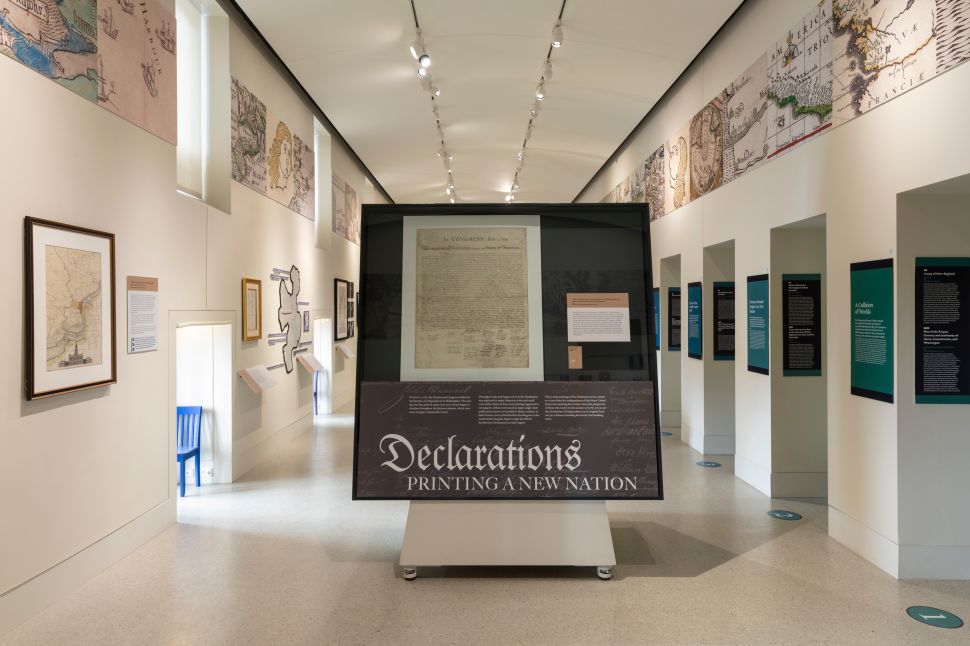
By the time the official handwritten version of the Declaration of Independence was created on July 19 and signed two weeks later on August 2, 1776, copies of the adopted final text had already begun to make their way throughout the 13 colonies. With Declarations: Printing a New Nation, the Boston Public Library focuses on the days before the document’s historical significance was fully realized, giving visitors a close-up look at the original printings that the colonists read via single-sheet broadsides and in newspapers (alongside less significant items like dentistry advertisements and rooms for rent). Most notably displayed is one of the nine surviving copies of William J. Stone’s engraved version of the Declaration of Independence. Commissioned by Secretary of State John Quincy Adams in 1820 to preserve the original, deteriorating text (housed at the National Archives Museum in Washington, D.C.), Stone’s engraving took three years to complete.
The library, which houses more than 20 million books, is worth further exploring for its architecture and murals. You can wander through on your own with a self-guided audio tour, but if you start at the McKim building entrance on Dartmouth Street, you can hit all the highlights, from the grand staircase’s yellow Siena marble and lion sculptures to the Bates Hall reading room on the second floor (you may recognize the popular read spot from films like The Time Traveler’s Wife). There’s also a Roman-inspired open plaza courtyard at the McKim building, and on the third floor, a gallery of John Singer Sargent mural panels that took the artist 30 years to complete.
‘Declarations: Printing a New Nation’ is on display through September 13, 2026; admission is free and open to the public.
Boston Public Library, Declarations: Printing a New Nation.
Boston Public Library
Boston Common, 139 Tremont Street, Boston, MA 02111
This one may sound touristy (and it can be if you go the costumed tour guide route), but hear us out. The 2.5-mile, red brick-lined path lets you quite literally trace the steps of the revolution, as well as those of American founding fathers like John Adams and Benjamin Franklin (the latter was born and raised in Boston before ultimately making Philadelphia his home). Opting to walk the trail at your own pace (or with an audio tour) lets you blend right in with the day-to-day foot traffic in downtown Boston as you make your way to sites like the Boston Massacre marker and Faneuil Hall Marketplace, where colonists convened to protest the Sugar Act and the Stamp Act (and which has since included speakers ranging from Susan B. Anthony to President Barack Obama). It also gives you some flexibility to make additional stops along the way and explore sites at your leisure. Be sure to stop by the Old South Meeting House for Revolutionary Spaces’ 25-minute show, which uses projected animations to chart the gathering that took place there to organize the Boston Tea Party.
Ruckus! x Revolutionary Spaces runs through December 31, 2026; purchasing tickets in advance is advised.
The Freedom Trail.
Kyle Klein
Museum of Fine Arts, 18th Century Art of the Americas
465 Huntington Avenue, Boston, MA, 02115
For the 250th anniversary of American independence, Boston’s Museum of Fine Arts undertook a major reinstallation of its Art of the Americas Wing. The resulting display is comprised of eight galleries, each of which delves into a specific theme relating to our nation’s history. To help tell the story of how art and artists shaped national identity in the 18th century and beyond, you’ll find more than 400 objects that the MFA curated from its own collections of Native and non-Native, North, South, Central America and the Caribbean, as well as new items borrowed from local scholars, artists and community members like the City of Boston Archaeology Program. John Singleton Copley portraits of founding fathers like John Hancock, Samuel Adams and Joseph Warren, in addition to artifacts of resistance like cowrie shells, help to give a more tangible look into American history from all angles. For Nonie Gadsden, the Katharine Lane Weems Senior Curator of American Decorative Arts and Sculpture at the MFA, two of the standout pieces—Paul Revere’s Sons of Liberty Bowl and a Copley portrait of Revere—can be found side-by-side in the Something’s Brewing gallery, which examines the commercial and social impact of tea, coffee, chocolate and mate. “He purposely wanted to show himself in his work shirt sleeves with the tools of his trade, looking at a teapot,” Gadsden tells Observer, pointing out the political symbolism. “It’s not a coincidence that he is showing a teapot here; this is the same year that the taxes on tea started,” she says of the 1768 painting.
As it is one of the largest art museums in the U.S., the MFA has plenty of other offerings to check out, too. From Egyptian sculptures to a Japanese garden and five galleries dedicated to ancient Greece, Rome and the Byzantine Empire, there’s something to cover every artistic preference. An ongoing jewelry exhibition showcases more than 150 pieces from the MFA’s collection, and the museum’s Impressionism and Beyond gallery includes works by Monet, Renoir and a Degas little dancer sculpture. Additionally, the MFA houses the most complete collection of works by John Singer Sargent, ranging from paintings and drawings to sculpture.
Admission is $30 for adults.
Museum of Fine Arts.
Museum of Fine Arts
Harvard University, Harvard and the American Revolution
Pusey Library, Harvard Yard, Cambridge, MA, 02138
Take even a glimpse into America’s founding, and you’ll quickly realize that Harvard University played a pivotal role, as many of the revolutionary leaders and influential public figures of the time counted Harvard as their alma mater. Harvard and the American Revolution, an on-campus exhibition that’s open to the public, details the school’s many ties to the revolution, including its lesser-known history as headquarters for George Washington and the Continental Army in 1775. Objects on display include five musket balls that were later found on campus during a 1959 building renovation, as well as letters and diary entries from Harvard community members that illustrate both the monumental and everyday moments people experienced during the tumultuous time. “One of the components we came up with was highlighting spaces on campus, and just around campus proper, that played a role in the Revolution and are still in active use by the university today,” says Sarah Martin, Harvard’s Associate University Archivist for Community Engagement. “There’s a wall in the exhibition that documents those 12 spaces and buildings, and then we have a takeaway map that you can bring with you to walk out on campus and into Cambridge to explore those sites now,” she tells Observer, noting that other free exhibitions on campus include Charting Independence (also in Pusey Library) and Houghton Library’s War of Words.
‘Harvard and the American Revolution’ is on display through December 18, 2026; admission is free and open to the public Monday through Friday.
Harvard and the American Revolution.
Harvard
Where to Stay
1 Newbury Street, Boston, MA 02116
You’re never more than a 15-minute car ride away from the exhibits on this list (and so many more!) when you stay in Boston’s Back Bay. And The Newbury, a member of LHW, ensures that you’re even closer to the city’s luxury shopping scene, as it sits right among the mile-long stretch of shops, salons and restaurants. (With Tiffany & Co. located in the lobby, you technically don’t even have to leave the hotel.) The pet-friendly, boutique hotel unveiled a complete renovation in 2021, including more spacious rooms and suites, as well as jewel-toned shared spaces like a fully mstocked library that serves complimentary coffee in the morning and snacks throughout the day to enjoy by the wood-burning fireplace. Across the street from the Boston Public Garden (the first public botanical garden in America), The Newbury offers impressive views from nearly all of its 286 rooms. But the best vista of all may just be from one of the velvet-covered chairs at the hotel’s 17th-floor rooftop restaurant, Contessa, which is enclosed in glass to give you panoramic views of Boston all year round.
The Newbury.
Nikolas Koenig
40 Trinity Place, Boston, MA 02116
A new addition to Back Bay in 2023, Raffles is the first U.S. property from the global luxury hotel brand, and it does not disappoint. While the 147 hotel rooms occupy floors six through 14, the Raffles lobby is actually perched above on the 17th floor, which makes for a dramatic entrance as you zip from the express elevator to the three-story Sky Lobby. The modern design has a Boston spin (including copper accents throughout that serve as a nod to Paul Revere’s copper plating company), and every room includes butler service that starts before you even check in. Highlights include a Guerlain spa and a 65-foot indoor pool, plus on-site dining options like La Padrona, headed by James Beard Award-winning chef Jody Adams, and the Long Bar & Terrace, which hosts an elegant afternoon tea with skyline views.
Raffles.
Raffles
776 Boylston Street, Boston, MA 02199
For more of a traditional upscale stay, the Back Bay’s Mandarin Oriental takes quiet luxury to new levels. The hotel underwent a $15 million renovation in 2020, updating each of its 148 rooms and suites to showcase more of a residential feel with touches of chinoiserie wallpaper and deep soaking tubs. There’s a 24-hour fitness center where personal training and private reformer Pilates sessions can be booked in advance, as well as an impressive spa menu that includes one-off treatments (think massages and Biologique Recherche facials) and multi-day wellness retreat programs if relaxation is your main goal.
Mandarin Oriental.
Mandarin Oriental
250 Franklin Street, Boston, MA 02110
If you prefer to settle in outside of the Back Bay, The Langham provides a quieter location in the Financial District that’s still close enough to Boston’s most famous attractions. Recently renovated guest rooms and suites are decorated with local artwork and feature cloud-like beds and white marble bathrooms that are stocked with Diptyque toiletries. But throughout the rest of the hotel, you’ll find nods to its history as the Federal Reserve Bank of Boston, most extravagantly in the Langham’s Italian restaurant, Grana, which sits in the bank’s former grand hall and is decorated with ornate chandeliers, velvet banquettes and terrazzo flooring that’s original to the space. There’s no spa on-site, but the hotel does offer a 24-hour fitness center, a 40-foot heated indoor pool and saunas.
Grana at The Langham, Boston.
The Langham
Where to Eat
279 Dartmouth Street, Boston, MA 02116
As you’re making your way through the shops on Newbury Street, take a lunch break at this trendy seafood spot (but not a total break, as you’ll spy just as many Chanel bags as lobster rolls inside). For people-watching while you sip on a Saltie Girl rosé or seasonal frozen espresso martini, ask for a seat on the patio, but indoor dining still provides plenty of photo ops, from the extravagant chandelier in the entryway to the sea-green and powder-pink décor throughout. Lobster rolls (served warm with butter or cold with mayo) and seafood towers are an obvious must, but the lobster fra diavolo (served over bucatini) is a standout.
Saltie Girl Boston.
Mike Cotrone
33 North Square, Boston, MA 02113
Tucked away in the North End (and just several doors down from the Paul Revere House) is Forcella, a cozy space with candlelit tables and rustic brick walls (plus, a private outdoor patio). Co-owned by Nino Trotta, who immigrated to the North End from Naples as a teen, Forcella serves up southern Italian dishes, as well as beloved staples like carbonara, chicken parmigiana and a burrata salad that changes to incorporate seasonal ingredients. You won’t find a dessert menu here, but that’s actually a good thing given all of the nearby bakeries. The “best” is hotly debated, but you can’t go wrong with picking up a few cannoli and lobster tail pastries at Bova’s Bakery, which is a few blocks away on Salem Street and has been family-owned since it opened in 1926.
Forcella.
Forcella
300 Pier 4 Blvd, Boston, MA 02210
The menu is made for sharing at Nautilus Pier 4, as are the waterfront views, which are best enjoyed on the patio with a cocktail in hand. If you want to experience the livelier atmosphere inside the restaurant, nearly all of the 160 indoor seats will give you a peek at the harbor. Located in the Seaport District, the menu has a heavy seafood focus that draws its inspiration from Asian flavors for a totally unique tasting that includes memorable dishes like spicy Szechuan dandan noodles, blue crab fried rice and a crispy marinated calamari piled high with shredded cabbage, cucumber, charred corn, peanuts and a Thai lime sauce.
Nautilus Pier 4.
Nautilus Pier 4
60 School Street, Boston, MA 02108
Should you find yourself in need of a snack while walking the Freedom Trail, make a quick stop in the historic Omni Parker House hotel, which opened in 1855 and counts itself as the longest continuously operating hotel in the U.S. You can sit for breakfast or lunch in Parker’s Restaurant (John F. Kennedy is said to have proposed to Jacqueline Bouvier at table 40), but the lobby-level School Street Coffeehouse makes for a convenient place to grab a cappuccino and an individual Boston Cream Pie (the latter was invented at the Omni Parker House in 1865).
Omni Parker House.
Omni Parker House
2 Pleasant Street, Charlestown, MA 02129
Once you’ve made it to your last stop on the Freedom Trail, the Bunker Hill Monument, head to the nearby Warren Tavern for a casual lunch that’s very much on theme. The tavern, which was one of the first buildings raised in 1780 after the British burned down Charlestown, was named after Dr. Joseph Warren, a Revolutionary leader who was killed during the Battle of Bunker Hill (and famously sent Paul Revere on his midnight ride to Lexington). Given its rich history as the oldest tavern in Massachusetts and a watering hole for the likes of George Washington and Paul Revere, Warren Tavern surprisingly feels more local than touristy with a solid lunch and dinner menu that includes plenty of classic bar foods.
Warren Tavern.
Boston Globe via Getty Images
