
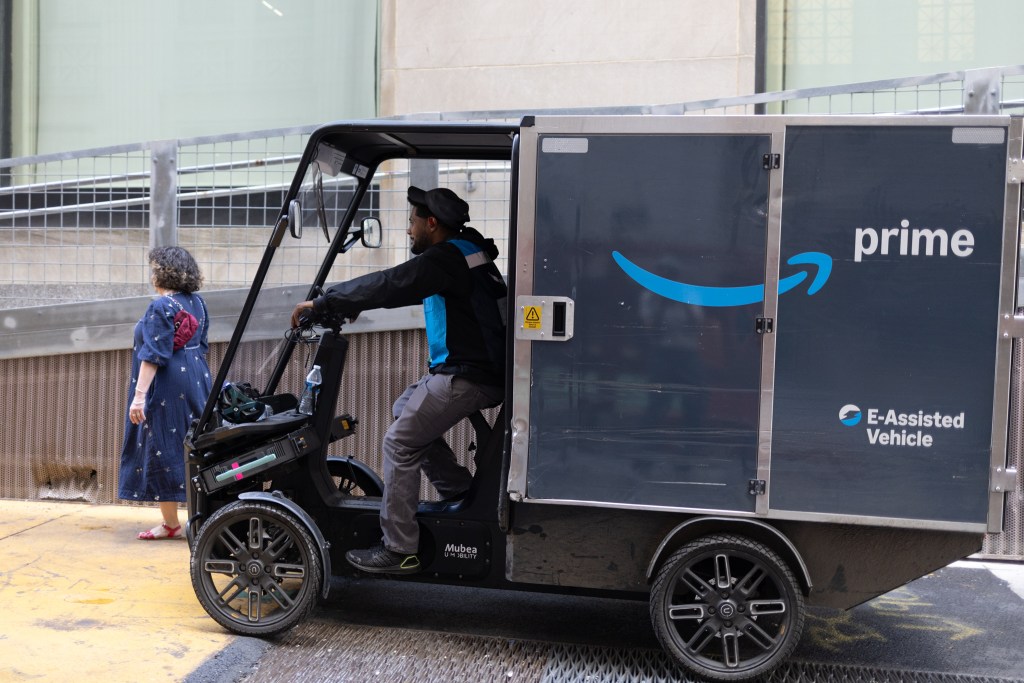
Luc Rene, an Amazon delivery driver in Queens, had already gone through five bottles of water in as many hours during his shift on Wednesday, the first day of an anticipated four-day stretch of dangerously hot temperatures in New York City. He’d used a sixth to douse a rag to cool himself down.
Rene’s route for the day included 222 packages — roughly a quarter of them oversized — and 47 stops servicing 190 buildings in Flushing and its surrounding areas. As he discussed the brutal temperatures on his break from inside his van, he kept the vehicle in park but his foot pressed on the gas; if he let go for 30 seconds or more, the air conditioner would automatically shut off.
“I don’t have words to describe how horrible it is,” Rene, 26, said. “The heat is extreme.”
As a potentially historic heat wave scorches New York City for a second consecutive day, drivers for Amazon described enduring dangerous and “suffocating” shifts. Though the company and its network of delivery subcontractors have made some adjustments — doubling the amount of rest breaks to four per shift and announcing reduced delivery routes — workers described those efforts as insufficient and lopsided. Because Amazon heavily subcontracts its delivery fleet, the experience may vary widely depending on the employer and garage.
Some workers, including Rene, told The City Reporter they were encouraged to grab as many water bottles as they needed before heading out for their shifts. But management at a garage servicing Brooklyn and Queens was keeping its water bottles in a locked refrigerator and closely rationed despite the extreme temperatures, according to two workers who agreed to speak on the condition of anonymity for fear of retaliation.
“I’m delivering 300 packages a day, even in this heat,” one of the workers said. “And you’re telling me I can’t have a f—ing ice cold water?”
A delivery worker cools off in Inwood during an early summer heat wave, June 23, 2025. Credit: Gwynne Hogan/THE CITY
A spokesperson for Amazon shared the company’s heat mitigation protocols, which include air-conditioned vans and reflective vehicle roofs that reduce interior temperatures, and providing electrolyte powder and insulated 64-oz tumblers workers can use on the road, among other equipment. All Amazon depots are equipped with water stations and ice machines, according to the company, which says it works closely with its subcontractors to monitor extreme weather and heat index thresholds and adjust routes as needed to allow additional time to rest.
“Above all else, [delivery workers] who may feel affected by the heat are always strongly encouraged to immediately stop working and get any support they need,” Amazon spokesperson Sam Stephenson said in a statement.
Stephenson added that the company’s delivery stations, where its subcontractors dispatch from, “are fully equipped with ample supplies of water, sunblock, and PPE related to heat protection,” and that company has invested more than $100 million towards heat mitigation retrofits to its vans.
Heat Protections
Amazon has for years insisted that the workers delivering packages for the company — who drive Amazon-branded vehicles, wear Amazon-branded vests, and rely on Amazon for roadside support — are not actually its employees. In New York, Amazon’s delivery fleet is subcontracted by more than 40 companies, an arrangement critics say shields the tech giant from liability in case of accidents, wage theft complaints, and collective bargaining.
Under federal law, employers must provide workplaces free from hazards that are likely to cause death or physical harm, but hundreds of workers nationwide have died from heat exposure since 2010, according to an NPR analysis of data from the Occupational Safety and Health Administration.
Job safety advocates and experts have long pushed federal regulators to create official rules to protect workers in agriculture, construction, factories, warehouses, kitchens and delivery from heat-related illness. In New York, a bill that would require employers to protect employees from extreme temperatures — both hot and cold — has stalled in the state legislature for years.
Absent clear state or federal guidelines, the city has limited recourse to go after private-sector employers who do not take steps to protect workers from extreme heat.
Mayor Zohran Mamdani leads an extreme heat preparedness briefing at the New York City Emergency Management Headquarters in Brooklyn on Tuesday, June 29, 2026. Credit: Michael Appleton/Mayoral Photography Office
On Tuesday, Mayor Zohran Mamdani said his administration is “encouraging” businesses to develop plans addressing extreme heat in the workplace, and reminding them that workers are entitled to protected time off under city law if they feel their health is at risk.
Kris Basmagy, who operates an Amazon depot on the Upper East Side, said his company has a “zero tolerance policy” when workers get sick on the job: if workers feel heat exhaustion symptoms, they must inform their manager, go to urgent care or the emergency room, and get paid for the full shift.
His employees — who mostly deliver on foot — have unlimited access to water and electrolyte powder provided by Amazon. By noon on Thursday, workers had cleared an entire pallet of water, about 100 bottles, and counting, Basmagy said. He is also giving workers free popsicles on their meal breaks and increased employee headcount during the heatwave.
All of the Amazon drivers who spoke with The City Reporter said that even though they were told they would be working lighter routes, their shifts — at least on the first day of the heat wave — had roughly the same amount of stops and packages as an ordinary shift. All of their vans had air-conditioning on Wednesday, they said.
Jerome Sloss, who works out of the same Maspeth garage as Rene, said his route on Wednesday was about the same as it usually is: 84 stops, with just under 200 packages.
An Amazon delivery truck makes stops in Manhattan, May 6, 2026. Credit: Alex Krales/The City Reporter
On Thursday, with the heat index forecast to reach 102 degrees, Rene had 257 packages to deliver with 105 stops, some of which included multiple buildings.
Though Amazon’s fleet have air-conditioning on the driver’s cabin, the back cabin holding the packages does not — and temperatures inside can feel 10 to 20 degrees hotter in there as they’re sorting and hauling boxes, said Sloss.
“It’s way hotter than being outside,” said Sloss. “It’s kind of suffocating.” One worker describes it as being in a “microwave,” and another as an “oven.”
Another driver in South Brooklyn, who asked to remain anonymous, only started delivering for Amazon two months ago and said this is his first heatwave. “I’m definitely scared of working tomorrow,” he said on Wednesday.
Deliveristas Feel the Heat
It’s not just drivers: the delivery worker advocacy organization Los Deliveristas Unidos has been sending notices to its members in multiple languages warning them of the effects of heat exhaustion and reminding them of their rights on the job. Most restaurants in the city are required to allow delivery workers to use the bathroom, but many are still forcing workers picking up orders for apps like UberEats and DoorDash to stay outside with their bikes, said Gustavo Ajche, a delivery worker and organizer.
Ajche said one worker approached him Wednesday at the Deliverista rest hub near City Hall with a headache, a giveaway symptom of heat exhaustion. “And that was only the first day — all the forecasts say it’s going to get even worse,” he said.
Some workers in the delivery sector have been able to work in heat-related protections into their collective bargaining agreements.
A delivery workers rides an e-bike past the New York Stock Exchange in Lower Manhattan, May 12, 2025. Credit: Ben Fractenberg/THE CITY
United Parcel Service, whose employees are members of the Teamsters, is required to provide workers with a one-gallon reusable water bottle, ice machines, two working fans in each truck, and to allow workers to take bathroom breaks as needed — all measures that were a major sticking point in 2023 national contract negotiations following the death of a Pasadena, Calif. driver of suspected heat stroke the previous summer.
As part of that pact, UPS also agreed to transition to air-conditioned trucks beginning in 2024 and to retrofit its existing fleet, which lacked AC or ventilation systems.
Jeffrey Arias knows the dangers of working in extreme heat all too well. In the summer of 2023, he was several hours into his shift for Amazon when he became nauseous. His van did not have a working air conditioner and, to make matters worse, the windows would not open. He spent the last “six or seven hours” of his shift throwing up, a common symptom of heat exhaustion, and he said he was not permitted to take the day off the following day.
Arias, now a staff organizer with the Teamsters on its campaign to organize Amazon drivers, said his job is now to proactively inform workers of their rights and ensure they have the resources they need to do their jobs safely. While the union had not received any reports of workers enduring heat-related illness on Wednesday, he anticipated more incidents will pop up as conditions worsen into the July 4th holiday.
“The company can provide ice and rags and, of course, unlimited water – they can afford it,” said Arias, 24. “Every time these drivers go to work, they’re risking their lives. And it shouldn’t be that way.”
Katie Honan contributed reporting.
Our nonprofit newsroom relies on donations from readers to sustain our local reporting and keep it free for all New Yorkers. Donate to THE CITY today.
The post Amazon Drivers Brace for Extreme Heat: ‘Risking Their Lives’ appeared first on The City Reporter.
