
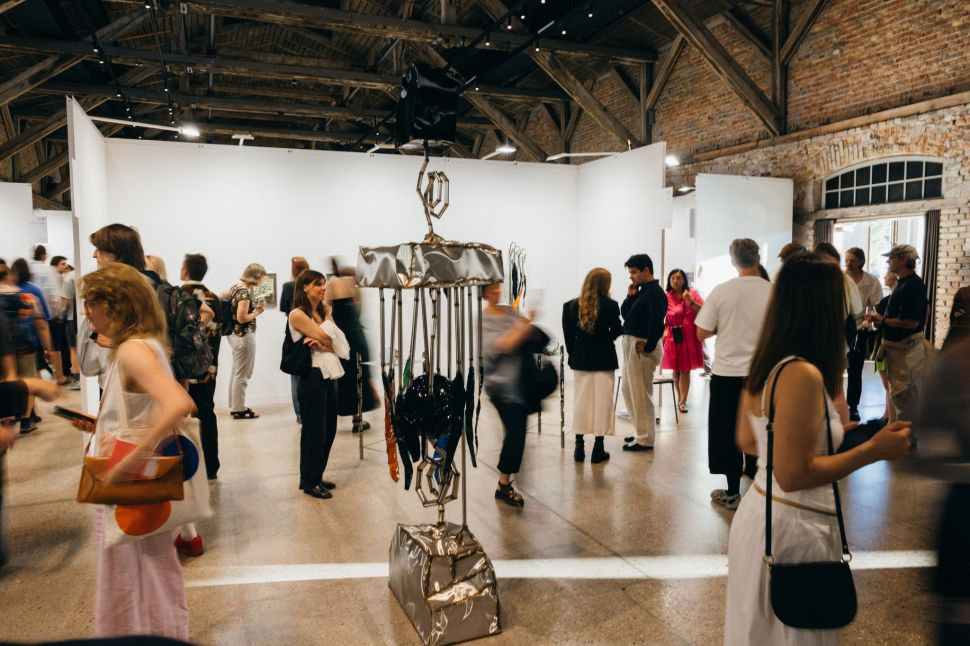
The burgeoning Baltic art fair Riga Contemporary completed its second edition last week, attracting a young stylish crowd on opening night. Prioritizing cultural fervor over commercial single-mindedness, it boasted deliberately affordable participation fees for galleries and free entry for visitors—largely possible because it’s subsidized by the Riga City Council. Bringing together 40 galleries from 15 countries, it adopted a two-pronged curatorial approach: on one hand, guided by regional scouting from the Latvian team behind Kim? Contemporary Art Centre, on the other, American reach by way of Jeffrey Rosen, the Texas-born co-founder of MISAKO & ROSEN gallery in Tokyo and a co-president of NADA, who helped anchor the first edition of the fair in 2025.
“It’s broadening the circle, keeping it international, but it’s also a little bit more realistic in terms of what we’re expecting of people,” Rosen told Observer. “We’re trying to grow a market within a region… rather than trying to start from another part of the world.” This was a pivot from the expansive view of last year, which brought over spaces from Korea and Jakarta. “It seemed irresponsible to try and get galleries from Asia to come unless they themselves had a good plan.” He felt that without striving so hard to be as geographically diverse as possible, the result was more consistent presentations.
Rosen shared a booth with the Milwaukee outfit Green Gallery, jointly showing almost entirely Latvian artists selling in the €3,000-6,000 range, including a painting by Amanda Ziemele (who represented Latvia at the Venice Biennale in 2024), deconstructed mirror pieces by Indriķis Ģelzis and psychedelic drawings by Viktor Timofeev. “We could use our international perspective and presence as a way to boost what’s happening locally,” Rosen reasoned.
“It takes time to let everyone know we are here to stay,” Zane Čulkstēna, founder of Kim? Contemporary Art Centre, added, noting the team’s efforts to become better acquainted with the regional Eastern European and Nordic scenes. “For years, we would rather meet in New York or Venice than in Warsaw or Budapest, or even in Helsinki. We made a conscious effort to go country by country and look into what’s happening there and approach galleries.”
Among the galleries, there was significant American representation: from New York (Jenny’s, Polina Berlin, Margot Samel, The Gallery), Chicago (Good Weather, Tala, Weatherproof, Met Him Pike Hoses) and Los Angeles (Gattopardo, Kristina Kite). The European presence included two galleries from Milan (Castiglioni, Eastcontemporary), two from Brussels (Gauli Zitter, Kin) and one from Paris (new garden galerie). There were eight galleries from Riga itself and a sprinkling from Helsinki, Bucharest, Warsaw, Tbilisi, Tallinn and Vilnius.
For a new fair, pre-existing models provide deeply problematic strategies as a result of “corporate greed and the fact that… they’re being made as mass entertainment events for an audience [even though] they’re trade fairs for professionals. Who’s winning in that equation? The person that owns the fair! But not the galleries; not the audience; not the artists,” Rosen said. “Maybe you start from the ground up with the local audience… You’re trying to generate some sense of culture, which can generate commerce.” Maintaining an intimate scale—and refusing to aspire to be a massive event in the long term—draws, perhaps, just a small portion of the population, but an audience large enough to feel like a viable alternative.
This sentiment was echoed in a conversation—part of the public program—around the topic of the art market in 2026. One speaker, Emily Watlington, deputy editor of Art in America/ARTnews, noted that we’re existing in an age without “a set of shared references” and that any “idea of there being an authoritative decider of who is an important artist has kind of fallen apart.” This status quo of disparate hierarchies, she pointed out, is one local communities can adeptly fill in for themselves. The idea was also echoed by an international panel addressing the topic of the role of regional art fairs, where speakers including the artistic director of ArtVilnius, the CEO of CHART Art Fair, the artistic director of Foto Tallinn Art Fair and the artistic director of Art Düsseldorf collectively agreed that it doesn’t make sense to aspire to ruthless global competitiveness over nurturing the local scene with the specificity on offer.
The two Estonian co-founders of London-based Galerina, Niina Ulfsak and Mischa Lustin, started the gallery within their apartment—”it was a bit like ‘if you know you know’ kind of thing… We would only DM [the address] to people because it was in our house”—until going public in January. (Gallerist Olga Temnikova of Temnikova & Kasela, who had a booth at the fair and spearheaded ESTHER in New York at the Estonia House, an event subsidized by the Estonian government, gave them their first internship when they were still teenagers.)
Of his native Baltic region, Lustin says: “It’s in its early embryonic stage—it really would be smart to capture it, because it’s only been 30-odd years of free market economy in this region, and it’s only now that the middle class is beginning to stabilize a little bit and emerge and start to poke the ceiling a little bit.” Given the huge success of companies with founders from this region—Vinted, Bolt, Revolut—”there’s more money in the economy.”
Not that much money, though. One Latvian gallerist somewhat dryly described the scene as “more art lovers than buyers.” Slovakian gallerist Nico Bernath, who launched his new namesake space in April, described European fairs as “sleepy” and that “you have to convince people” relative to the American insouciance about spending on art. Bernath was showing Hungarian artist and healer Réka Lőrincz, who toys with gender stereotypes, and whose embroidered piece Invisible Work, selling at €7,000, was made from actual American dollars set within delicate embroideries—a perfect capitalist emblem. Bernath has participated in fairs with a previous project in Mexico City and in Miami, and is more enthusiastic about showing in North and Central America.
By contrast, Lustin posited that “there are enough cool emerging galleries [at the fair] where if you would like to invest in contemporary art whose value will grow, these would be, logically, the galleries to do it at. Because they’re more affordable—now—but many galleries here have a very tight grip on the institutional support of these artists’ careers, because that’s what provides the longevity of these artists’ market.” Galerina was showing small new works for £600 by a Polish artist and British artist Sarah Staton’s larger pieces on linen, selling from £5,000-6,500. Lustin continued: “When we do the fairs, obviously, the objective is to sell, but another objective is to meet those curators and institutional people and writers who do reviews.”
“Our collector base was the art world itself,” Lustin added. “It wasn’t the people who have, like, 10k to spare on an artwork. These were the people who would have 2k to spare or a thousand pounds to spare—the artists, the gallerists, the curators, the sort of people who are in this community.”
Gallerist Peter Bencze of Budapest-based Longtermhandstand said: “I don’t believe in all of this crisis. If you are showing good art and you are doing the work, at some point it will pay off. There is a person in the world who wants to buy a painting from you—you have to find them! I truly believe these small-format fairs, like Riga Contemporary, are helping a new generation… This is part of the evolution, even if it’s slower than big fairs, but I really like the conversations.” His booth featured a duo show: Hungarian artist Attila Bagi, whose €4,000 paintings referenced a set of posters from the 1982 World Cup, and half-Hungarian half-Syrian ceramicist Róza El-Hassan, showing women’s anti-war activist circles selling for €4,500 each.
Whether the fair is in crisis, the second edition overall seemed successful. Rosen noted this second edition “feels improved… It’s not an unknown quantity.” He described the first year as possessing a “what is going on?” vibe, “whereas I felt like [at the opening] people were like, this is our art fair.”
