
Behind the Wimbledon whites, pristine courts and gleaming trophies lies a world far more brutal than the public ever sees. The best tennis memoirs and autobiographies strip away the glamour to expose the grueling physical and mental realities of a sport most of us know only through high-profile tournaments, which read like highlight reels of athletic perfection. The books below reveal the real cost of life at the top, showing both what it takes to get there and to stay there.
When the players who authored them put pen to paper, they bypassed self-congratulation in favor of revelation, exposing everything from family struggles and personal flaws to the immense psychological toll of the nomadic, hyper-competitive lifestyle professional tennis imposes on its stars. Often pushed into rigorous training before they had a chance to form their own identities, players describe feeling trapped not only by the pressure but also by the fame that winning brought.
For tennis’s most decorated champions, the toughest opponent was rarely the person on the other side of the net. Althea Gibson faced down the sport’s country club racism. James Blake battled injury and personal loss. In some cases, a player’s main adversary becomes the game itself, as explored in Andre Agassi’s groundbreaking memoir Open—widely considered one of the best first-person books about tennis ever written—which chronicles his overwhelming resentment toward the sport. Beyond those, these are the tennis memoirs and autobiographies that paint the clearest picture of the game.
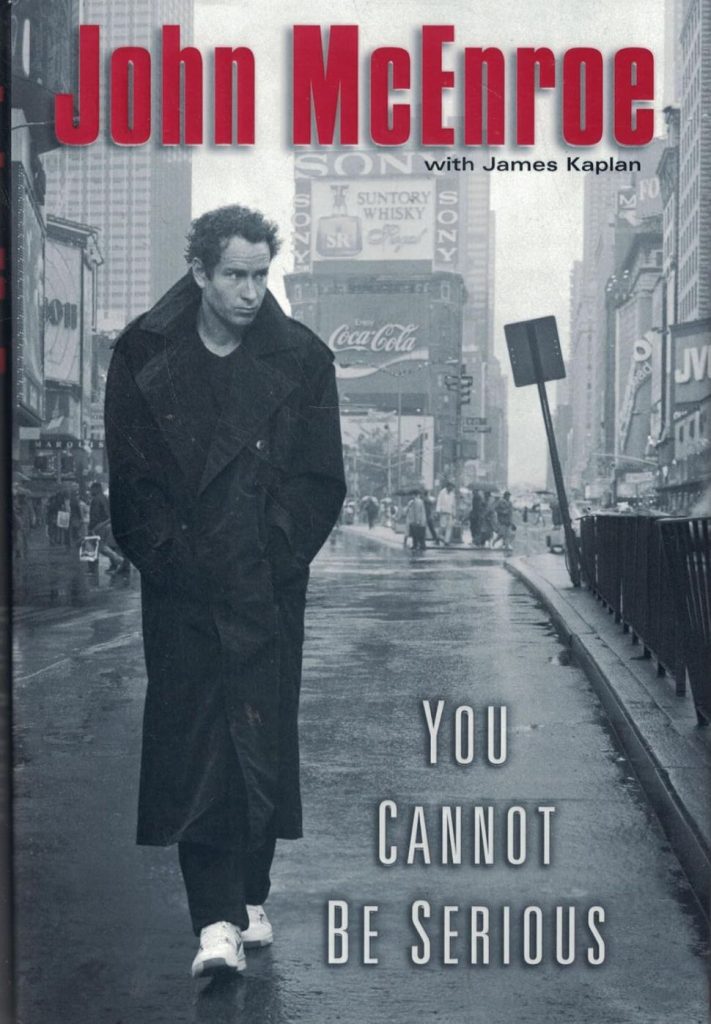
‘You Cannot Be Serious’ by John McEnroe
‘Open: An Autobiography’ by Andre Agassi
‘Unstoppable: My Life So Far’ by Maria Sharapova
‘A Handful of Summers’ by Gordon Forbes
‘All In: An Autobiography’ by Billie Jean King
‘Breaking Back: How I Lost Everything and Won Back My Life’ by James Blake
‘You Cannot Be Serious’ by John McEnroe
The title of this tennis memoir comes from McEnroe’s famous 1981 outburst at Wimbledon. He was a lightning rod on and off the court, and You Cannot Be Serious offers an unvarnished look at a career that was defined as much by temperament as talent. Whether he’s writing about his triumphs and tantrums or his personal entanglements—including his two high-profile marriages—the appeal of his story lies in the honesty with which he tells it.
‘You Cannot Be Serious’ by John McEnroe.
G. P. Putnam’s Sons
‘Unbreakable’ by Jelena Dokic
Dokic’s story begins in the chaos of a collapsing Yugoslavia and ascends to the global heights of professional tennis, but its true subject is her own survival after years of abuse at the hands of the domineering father who was also her tennis coach. She writes unflinchingly about cruelty, poverty and prejudice, charting the path she took to escape her father’s control, rise up from rock bottom and reclaim her agency.
‘Unbreakable’ by Jelena Dokic.
Ebury Australia
‘Open: An Autobiography’ by Andre Agassi
Agassi’s memoir is frequently cited as the finest tennis memoir ever written, and for good reason: it lays bare the fact that he came to despise the sport that made him famous. He describes a childhood engineered by a domineering father who made him hit millions of balls, the isolating burden of celebrity and a prolonged struggle with addiction. Unlike some titles on this list, Open is accessible to readers with no interest in tennis, because it’s not so much about tennis as it is about the search for meaning when outside validation is no longer enough.
‘Open: An Autobiography’ by Agassi
Vintage
‘The Racket’ by Conor Niland
Niland turns his attention away from tennis’s celebrated elite and toward the anonymous majority who chase rankings without ever approaching wealth or fame. His account captures the grinding logistics of low-level tournaments, the psychological wear of constant travel and precarious finances and the small-time corruptions—e.g., gambling, doping—that cast a shadow on the tour’s lower rungs. Wry and clear-eyed, it reveals the oftentimes invisible economy that sustains tennis from below.
‘The Racket’ by Conor Niland.
Sandycove
‘Unstoppable: My Life So Far’ by Maria Sharapova
Sharapova traces her ascent from her modest upbringing in Siberia to her five Grand Slam titles, framing her career through relentless discipline and the sacrifices required to sustain it. She addresses her high-profile rivalry with Serena Williams and offers her own account of the doping suspension that interrupted her career. She’s notably unwilling to smooth over the complicated parts of her legacy; she writes about ambition and controversy with equal candor.
‘Unstoppable: My Life So Far’ by Maria Sharapova.
Sarah Crichton Books
‘A Handful of Summers’ by Gordon Forbes
Forbes offers a wry and humorously affectionate portrait of tennis in its amateur era, before sponsorships and prize money reshaped the sport. Rather than dwelling on match results, he lingers on the eccentric personalities found on and off the court and the misadventures of his contemporaries, delivering a book that is more comic anthropology than competitive record. In its distance from today’s polished professionalism, it offers a delightful glimpse of a bygone tennis world defined not by commerce but by camaraderie.
‘A Handful of Summers’ by Gordon Forbes.
HarperCollins
‘All In: An Autobiography’ by Billie Jean King
King’s memoir uses her own trajectory—from her days playing on public park courts to winning dozens of Grand Slam titles across singles, doubles and mixed doubles—as a lens through which to focus on broader social change, including the founding of the women’s professional tour and her landmark advocacy for equal pay and LGBTQ+ rights. She writes with unusual openness about private struggles, among them an assault she endured as a teenager, disordered eating and what being outed publicly cost her.
‘All In: An Autobiography’ by Billie Jean King.
Knopf
‘Rafa’ by Rafael Nadal
Co-written with journalist John Carlin, Nadal’s memoir jumps between his own first-person reflections with Carlin’s third-person narration, which fills in context over a period ranging from the tennis star’s upbringing in Mallorca to major victories like the 2008 Wimbledon final. The narrative, which is enhanced with plenty of personal photos, emphasizes humility and family as the foundations of Nadal’s resilience, particularly through the injuries that threatened his career.
‘Rafa’ by Rafael Nadal.
Hyperion
‘Breaking Back: How I Lost Everything and Won Back My Life’ by James Blake
Blake’s memoir chronicles a single catastrophic year—a neck fracture, a paralyzing illness and the death of his father from stomach cancer—and his improbable return to the top of his game. Central to the book is his insistence that tennis is fundamentally a psychological contest, one in which confidence and optimism are as decisive as skill. “Breaking my neck was the best thing that happened to me in 2004, because it gave me six weeks to spend with my father when he was sick, and be home,” Blake told ABC in 2007. While most of us won’t face as much in as compacted a span of time, his account of doubt, grief and recovery feels universally recognizable.
‘Breaking Back’ by James Blake.
Harper
‘I Always Wanted to Be Somebody’ by Althea Gibson
Gibson’s autobiography recounts her progression from a difficult Harlem childhood to becoming the first Black champion at Wimbledon and the U.S. Open (then the U.S. National Championships), breaking barriers that had long excluded players like her from the sport’s highest levels along the way. (She notably inspired later players like Billie Jean King and Arthur Ashe.) While not as compellingly written as some other tennis autobiographies, her account is notable for its directness about hardship and discrimination—she shares her story without an ounce of self-pity.
‘I Always Wanted to Be Somebody’ by Althea Gibson
New Chapter Press
‘Chasing Points’ by Gregory Howe
At 34, Howe abandoned his teaching career to pursue a professional tennis ranking. His memoir follows a year spent in the sport’s lower circuits, competing against opponents half his age across four continents, and captures both the absurdity and the dignity of pursuing a dream past the point most people would deem achievable. Its appeal lies in its honesty and humor, plus a rare look at the sport’s unglamorous foundational levels. It’s a great read for anyone of a certain age who’s nurturing a secret dream.
‘Chasing Points’ Gregory Howe.
Pitch Publishing
