
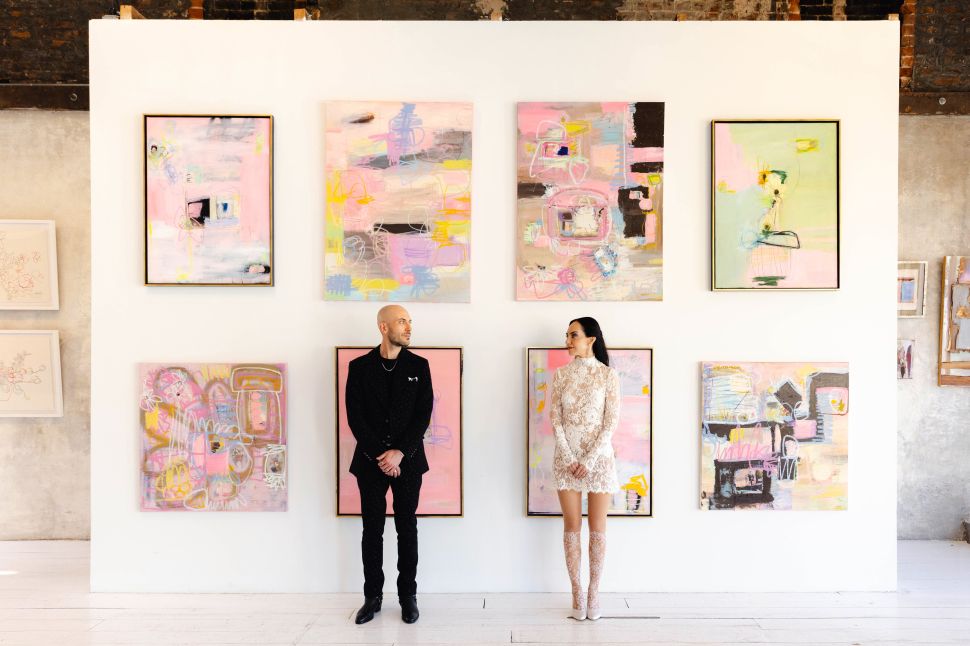
Curator Samantha Katz, who owns 1:1 Gallery with her husband, the architect Alan Paukman, didn’t necessarily set out to create an arts festival. What she wanted to do was shine a light on the lesser-known cultural output of her adopted city, New Orleans—the culture you find when you look beyond “boobs and beads and Bourbon Street,” as she put it. The result was Becoming Together, a multi-day happening that unfolded across venues earlier this year. What set the weekend apart from a typical arts festival was not its scale, which was decidedly small, or its scope, which encompassed painting and sculpture, live performance, design, sound and food, but its refusal to separate audience from artist. It was, Katz told me, not so much a gathering of works to be passively absorbed but rather a distributed work in its own right in which both spectators and city became co-authors.
Drawing on New Orleans’ deep-rooted traditions of improvisation and pageantry, Becoming Together assembled a roster of more than 40 local artists spanning visual art, performance and culinary practice, all of whom had a hand in developing a program that moved across distinct New Orleans sites, including Studio 633, Kingsway Mansion, Toulouse Theatre and the deconsecrated chapel at Hotel Peter & Paul. Katz’s role was essentially facilitator: “all I did was create the canvas, but they showed up with such expression and authenticity and creativity,” and each location also had a part in shaping the weekend. Every day had its own dress code and thematic lens, through which participants—all invitees at this edition of Becoming Together—could express themselves, contribute or otherwise weave themselves into the festival’s fabric.
Observer spoke with Katz about why models of cultural engagement that favor participation over spectatorship feel increasingly urgent, what it took to hold space for collaborators across five disparate programs and whether Becoming Together could become an annual event in New Orleans or something she adapts to other cities.
For those who weren’t there, how would you describe what “Becoming Together” actually was?
It was a three-day, three-night art festival that really served as a living love letter to the city of New Orleans. Each program, of which there were five, focused on a different medium. Night one was a visual art exhibition. Day two was a culinary pop-up. Night two was a five-act back-to-back DJ lineup at the historic Toulouse Theatre, which has a history of hosting every famous act you can think of, from Lady Gaga to Charli XCX to the Wilson Brothers. We really wanted to lean into the darker sides of New Orleans culture, so we called it the Unholy Disco. Then the third day, Sunday, there was a second line parade with a local brass band, because jazz is obviously so integral to New Orleans culture. There’s a 300-year-old tradition of Mardi Gras parading krewes, and each one typically has a theme. We created a new concept called ‘Krewe Do You,’ which turned that tradition on its head and encouraged people to show up as their most embodied and reflective selves.
So it was definitely more participatory than your typical festival. What do you think is driving the shift we’re all seeing, both outside of and in the institutional sphere, toward participation over spectatorship in the arts? And do you see this as where art consumption, or cultural consumption, is heading?
This sits in a frame of ‘beyond the event model.’ It’s not a festival, it’s not an art fair. It was a distributed, participatory work where the guests were in full costume, leaning into the very integral cultural DNA of the city itself, whether they were getting up and sharing their work in a performative, musical or choreographic aspect. They really became a part of that broader tapestry. We were interested in what happens when you remove the audience-artist divide entirely and let that social fabric become the medium. And I think part two is artists as co-authors. We’re not programming artists into slots, we’re inviting them to shape the experience itself. There is the traditional nature of the art world, so much work is online, there’s a lot of sterilization through traditional gallery models and fair models. There is a need and a hunger for this type of participatory work.
You went well beyond the typical art-plus-food model to include architecture, choreography, music and even tarot. How did you think about that range?
I think that’s where New Orleans really comes into the picture. The city served as the medium. New Orleans itself is a co-author because the city understands performance and procession and collective expression, it felt wrong for us to extract or exclude any one medium. What we were able to do is compartmentalize. In three days with five programs, we created a structure within that broad canvas. In Krewe Do You alone we had 12 different participants covering poetry, song, meditation, vocal chanting, piano and dance. We needed to create a container that allowed for all types of expression, but with enough structure to allow it to come to life in a way that felt digestible.
How did you approach coordinating that many artists and disciplines in one framework? Or to put it another way, what did you do to make sure artists were locked into whatever constraints you imposed?
I have a 20-year history of curating. I was working with Art Basel Miami from 2007 onward, I was one of the founders and co-leads of Bushwick Open Studios, which has been going on for 17 years. My husband Alan, who is co-owner of the gallery, is an architect. He’s a teacher at Tulane University and owns his own architectural practice. The way our minds and our process work is we think about experience the way an architect thinks about space and the way a curator thinks about narrative. That made it very easy for us to create a process and a workflow. And then with each of the artists, all I did was create the canvas, but they showed up with such expression and authenticity and creativity in ways we could not have expected.
How long did it take to put together, and is it something you’ll repeat?
Nine months. This was a self-funded endeavor and felt very much like a labor of love and a gift to our city. I think if we were to pursue this on an annual basis, we would need sponsorship, which is a conversation for another day, but it’s not out of the picture. In the meantime, because we do have a physical gallery space, we will continue to host monthly pop-ups, and each month we do try to focus on a different medium, all in the interest of showcasing local emerging contemporary works.
Let’s talk about ‘active participation,’ which is a term that’s maybe overused in the art world. What did it mean in the context of “Becoming Together,” and why was it important to you to engage people in a participatory way?
From the very first invitation to the end ceremony, there were many touch points where we invited guests and participants to lean into different costume moments. Each day and each program had a different theme. The visual art exhibition had a theme called Tone on Tone, where we asked guests to come head-to-toe monochromatic, one color of their choosing. The second day, the Avant Garden, the culinary pop-up at the Kingsway Mansion, had a theme of Surrealism. That evening, the Unholy Disco, the theme was Monster Mash. And then during Krewe D0 You, we really wanted people to show up as their most expressed selves, so the theme was elevated to feel free to express yourself in robes and pajamas in a way that makes you feel comfortable, intimate, cozy but still expressive. We also had a lot of impromptu music moments, people brought their own instruments. We had a local fashion designer, Margaret Shea, who had an entire two-rack costume moment where guests could play dress up. We had friends who are local tarot readers who popped up and did readings for all of the guests.
Some might say all of that framing could distract from the visual art that was also part of Becoming Together. How would you respond to that?
What we did to solve that was extend the visual art exhibition, which opened on night one, for a week beyond the festival container. We wanted each of the six visual artists who were part of that exhibition to have their moment in the sun, an economic opportunity and a marketing opportunity to share their work both locally and with broader audiences. Food is ephemeral, as is music, so luckily we didn’t have any kickback on the culinary or the performance aspects. But in terms of the visual art, wanting to take that extremely seriously, we worked with the artists, explaining the duration of the show. They really got it and bought in and are very open to continued collaboration.
What else makes the Becoming Together model unique?
We’ve talked about the city as the backdrop, we’ve talked about the beyond-the-event model. There’s also having a longtime curator and architect as the center points for thinking about broader structure and reframing the typical formats. But one thing we haven’t talked much about is art as social infrastructure. This felt like an experiment in rethinking what an exhibition or gathering can be, and I hope it inspires people to explore and expand their own creative outlets in a similar way.
I think it’s worth mentioning that Becoming Together was an invitation-only event, not a ticketed festival. How did you think about who was in the room?
It was by invitation only, with about 75 percent attendance from New Orleans-based locals, mainly people we knew through the art world, guests of the visual artists themselves, or people in our broader community. The reason we wanted to focus about 75 percent of the invites on New Orleans locals is we want them to have a platform to share their story. The city has been so good to us, and you throw a rock in any direction and you’ll hit the most talented person you’ve ever met. Those people deserve to be witnessed. New Orleans, in my experience, gets a bad rap for being a party town, all boobs and beads and Bourbon Street. We’ve never even been to Bourbon Street. There’s such a robust creative community here, and we really wanted some of our greatest art supporter friends to participate in this and to see the city through our curatorial lens in a way that would rewrite that narrative.
Could you see it scaling, maybe becoming a ticketed event, or traveling to other cities?
I actually produced a television show, one season only, that focused on 10 cities across the United States where I documented each one. I focused on telling the narrative of those cities, and each one has such a different cultural DNA. I focused on New Orleans for the pilot, then Los Angeles, Austin, Nashville, et cetera. I think this is very much in that same vein, where each top- and second-tier city across the United States and beyond has a story to tell. To the extent that we could continue to pop this up in a way that plays upon and gives credit to local creatives, that is certainly something we would love to do. To any extent I could help support or inspire other cities or communities to create platforms for artists in proximity, or their own culture, to share their work, I am 100 percent on board. The people who participated in Becoming Together didn’t just attend or view the work. They became a part of it, and everybody in the world, in their respective communities, has the opportunity to do the same.
