
The expectation that artificial intelligence will soon invade every aspect of modern life is cliché by now, but that world-altering technology found its way into the automotive world ahead of schedule. From voice recognition to satellite navigation, more rudimentary forms of A.I. became part of the driving experience more than a decade ago. Those functions are programmed responses to instructions or other human input. Such systems understand commands and do as ordered. This era’s developing A.I. thinks and seeks to understand, inform, predict and enhance human functioning.
To that end, the A.I. being incorporated into the vehicles of 2026 is evolving faster than it can be applied, inspiring a variety of opinions on where it’s all headed and how the technology can be used. From an automaker’s perspective, McLaren’s production of elite supercars and its management of a globally competitive Formula 1 racing team demand the inclusion of the most cutting-edge A.I. abilities. According to Christoph Meyer, the automaker’s chief programme officer, McLaren’s A.I. story is focused on the huge efficiencies it can create in the design and engineering stage, which they refer to as ‘A.I. enhanced engineering.’ “As for our use of A.I. in engineering and design, McLaren Automotive is transforming its future product development by embedding true end-to-end agentic A.I. across the entire engineering lifecycle,” he told Observer.
For the uninitiated, agentic A.I. can follow elaborate instructions without supervision, set its own goals, create detailed plans and execute any related tasks using its own chosen external tools or systems. “McLaren applies a ‘perfect fit’ AI stack to bring rapid speed and scale throughout the design and engineering development process,” Meyer added. “The team can now explore more design space, run complex tests and simulations at an incredible pace, tune every component with greater precision and reduce manual, repetitive tasks through leveraging engineering agents.”
Meyer insists the resulting environment allows teams to focus on high-value design and engineering thinking, while leaving process-level tasks to the A.I.
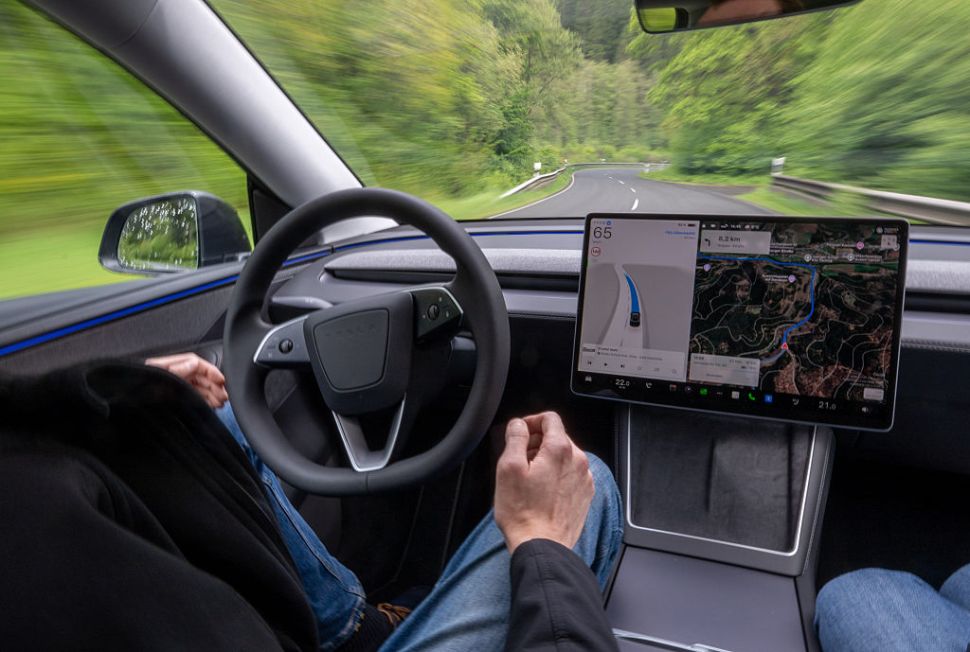
Sam Abuelsamid is vice president of market research for the telemetry firm’s Transportation and Mobility Research and Advisory Practice. Focusing on assisted and automated driving and mobility services, he believes A.I.’s most profound effect in the near future will be the continued removal of human beings from the driving process: “The biggest consumer facing application of A.I. is Advanced Driver Assisted Systems—especially the latest hands-free systems like Super Cruise (from General Motors). It’s still relatively new for most automakers, but Tesla has really shifted their entire ADAS stack to be based on A.I. models. Mercedes Benz is using Nvidia’s Alpamayo end-to-end AI ADAS starting with the new CLA. Lucid and Jaguar Land Rover are adopting it, too. Nissan and Stellantis have also announced plans to roll out next-generation ADAS based on Wayve’s AI system in the next couple of years.”
Abuelsamid predicts the market will see increasing use of A.I. in areas such as powertrain and chassis control, and “an A.I. model could potentially manage aspects like motor control and battery charging and discharging to improve efficiency for better range. In order for that to work, the AI models need to run in real time on the vehicle rather than in the cloud.”
According to Dr. Liucheng Guo, chief technical officer and co-founder of TGO, a London-based company working on sensing technology for automotive interiors, current A.I. is increasingly about understanding the real-time state of the driver, passengers and vehicle environment. “That includes driver assistance, occupant monitoring, safety intervention, predictive maintenance and more adaptive human-machine interfaces,” Guo told Observer. “We see a major opportunity in pressure-mapping and material-integrated sensing. A seat, armrest, steering wheel or interior surface can become an intelligent sensing layer.”
As an example, Guo explained that a camera can be used during development to train an A.I. model to understand posture, body position and user intention—but the production vehicle does not need to rely on a camera. “The system can infer posture and occupant state from pressure and touch data alone. That creates a more privacy-preserving, non-invasive way for the car to understand what is happening inside the cabin.”
Guo rejected the idea that A.I. thinks like a human mind, but he stresses it can react much faster in safety-related situations, processing more data or taking over tasks that people either cannot do consistently or do not want to do repeatedly. “Useful AI in a vehicle is not necessarily trying to imitate a person,” he said. “Its value is in recognizing signals that humans may miss, such as a change in posture, an unfastened child seat, an out-of-position passenger, a driver shifting weight before reaching for a control or someone becoming unstable or uncomfortable.”
Guo doesn’t see the human being getting replaced by the car thinking on his or her behalf, but rather supporting the user quietly and naturally: “A passenger should simply sit down, move naturally, and the car should understand enough to adapt. This is especially important for age-friendly and accessibility-focused design where the best interface may be no visible interface at all in intention-aware, safety-aware and personalized cabins.”
