
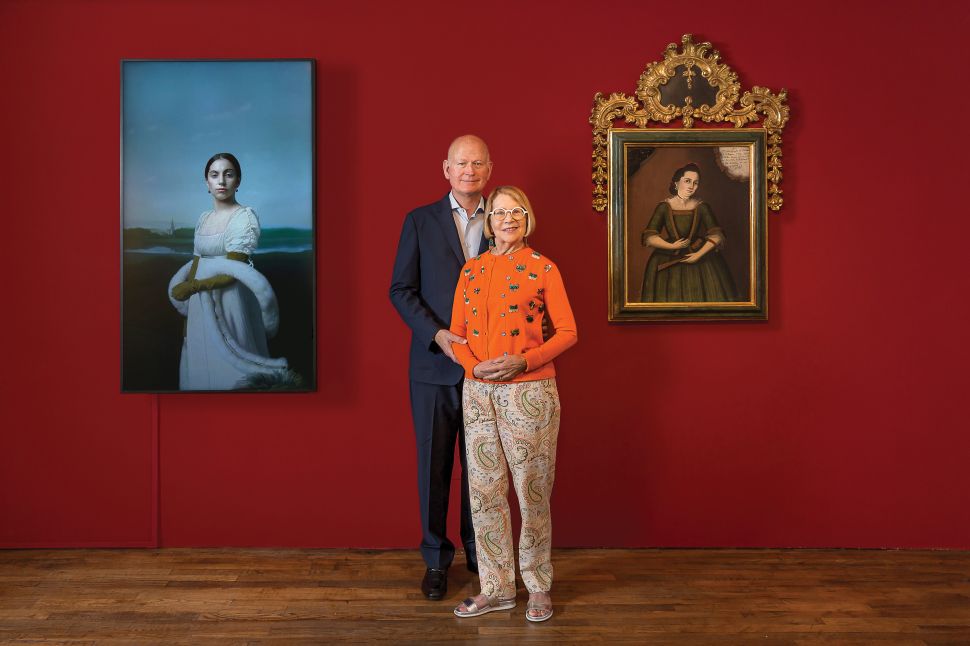
Carl Thoma is 77 years old, a billionaire and one of Dallas’s most prominent art collectors. Together with his wife Marilynn, whom he met while studying at Oklahoma State University, he has assembled an art collection remarkable not only for its scale but also for its geographic, historic and stylistic breadth. The Thomas’ holdings encompass a wide range of disciplines, and include Japanese bamboo pieces, Spanish colonial portraiture, Native American art and an extensive collection of digital art. The latter is currently Carl’s favorite genre: “I’m drawn to where art is going. The experimental, digital, time-based work that’s redefining the medium’s boundaries,” he tells Observer.
Most Dallas art aficionados have become familiar with the Thoma Foundation through the Dallas Art Fair—its latest exhibition, “Presence of Absence: Embodied Portraiture,” opened concurrently with the fair this past April. The building on Cedar Springs dates to 1921, the elevator that carries visitors to the foundation’s headquarters is from the 1950s, yet the installation art that greets guests when they enter the premises is ultra-contemporary. In the adjacent gallery, separated by a glass wall, 18th-century portraits gaze back at the viewer, creating a dialogue between past and present.
This is the third exhibition the foundation has presented in Dallas and it will remain on view until next year’s Dallas Art Fair. The show succeeds in bringing together a very heterogeneous collection with coherence. Whether through the lens of digitalization, indigenous voices or postwar Western artists, it explores questions of individuality, authenticity and self-determination, featuring works by artists like Robert Rauschenberg, Hito Steyerl and Jeffrey Gibson. The sparkling rosé from the couple’s own vineyard in Oregon, Van Duzer, served at the opening, undoubtedly enhanced the experience. I met the foundation’s attentive and engaged staff that works alongside the Thomas at the foundation’s headquarters. Carl showed me one of his favorite works at the moment, Talking Shit With My Jaguar Face by Eamon Ore-Giron (2024), a colorful geometric painting exploring indigenous sacred objects from the Americas.
The Thoma Foundation has only been open since 2023, two years after the couple relocated from Chicago. Yet it already feels as though Dallas is becoming “Thoma Town,” as museum publicist Taylor Mayad Powell puts it. Both her clients, the Meadows Museum of Spanish Art at SMU and the Crow Museum of Asian Art, are showing works from the Thoma Foundation this year. “Spectacles of Power and Faith” opens August 23, 2026 and brings together 63 paintings of colonial South America. This is a passion project of Marilynn’s; with a total of around 250 pieces, it’s one of the largest collections of Spanish colonial art outside of Latin America. Meanwhile, the Crow will present parts of the Thoma Japanese bamboo collection at its Dallas Arts District location this November—likewise one of the largest in the world, with about 300 pieces.
Superlatives seem to be manifold when it concerns the Thomas, which makes the couple’s move to Texas, where everything is famously bigger, all the more fitting. Carl explains their motivation behind the relocation as follows: “Dallas is one of the fastest-growing cities in the country, and that energy was appealing. A community actively shaping its own future, with a strong and collaborative network of collectors, institutions, and arts supporters.” And was the move worth it? “What we found exceeded our expectations,” Carl says of the town. “The patrons here are ambitious and open-minded. There’s real space for experimentation.”
Speaking of art patrons: many cultivate an aura of eccentricity, projecting an image of decision-making driven by instinct. Collectors at this level are often known to be obsessed with a particular artist or haunted by a masterpiece they passed on before its value soared. Carl, on the other hand, makes acquiring art sound like a calm, precise matter—methodical instead of emotional. Asked about favorite artworks, he replies: “Like children, there are no favorites.” He describes his wife’s and his acquisition habits as “straightforward: we collect what we like” and adds what I could have guessed: “We do not collect in accordance with the art market.”
When I ask Carl about a dream artwork he has been pursuing, he tells me there is none. Nor does he harbor regrets about pieces that got away: “We make our decisions carefully and with real intention. When you approach it that way, regret doesn’t have much room to take hold.” Carl, who is co-founder of private equity firm Thoma Bravo, appears at peace with his decisions—a rather unusual state for someone operating within the volatile, competitive and often dramatic ecosystem that is the art world. Pragmatism and stoicism are not traits often associated with collectors of this stature, but whatever the origins of this approach to art patronage, it is difficult not to admire. For Thoma, collecting is “a responsibility to make sure that experience [of the arts] isn’t reserved for a few.” One of the first things collections manager Maegan Robson mentions about her boss is the following: “It should be illegal to buy art and not show it to the public.” To Carl, collecting is a sort of mission: “You become a serious collector when you understand your role as a steward, not an owner.”
Is there still room for reverie in the Thoma household? “The real dream is making it [the collection] accessible, seeing it travel to museums regionally, nationally, internationally, and reaching as many people as possible,” Carl admits. The couple also oversees the Thoma Scholars Program, which gives access to higher education for “promising rural and first-generation students with financial need” across Northwest Oklahoma, West Texas and Eastern New Mexico. Through their partnerships with Texas Tech University and Oklahoma State University, the Thomas cover attendance and provide “mentorship, leadership development, and long-term guidance,” as Carl explains. “Education sits at the center of everything we do. Building a collection is only part of it. The more lasting work is sharing it, and helping the next generation find their own way in,” he concludes.
Carl and Marilynn have been acquiring art for over half a century: they began collecting right after graduating from Stanford in 1975 and today own over 1,700 pieces, with museums like LACMA, the Museum of Contemporary Art Chicago and the Dallas Museum of Art borrowing works from their collection. They don’t appear to be slowing down, either—in addition to maintaining an exhibition space in Santa Fe with rotating displays, they recently launched First Fridays at their Dallas foundation, where the space is open to the public on the first Friday of each month from noon to 3 p.m.
Yet it is not only the couple’s commitment to philanthropy that makes them compelling. The strength of their collection lies in its deliberate focus on lesser-known artists and generally overlooked art domains and periods—Japanese bamboo, portraiture from the Spanish Americas—and in making them available to the public. The Thoma Foundation is a major gain for Dallas and, thankfully, Carl has no regrets about moving here.
More art collector interviews
For Marie-Cécile Zinsou, Building a Museum in Benin Was Just the Beginning
Annie Taylor On Collecting as Cultural Stewardship
Kiran Nadar’s Ambition to Put Indian Art On the World Stage
Jennifer Gilbert Is Selling Masterpieces at Sotheby’s to Fund a New Arts Nonprofit in Detroit
How Two Hong Kong Collectors Are Choosing Public Engagement Over Possession
Yasmine Berrada Wants to Change the Way the World Sees Moroccan Art
John Jonas On Living With Art
