
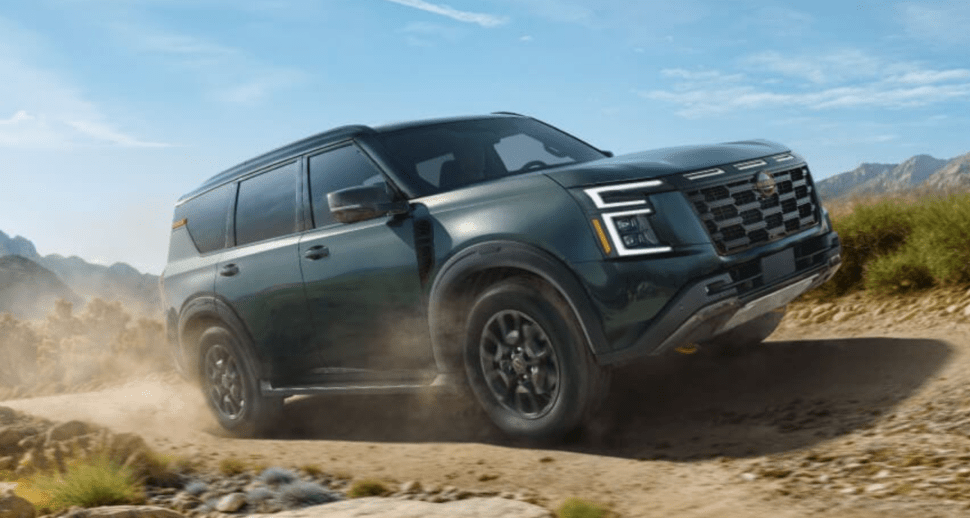
It’s 2026, and the Nissan Armada would like a word. There was a time when Japanese vehicles were all about tiny, fuel-efficient hatchbacks and sports coupes, with the automakers from the Land of the Rising Sun and its neighboring nations content to leave the bigger vehicles to the U.S. of A. Not anymore. The full-size, eight-seat SUV rolls in at more than 209 inches, weighing more than 6,000 lbs. That puts it on the same scale as the largest people carriers in the business, and Nissan’s engineers have maximized its features for its price in the hope of stealing some buyers from the usual SUV suspects.
The aptly named Armada faces competition on two fronts. First, there is the similarly sized and priced Asian market competition. Lining up with the Armada at the starting line are the Toyota Sequoia, Honda Passport, Infiniti QX80, Lexus GX and the Hyundai Palisade. Other brands such as Kia, Mazda and Subaru put out their own SUVs, but nothing from the eight-seat ocean liner breed we see with the Armada.
In this subcategory, the Armada leans into the higher end of the price range without surrendering to extravagance. Starting around $58,000 for the entry-level model, the menu runs north of $82,000 for the Platinum Reserve.
Bearing an unnecessarily similar name, the Armada Platinum sits in the middle of the trim line with an MSRP of about $71,000. That amount puts the Armada on similar footing with the more refined versions of the Sequoia, while outclassing the Passport and Palisade. The Infiniti and Lexus entries run some $20,000 higher than the priciest Armada, pushing them into the mid-luxury class.
Meanwhile, this beefy Nissan presents itself as an alternative to more expensive American full-size SUV royalty. The Lincoln Navigator, Cadillac Escalade and GMC Yukon Denali are each still big enough to have their own zip code and carry the same small army as the Armada, but a buyer has to dig deeper into the coffers to load up said army. The Navigator’s price runs up to $120,000, while its rival Escalade tops out closer to $170,000.
To lure buyers away from the brawnier American players, Nissan loads its SUV with maxed-out features in the Platinum build. The interior cabin centers around a NissanConnect dual-display design with a 14.3-inch infotainment screen with voice-activated Google capability, Apple CarPlay and Android Auto feeding into a 12-speaker Klipsch audio system.
The quilted leather seats are climate controlled, while the folks back in stowage get their own tri-zone automatic temperature control. Everyone sits under a first-row, power-operated glass moonroof.
Nissan’s pitch to SUV shoppers is simple: while they could still drop well more than $100,000 for the Escalade or Navigator, they’ll get all of the same creature comforts, driver aids and entertainment options in the Armada, with enough money saved to buy a new Nissan Sentra on top.
In the performance department, the Armada follows the herd by retiring the V8 engine that would have powered such big machines in the past in favor of a 3.5-liter, twin-turbocharged V6. That’s the way of the world for fossil-fuel-engine vehicles now, and there’s no shifting it. In years to come, we will all live and drive at the mercy of turbocharger durability.
In this case, the V6 produces 425 horsepower and 516 lb-ft of torque. Torque matters to a big SUV as much as it does for a sports car, but for different reasons. For a Nissan Z, torque aids acceleration by putting the power down quickly. For an Armada, it aids the wheels for an immediate dig-in when towing the SUV’s 4-ton capacity.
Aesthetically, the Armada is a big box on four wheels. That’s not a cheap shot at the Nissan exterior designers; all of the full-size SUV competition’s models are also big boxes on four wheels, right up to the Rolls-Royce Cullinan. The visual trend is as boring as a beige room, but it’s also expected by buyers looking into these human transporters. The only real appeal of that visual coding is that any full-size SUV is still better looking than a minivan.
Nissan positions Armada advertising to sell it like a rugged, off-road beast, but it doesn’t have that vibe behind the wheel. Its sheer weight and bulk would get it through most wilderness driving predicaments short of rockier terrain or deeper streams, but the handling feels more tuned to civilized conditions atop pavement. Meanwhile, the interior lacks the rugged serviceability of a tailor-made off-road machine, leaning instead toward urban or suburban sojourns.
Once at home on asphalt, the Armada cruises as any massive SUV should. Its heavyweight suspension protects driver and passenger bottoms from the harsher realities of potholes and speed bumps while moving with a preferred climate and providing chosen entertainment. That’s the true identity of the Nissan Armada Platinum: it gets everyone home in total comfort for less money than the snooty Americans a few doors down the block.
