
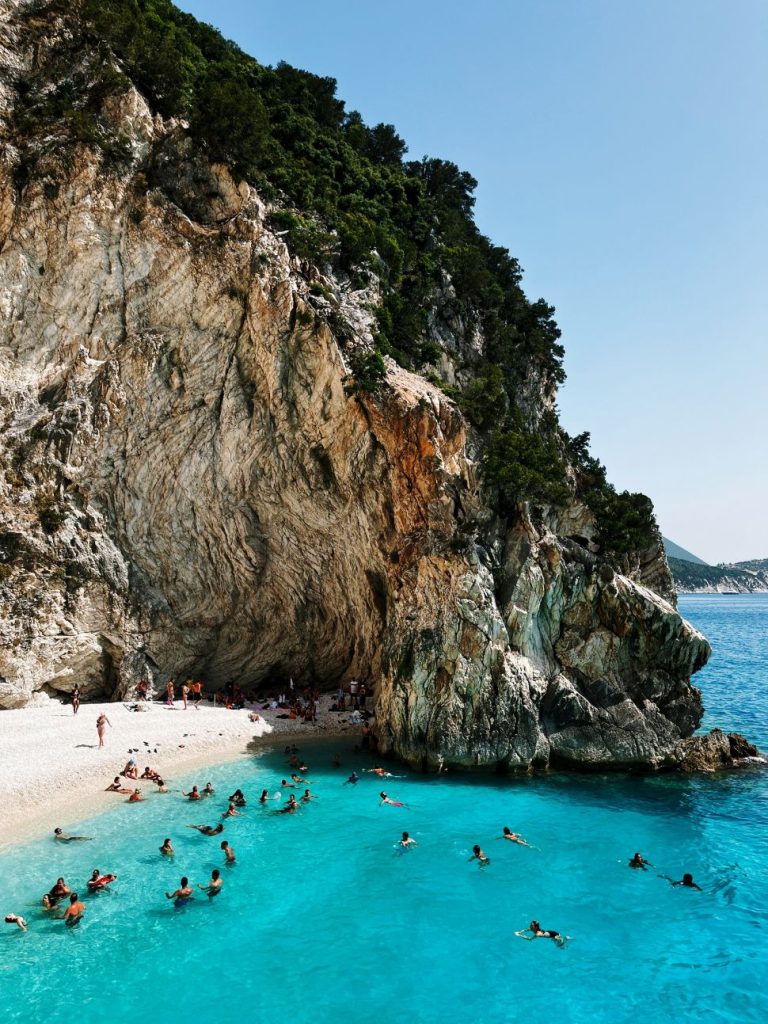
Every summer, the same handful of islands absorb the same several million people, and every summer, a few more travelers decide there has to be a better way to spend a week. There is, but it’s worth understanding what they’re escaping first. The gigantic cruise ship is usually the tell: when one noses into a harbor, 4,000 passengers spill into a town built for 400, the gelato line laps the church twice, and the place stops being itself until the boat leaves at dusk. Santorini has made its peace with this. So have Capri, Hvar town and Mykonos, all of them now case studies in what happens when a destination says yes to absolutely everyone.
The good news—and the reason for this list—is that the Mediterranean still keeps its secrets, and they sit closer to the famous ones than the burnout would suggest. There are volcanic dots flung nearer to Africa than to their own capitals, where a single stubborn winemaker has carried an indigenous grape through phylloxera and a century of everyone’s indifference. There are Adriatic outposts that sat behind a military fence until 1992 and came out the other side with their fishing villages mercifully intact. There are Aegean rocks two miles off the Turkish coast where, once the day boats clear out, the loudest thing you’ll hear is a goat reconsidering its footing.
The honest truth is that these islands don’t all deliver the same thing. Some reward you with a design hotel and a Michelin kitchen; others offer a guesthouse, an unreliable ferry and the increasingly rare pleasure of a place with nothing to prove. We’ve flagged which is which, because on half this list, the roughness is the whole point, and pretending otherwise does you no favors. These 15 islands spread across the entire basin, each one worth the additional leg, the transfer and the occasionally unhinged ferry timetable it takes to reach them.
The Under-the-Radar Mediterranean Islands to Know
Ithaca, Greece
Odysseus spent 10 years clawing his way back to this rocky Ionian speck, and most travelers still haven’t made the trip. The island is shaped like a butterfly, two mountain masses pinched together at an isthmus barely a quarter-mile wide, the whole of it cradling Vathy Bay, one of the deepest natural harbors in Greece. Above the town of Stavros sits the School of Homer, a Mycenaean acropolis where, in 2025, archaeologists announced that they’d found inscriptions to Odysseus himself, evidence of a hero cult that ran a thousand years. Christopher Nolan’s Odyssey hits screens in July 2026 after filming across Sicily, Morocco and Scotland—everywhere, pointedly, except the island Odysseus was actually trying to reach. The honey is sage, not thyme; the dessert is rovani, sticky with rice and cinnamon; the wine comes from indigenous grapes around Perachori that you won’t find off the island. Rock n’ Olive runs two contemporary villas with private pools and Starlink on a mountain plot near Vathy, while Hotel Perantzada 1811 fills an old neoclassical mansion in town with jewel-toned rooms and an infinity pool.
Ithaca, Greece.
Unsplash
Pantelleria, Italy
Forty-three miles from Tunisia and 68 from Sicily, this scorched volcanic plug feels more North African than Italian, and it doesn’t lean on talc-fine beaches for its personality. You climb down iron rungs into the sea instead. The wind is so relentless that the Zibibbo grapes grow hunkered in stone-walled hollows, a head-trained method called alberello that UNESCO named Intangible Cultural Heritage in 2014, the first agricultural practice ever to get the nod. Those grapes become passito, the honeyed dessert wine; Donnafugata’s Ben Ryé and Marco De Bartoli’s Bukkuram set the standard. Soak in the Specchio di Venere, an alkaline crater lake where you smear yourself with warm therapeutic mud like everyone’s watching, then drive the terraced interior because nothing here is walkable. Here, you sleep in a dammuso, the domed lava-stone house the Arabs left behind. Above the village of Scauri, amid the same farmsteads and volcanic-rock walls, Sikelia Hotel turns 20 of them into suites and pours a house wine off its own vines, with a restaurant in partnership with Trussardi alla Scala. Tenuta Borgia rents seven more on a working wine-and-caper estate, the ones where Luca Guadagnino shot A Bigger Splash.
Pantelleria, Italy.
Unsplash
Djerba, Tunisia
Djerba, Tunisia’s largest island, lies off the southern coast and is reached by a Roman-era causeway. In 2023, it was named a UNESCO World Heritage Site for a settlement pattern 3,000 years in the making—a mosaic of Berber, Arab and Jewish life that has somehow held. The El Ghriba synagogue in the village of Erriadh is among the oldest in the world, its interior all blue tile and hanging lamps, and every spring it draws a Jewish pilgrimage from across the diaspora to one of the last such communities in the Arab world. Wander the covered souk at Houmt Souk for silver and painted pottery, climb the 16th-century Borj el Kebir fort at the water’s edge, then stroll to Djerbahood, where artists from more than 30 countries have covered Erriadh’s white walls with 250-odd murals. You sleep, fittingly, at Dar Dhiafa, where four such houses have been stitched into a single boutique hotel of 12 rooms, a labyrinth of courtyards and bougainvillea in the heart of Djerbahood, a 10-minute drive from Houmt Souk and a world away from the beach hotels.
Djerba, Tunisia.
Unsplash
Porquerolles, France
The French Riviera you assumed had been paved over entirely still has one wild piece: a national park where cars are banned and development stopped decades ago. The state bought most of the island in 1971 to keep it that way. A businessman named François Fournier bought the island in 1912 and gave it to his wife as a wedding present, then planted the 500 acres of vines that still produce Côtes de Provence rosé from three estates. Rent a bike and pedal to the Plage Notre-Dame, routinely called one of France’s best beaches, or the easier Plage d’Argent through the pines. Climb to the 19th-century Fort Sainte-Agathe for the view back toward the mainland, then give an afternoon to the Fondation Carmignac, the contemporary art villa that opened to the public in 2018, where you pad through the galleries barefoot and the sculptures hide among the olive trees and lavender. Out at the island’s western tip, on a 124-acre estate the Fournier family has held since the start, Le Mas du Langoustier spreads 47 rooms in terracotta and sky-blue shutters with a sandy path to its own beach.
Le Mas du Langoustier Hotel.
Le Mas du Langoustier Hotel
Folegandros, Greece
The Santorini fix without the Santorini consequences, Folegandros is a curved-knife sliver of Cyclades with 719 residents, no airport and a Chora (town) perched 656 feet above the water. Cruise ships can’t dock, and the island is in no hurry to change that. The medieval Kastro quarter dates to 1212, and the whitewashed Panagia church crowns the ridge above town up a zigzag of steps that doubles as the local stairmaster. Boat out to the Chrysospilia sea cave, where Hellenistic-era visitors carved their names into the ceiling, then scramble half an hour down to Katergo beach, which offers pebbles, clear water and absolutely nothing else. On a clifftop of its own near Petousis, the southeast coast falling away into the Aegean, Gundari opened in 2024 as the island’s first real five-star hotel, each of its 27 stone-and-timber suites boasting a sea-view pool and a spa cut into the rock; the Orizon restaurant is helmed by Lefteris Lazarou, Greece’s first Michelin-starred chef.
Gundari.
Vis, Croatia
The Yugoslav army kept this island off-limits to foreigners from the end of World War II until 1989 and didn’t fully decamp until 1992. Decades sealed off did what no preservation order could: while Hvar became a yacht parade, Vis stayed a fishing rock with two stone towns and vineyards worked for 2,000 years. Hike up Mount Hum to Tito’s Cave, where the marshal ran the Partisan war in 1944, and tour the submarine tunnel at Parja Bay, big enough to swallow a 361-foot sub. The wines are indigenous Vugava and Plavac Mali; the cult producer, Lipanović, ages his in a former military tunnel. Mamma Mia! Here We Go Again filmed the “Waterloo” finale on a Tito-era artillery battery here, a sentence that is either a lure or a warning. In Kut, the old Venetian quarter of Vis town, Hotel San Giorgio puts a handful of rooms behind a stone façade a few streets back from the water.
Vis, Croatia.
Procida, Italy
Capri’s broke, beautiful cousin, Procida, is the smallest island in the Bay of Naples at 1.6 square miles—the one the ferry crowd skipped on the way to Ischia until 2022, when it was named Italian Capital of Culture and visitor numbers promptly tripled. The pastel houses of Marina Corricella stack up a hillside reachable only on foot, by stairways the locals call scalatinelle. The harbor served as the fictional Mongibello in Anthony Minghella’s The Talented Mr. Ripley; Pozzo Vecchio beach is where Mario meets Beatrice in Il Postino. Climb to Terra Murata for the abbey from 1026 and a Bourbon prison that locked its last cell in 1988. Just below the old citadel, La Suite Boutique Hotel occupies a restored 18th-century residence with a black lava stone pool, though I’d keep your service expectations on a short leash.
Procida, Italy.
Unsplash
Menorca, Spain
Menorca is Mallorca’s calmer sister: a UNESCO Biosphere Reserve since 1993 and, since 2023, keeper of a fresh World Heritage designation for its Talayotic megaliths, 280 archaeological points dating to 1600 B.C. You can stand inside the Naveta des Tudons burial chamber, the best-preserved of its kind anywhere. The Camí de Cavalls, revived from a 14th-century coastal patrol route, covers 115 miles around the island in 20 stages past cerulean coves—in the best way. Menorca Experimental turned a 19th-century finca on the island’s south side into 43 rooms by Dorothée Meilichzon, nine of them villas with their own dipping pools, the Camí de Cavalls passing close enough to walk to the Cala Llucalari cove before breakfast. New on the scene, Vestige’s Binidufà has 11 rooms in a red-stone 18th-century finca sharing nearly three miles of private shoreline with its sister property, Son Ermità. Out on the Illa del Rei in Maó harbor, Hauser & Wirth opened a free gallery in 2021 with architecture by Luis Laplace and gardens by Piet Oudolf, and more than 300,000 visitors have since found their way to a private island to look at art.
Binidufà.
Binidufà
Symi, Greece
Symi is an hour by catamaran from Rhodes, three miles from Turkey, and all but emptied of its day-trippers by late afternoon, which is exactly when it gets good. The Italians ran the island from 1912 to 1943, and their 1881 clock tower still presides over Gialos, a harbor stacked with neoclassical mansions in ochre, terracotta, lilac and cobalt. Façade colors are restricted by law, so the whole amphitheater behaves like a single painted composition. Climb the 500 stone steps of the Kali Strata to the upper village, make the trip to the Panormitis monastery at the southern tip, and order the tiny shell-on Symi shrimp eaten whole, heads and all. The population is now 2,500; it was 25,000 at the peak of the sponge trade in 1908. Two of those harbor mansions now take guests: the Old Markets, a Greek national monument, holds 10 rooms above a rooftop restaurant, and Hotel Aliki has stood on the Gialos waterfront since 1895.
Symi, Greece.
Salina, Italy
The greenest of the Aeolians is ringed by six extinct cones, the tallest of which—Monte Fossa delle Felci, at 3,156 feet—is the highest point in the whole archipelago. This is the only place on earth that makes Malvasia delle Lipari, the amber dessert wine the Greeks planted here 2,500 years ago; when visiting, drink Hauner, the biodynamic Caravaglio, or Tasca d’Almerita’s Capofaro. Here’s the correction worth knowing: most of Il Postino was shot on Salina, not Procida, including Neruda’s red house and the beach at the Faraglione di Pollara. The caper festival lands on June 7 this year, and yes, an island throws a party for a condiment. The intimate, family-run Principe di Salina looks airlifted from the Cyclades, all whitewash above the sea, while Capofaro sets six Relais & Châteaux rooms inside a working lighthouse on the Malvasia vines themselves.
Salina, Italy.
Unsplash
Ponza, Italy
A volcanic crescent halfway between Rome and Naples, a Roman weekender since the actual Romans, and all but unknown to anyone north of the Alps. Yellow-and-white tuff cliffs and sea stacks ring the coast; the Chiaia di Luna beach beneath 330-foot cliffs is closed on foot for rockfall now, so you admire it from a boat like everyone else. The Grotte di Pilato are sea caves that the Romans hand-cut in the first century to farm moray eels beneath an imperial villa, as one does. Mussolini was briefly jailed here in 1943. The 524-foot Roman tunnel that still bores through the rock is also how you reach the bay from the Grand Hotel Chiaia di Luna, the only hotel set above it, about 70 terraced rooms ranged across a natural amphitheater on the southwest cliffs. Ferries run from Anzio in just over an hour, which makes it a Rome escape that Rome would prefer you keep to yourself.
Grand Hotel Chiaia di Luna.
Grand Hotel Chiaia di Luna
Gozo, Malta
Malta’s little sister moves at the speed of a horse cart and sees no reason to apologize. The Ġgantija temples on the Xagħra plateau date to around 3600 B.C., which makes them older than the pyramids and Stonehenge, and you walk among megaliths weighing more than 50 tons. The famous Azure Window arch collapsed into the sea during a storm in March 2017; its remnants now make a sought-after technical dive, alongside the Blue Hole chimney and the Inland Sea tunnel at Dwejra. Ramla Bay glows orange-red from iron-rich sand. Near Dwejra in the island’s quiet west, the Kempinski San Lawrenz handles the resort end with 120 rooms and the Mediterranean’s largest Ayurveda center, while clifftop Hotel Ta’ Cenc spreads 74 rooms across 395 acres dotted with the same Neolithic dolmens you came to see. The fast ferry from Valletta takes 45 minutes.
Gozo, Malta.
Unsplash
Korčula, Croatia
The island insists Marco Polo was born here in 1254, and while that’s a 20th-century invention rather than a fact, he was demonstrably captured in a sea battle just offshore, so the EU-funded Marco Polo Center splits the difference. The herringbone streets of the Old Town are angled to break the wind, and the town’s legal statute dates to 1214. Three endemic whites reward the trip: Pošip from the villages of Čara and Smokvica, and Grk from Lumbarda, grown on fewer than 40 sandy acres anywhere on earth. Order a drink at the Massimo cocktail bar in a fortress tower and it arrives by pulley, hauled up the outside wall, because the staircase gave up. Catch the Moreška, a clanging sword dance staged twice a week in summer. Inside that same walled Old Town, the Lešić Dimitri Palace fits six Relais & Châteaux suites into a converted bishop’s palace, each named for a Silk Road stop.
Korčula, Croatia.
Unsplash
Tilos, Greece
The strongest sustainability story in the Mediterranean, Tilos became the world’s first island to run on hybrid renewable power, a wind turbine and a solar array backed by batteries. In 2021, it went even further and certified itself as the world’s first Zero Waste Island, diverting about 90 percent of its trash from landfill through door-to-door collection. The old dump is now a circular-economy center, which is either heartening or a sentence you never expected to read about a vacation. The geology is stranger still: the Charkadio Cave revealed 10,000 bones of a dwarf elephant species barely four feet tall; they were the last of Europe’s last surviving elephants, gone around 3500 B.C. Roughly 500 people live here year-round. Down at Livadia, the Ilidi Rock apartments are built right into the cliff above the bay. You reach the island from Rhodes by a two-hour catamaran.
Tilos, Greece.
Nicolas Economou/Getty Images
Kastellorizo, Greece
Greece’s easternmost inhabited island is a mile and a quarter off the Turkish coast and a 22-hour ferry from Piraeus, which is why almost nobody goes. The population is 594. It’s named Megisti, meaning biggest, because it’s the largest of a very small archipelago, a Greek joke at its own expense. The Blue Cave is the country’s largest sea cave at 246 feet long, entered by ducking under a low lip before the interior floods cobalt; monk seals turn up inside, unbothered. Gabriele Salvatores shot the whole of Mediterraneo here in the summer of 1990, and it won the Academy Award for best foreign language film; the port houses and the taverna square are still recognizable. The 14th-century Red Castle of the Knights of St. John gives the island its Italian name. Among the restored mansions on the waterfront, Casa Mediterraneo skips the usual whitewash for Asia Minor spice tones and rainbow glass, five suites and a room across three of them, while the Megisti Hotel offers 19 rooms and the only private bay swimming on the island.
Casa Mediterraneo.
Izzet Kulaksiz
