
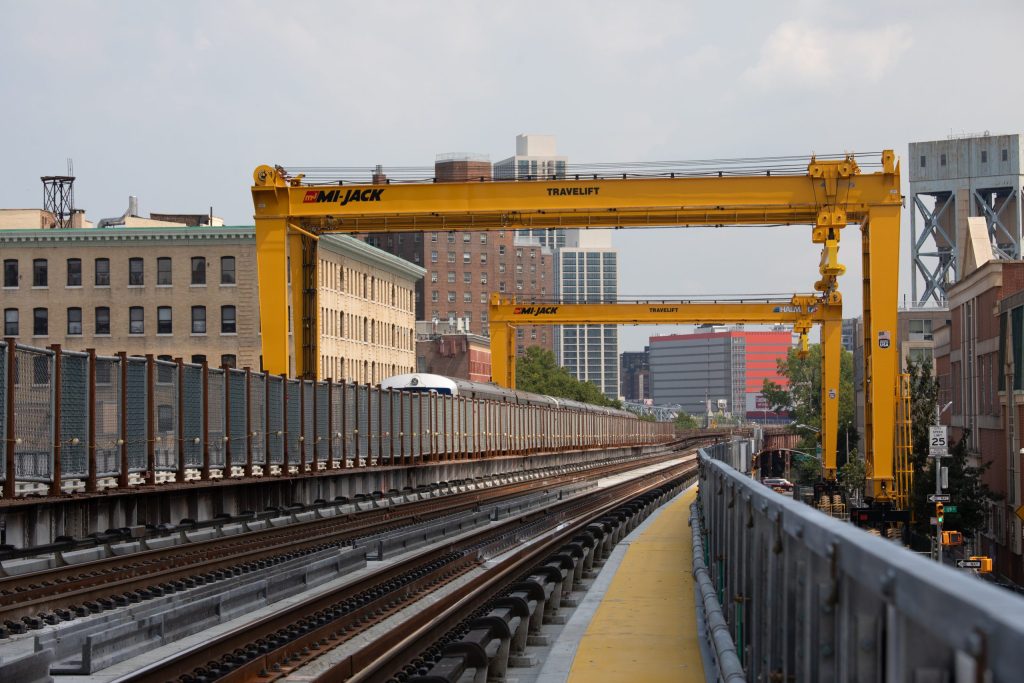
The rebuilding of an East Harlem rail structure from the 1890s has arrived at its destination five years ahead of schedule, officials announced Monday — without disrupting passenger service along Metro-North’s main artery in and out of Grand Central Terminal.
Gov. Kathy Hochul donned a hardhat and stood with MTA executives to ceremonially knock “golden clips” onto the railroad tracks atop the elevated Park Avenue Viaduct, capping a structural replacement project that was forecast to be completed in “about eight years” when work began in late 2023.
The structural repairs were done while Metro-North trains continued to run over the viaduct with a 97% on-time performance rate, according to the MTA. That topped the commuter railroad’s monthly 94% on-time performance goal.
The trains kept running through the use of custom-made gantry systems that lifted prefabricated bridge units weighing nearly 200,000 lbs. into place, with enclosed work zones created between operating tracks.
Gov. Kathy Hochul speaks about MTA workers completing the renovation of the Park Avenue Viaduct, which carries Metro-North trains over East Harlem, July 27, 2026. Credit: Ben Fractenberg/The City Reporter
“Our priority is to make sure that our riders, who we just treasure, never feel disrupted that they say, ‘Oh it’s just another hassle,’” Hochul said. “That era is over, that’s why we were able to accomplish this, shaving off four to five years.”
Officials added that the weekends-only work on the viaduct, which extends between East 97th Street and the Harlem River, came in nearly $200 million under its initial $833 million budget.
‘Incredible Time Savings’
Towering gantry systems were deployed above the viaduct’s four tracks to replace the viaduct’s steel and concrete deck with hundreds of ready-made bridge sections that each weigh 190,000 lbs.
“We said to the contractors, ‘Show us the fastest, cheapest way of getting done,’ and it led to innovation,” said Janno Lieber, the transportation authority’s chairperson and chief executive. “The innovation is what yielded those incredible time savings.”
The 133-year-old viaduct carries 98% of all weekday Metro-North commuters in and out of Manhattan and is among the decaying structures that have been targeted for upgrades as part of the MTA’s nearly $70 billion capital plan for 2025-2029.
Lieber said there was “real urgency” in overcoming the “progressive decline” of the 1.8 mile-long East Harlem viaduct.
“When you subject concrete and steel to water, salt and chemicals for 100-plus years, stuff happens and it was happening fast,” he said. “That’s how we decided we had to do this project immediately and to do it fast.”
MTA workers completed renovation work on the Park Avenue Viaduct, carrying Metro-North trains over East Harlem, July 27, 2206. Credit: Ben Fractenberg/The City Reporter
The capital plan calls for spending $9 billion to secure miles of old steel and concrete structures across the regional transportation network.
For Metro-North, that includes rebuilding the two other components comprising the commuter railroad’s so-called Grand Central Artery, a tunnel and train shed beneath Park Avenue.
The MTA estimated in 2024 that nearly half of the railroad’s bridges were in poor or marginal condition.
Jamie Torres-Springer, president of MTA Construction & Development, said the lessons learned from the Park Avenue Viaduct project will be used to protect subway tracks exposed to the elements.
“We’re going to, within this program, get about half — or over 30 miles of our 65 miles of elevated subway — rehabilitated,” Torres-Springer said. “We don’t have many structures that are in this state of disrepair.”
‘A Torturous Situation’
But even as officials touted the accelerated completion and Metro-North’s on-time performance marks, the owner of a garden center that had a location relocated from beneath the viaduct said the construction has left the business “teetering.”
“I am writing my own obituary as a business,” said Dimitri Gatanas, owner of the Urban Garden Center, which has operated from three different locations beneath the viaduct. “With the retail, I can tell you that it’s under siege and it’s been very difficult.”
It’s not the first time Gatanas has tangled with the MTA.
After a May 2016 fire that shut down Metro-North service and damaged the viaduct, the MTA sued in state court, alleging the garden center stored “hazardous, flammable and explosive materials” beneath the tracks at its storage center between 117th and 118th streets.
Gatanas said the fallout from having to relocate the garden center to a warehouse on East 117th and to a spot further south in La Marqueta, a public marketplace, now has him thinking of starting over again in New Jersey or shifting into e-commerce.
“I understand there is a greater good and that public transportation is super important for New York City, it’s the lifeblood of the city,” he told The City Reporter.
But he said a garden center like the one that his family has operated since 1959 is also important.
“It’s a torturous situation for me,” Gatanas said. “I don’t know what to do.”
Our nonprofit newsroom relies on donations from readers to sustain our local reporting and keep it free for all New Yorkers. Donate to THE CITY today.
The post Major Metro-North Connector Rebuilt 5 Years Early Thanks to Prefab Pieces appeared first on The City Reporter.
