
Open Kitchen is a monthly interview column covering the joys and frustrations of Brooklyn restaurant operation in all its many forms.
South Slope is a city unto itself. Geographically, it’s technically northwest Brooklyn, I guess, wedged between Prospect Park, the BQE, and Greenwood Cemetery, but within these boundaries it has the pace, the noise and the energy of a suburb within a city. Travel down Seventh Avenue, and when Park Slope bottoms out, as its name suggests, a gentle incline begins as the cross streets change from names to numbers. Pass New York Presbyterian and the Barnes & Noble, and you’ve found it. In Brooklyn, there is rarely occasion to go there unless you live there, but you will inevitably find yourself driving through a few times a year, probably en route to a destination in another neighborhood, and look around with a type of wonder at its tranquil brownstones, row houses, and mixed-use apartment buildings on its two main commercial strips.
It was once Brooklyn’s answer to the West Village, a lesbian-leaning haven for queer bars, cafes, bookstores, and softball leagues. But as long ago as the mid-aughts, gentrification began pushing this community out in favor of a stroller class that has staked its claim around the Seventh Avenue F train stop. There are remnants of what the area was, like Ginger’s, which recently, shamefully, had to deal with predictable NIMBY pushback around this month’s Pride celebration.
From a culinary perspective it’s always largely been utilitarian. Charming taquerias, oyster bars, sushi counters, and trattorias you’ve probably never heard of line this stretch of Fifth, Seventh, and Eighth (with a smattering on the northern reaches of Sixth), but they all feel like beloved war horses lifted in from Katonah or White Plains, places on their third or fourth lease that are sought out not for their innovative cooking but their happy hours, or their Tuesday night specials that feed a price-conscious family of four, or the server your kid has been on a first-name basis with since pre-K.
This is why chef/owner Jayesh Kumar’s LORE represented such a fascinating tonal shift when it opened in 2021. From its minimalist decor (save for the modernist canvases hanging from the walls hand selected by Kumar’s partner, Daria Brit Greene) to its craft cocktails and a dinner menu that treats lobster tails, scallops, racks of lamb, and duck confit with European technique and refined Indian flavors, LORE swaggered onto its sleepy Seventh Avenue corner with a seriousness of purpose and unapologetic price point that immediately announced it as a destination for those who live around the corner as well as the other side of the park.
It’s reminiscent of Top Chef Dale Talde’s electrifying tenure in the area, when over seven years he ran a namesake restaurant down the street, along with Thistle Hill Tavern and Pork Slope, a glorious BBQ dive bar closer to Barclays than Greenwood. Kumar has already begun on this trajectory, expanding with FOLK, a high-end wine and cocktail bar with small plates on a commercial stretch of Sixth Avenue in a neighborhood nether region so remote I didn’t even know it existed before I stopped by for dinner with my kids.
That meal made two things about Kumar’s businesses clear. The first is that they are wildly popular. I pulled up on a Thursday when the doors opened and still had to promise the hostess she could have our table back within the hour because their first turn was fully committed. This is better than I fared the first time I attempted to eat at LORE, on a gross Sunday night in mid-February when I couldn’t get a single bar seat because the service was booked, something incredibly difficult to conceive happening on a night like that, at Seventh and Fifteenth Street, at any point over the past two decades.
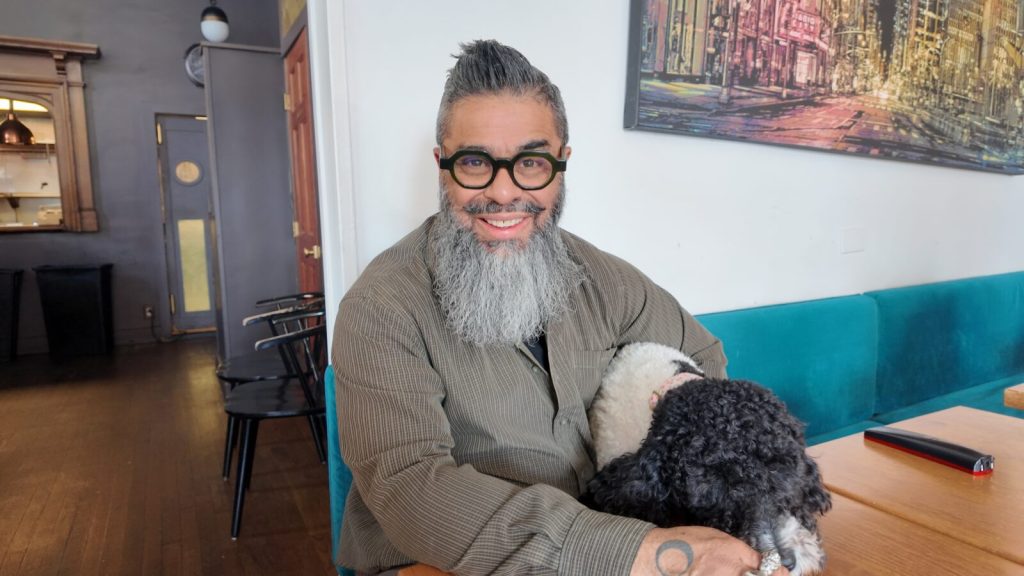
The other, which is what ultimately differentiates FOLK and LORE from my memories of the Talde run in South Slope, is five years in, Kumar is not taking anything for granted. He was in FOLK’s dining room shmoozing with a mother and her young son when I arrived, and throughout our meal he bussed tables, ran food from the kitchen, talked over the seating strategy for the evening with the hostess, and was admirably patient with all the prying, meandering questions my daughter peppered him with when he stopped by for what I assume he thought would be a perfunctory check-in. Kumar is fully baked into the recipes of his restaurants—a good business decision. He’s a ring guy and a watch guy and has tattoos on his hands and a pushbroom salt-and-pepper beard and a mustache waxed at its tips and looks like one-half of a couple on the far side of a bar eyeing you suggestively because he likes your vibe. But his style belies the humble work ethic, warmth, relentless positivity, and boundless creative energy he applies to operating the businesses and writing the menus at both of his restaurants.
Kumar grew up in Mangalore with parents who worked most of their years abroad in Oman. He learned his trade in Basel, Switzerland, working in Hilton Hotels for over 20 years before going into business for himself in the late ’90s, first serving traditional Indian takeout to a community of American and British expats, then developing the style of culturally promiscuous Indian cooking featured at LORE and FOLK. A chance encounter with Greene led to him moving to America and eventually reimagining his restaurant(s) for an American audience.
I had a Bombay pot pie with chunks of chicken tikka masala bathing in rich gravy, served in a cast-iron crock with a puff pastry lid, while my daughter picked at her turmeric-tinted potato latkes topped with wilted oyster mushrooms, caramelized onion, creme fraiche, and caviar, both dishes ideal for a chilly late-spring dinner.
As I walked out of FOLK, past the vinyl sided row houses that wouldn’t look out of place in Yonkers, trailing my kids, I was warmed by a balmy breeze and the sun setting over the Prospect Expressway and the halflife of draft negroni spiked with pineapple liqueur in my system. And for a moment, I couldn’t help but feel that I had made a profound mistake in my life, choosing the chaotic funk of Flatbush over the remote tranquility of this stretch of shade-strewn blocks that is Jayesh Kumar’s dominion, now and for the foreseeable future.
(This interview has been edited and condensed to make me sound like less of an asshole)
Photo by Francisco Hernandez
My first, obvious question is: What watch are you wearing right now?
So I have two watches on. I wear multiple watches.
Amazing.
I always double-wrist. So on my right hand is a Rolex, which I got from my wife for my citizenship last year. It’s a birthyear watch, 1967. On my left, I have a Cartier roadster, which I got a long, long, long time ago in Basel, Switzerland. I actually never wore it because it was not a watch you can wear all the time. So it just re-emerged for watches and wonders this year. They stopped production, but now they got a new version of it. So I was like, oh, this is a good time to wear it.
Do you wear your watches while you’re cooking? I would be so afraid.
Yes. The watches I wear for cooking are very safe watches: steam proof, waterproof, so nothing enters that. The worst thing that you can do with certain watches is wear them when there’s steam.
So you learned how to cook in Switzerland. How and at what point do you apply your childhood knowledge of Indian food to professional restaurant Indian cooking?
I first learned the European style of cooking. So French, Swiss, German is what I learned in Basel, Switzerland, and in hotel school. These are techniques I applied to Indian food. We couldn’t find the Indian food we wanted in Switzerland at the time, so my mother used to send me one recipe a week in a letter, and I’d replicate the recipe at school.
Once I started learning the techniques, the cooking time of two hours in my mother’s recipes went down to 45 minutes, or the cooking time of three hours went down to half an hour. At school, we learned the most important thing is getting the mise-en-place together before you start cooking. The way Indian cooking works is you’re making, say, the curry first and then you’re putting in the meat and the meat has to braise slowly in it. What I learned was you can isolate the elements by marinating the meat and cooking it separately. By the time you’ve made the sauce, it’s only 10 to 15 minutes. Then you can combine them to order. And for me, the final product is much better.
I think it’s fascinating that your vision of Indian cuisine is true to your life experience, more of a natural, intuitive destination that you’ve come to in fusion because you learned your trade in a European country with a lot of global influences.
Yeah. A good example is, let’s say you’re making a Swiss dish. There’s a dish called Zürcher Geschnetzeltes, sliced veal in a mushroom cream sauce. I will never forget this dish because in a restaurant I cooked in, it was made in 10 minutes. And I’m like, “What the hell? How do these guys get this perfection every time they make it?” So what this guy does is he sautes the shallots, and then he sautes his sliced beef in it. As soon as it’s halfway cooked, he takes the beef and puts it on the side, uses a little bit more shallot, sautes the mushrooms, then deglazes with a little white wine. And then he puts in cream and a dollop of butter and gets this creamy sauce, then he returns the meat in its juices into this sauce to cook through, and then he’d serve it on rosti potatoes. I’m like, “This is insane,” and it was done in 10 minutes.
I wish it was cold right now. I’d make that for dinner tonight.
So I try to do the same thing with Indian food. I separate the proteins and the sauces. So the lamb or the goat take a long, long time. But that’s good because then you are cooking the goat meat with garam masala, with a little bit of stock, onions, chili, ginger, garlic, so the goat itself gets all of these flavors and takes off. It’s not gamey anymore. Then you’re making this sauce with that braising liquid, reduced fully, then integrating this meat that is so tender, it’s crazy.
When does the global influence start creeping into your cuisine?
After 14 years of running a traditional Indian restaurant in Basel, I opened a new place and started infusing things. I was very keen because I used to go to Italy every year for truffle season, and I used to look at the risottos, the arancinis, the pastas, all these dishes you can integrate Indian cuisine into. This is where that started forming in my mind. I used to make this risotto with a lamb-shank curry, like a Rogan Josh. So a saffron risotto with a Rogan Josh curry of shank. And the shank was just falling off the bone.
Sounds kind of like ossobuco.
There you go. Exactly. Exactly.
Can you bring that back?
[Laughs.]
What brought you to South Slope?
Daria lived in Kensington. And there was a time when we had gone to this place called Camperdown Elm, and I told Daria, this corner is such an amazing corner. This size of the restaurant is such an amazing size. Not too big. If the rent is cool, actually, we should try to get this restaurant someday. That was in 2019. We were looking at other spots; there was one on Union Street, which didn’t match. There was another one on Dean, which we were in negotiations on. Then COVID happened, so we didn’t sign.
In 2020, we were staying at a farmhouse in Hyde Park, which belonged to Amar’e Stoudemire. Daria worked for Amar’e at that time before she joined Samsung. So Amar’e was in Israel at that time, playing for, I think Maccabi or something. He had told us, it’s going to be very, very bad in Brooklyn. I think you should pack up and go to the farmhouse. So we left to Hyde Park, and we were there for nearly a year on a 350-acre farm. And then we found this place in April 2021. October 21, we signed, and end of that year, we opened.
Photo by Francisco Hernandez
So you’re kind of walking into this new city, you don’t really know the lay of the land, and I’d suggest LORE and FOLK, in terms of their ambition, price point, and level of refinement, are unusual for the neighborhood. Were you aware of that? How has the community received you?
I was basically looking at cheap rent. I was not looking at anything else at the time we made the decision to go forward. Daria said, “If you are good, and I know you are, people are going to come to you. So don’t worry about where the place is.” I had no idea how the lay of the land was. I didn’t know anything. I just knew that I have to make good food, give them good service, and then hopefully, they will understand what I’m trying to do, and they will keep coming back again and again and again.
It was a good time to negotiate because that was COVID and nobody knew what the future looked like. The landlord said, “You know what? At least for the first five years, let’s go on with this one. You’ll have a three-percent raise every year.” And that was okay for me. And even now, I’m paying $7,000-something dollars, after five years, which is absolutely fabulous for that area right now.
The media around us—getting the Bib Gourmand from Michelin was a big deal. That was how we got ourselves established. Now we know how Tuesdays are going to be. We know how Wednesdays are going to be. We know how the holidays are going to be. It was very, very difficult in the beginning, when we started out, but let me tell you one thing: This community—I have to take my hat off to my community, they have given me so much love. It is insane. I’m so humbled and still in awe, just looking at the way LORE happened for us. We are still there after four and a half years, and that is a big deal in a place like this.
When I came in, you were hanging out with the table next to me, then you were clearing tables, and it seems like you cook at your restaurants pretty frequently. What is your approach to hospitality? Is working the floor so directly pragmatism or philosophy?
There are three different parts to this. First is my team should know that I am there for them whenever they need me. They should know this guy is hands-on. They should know that this guy can do any part of this business. I can be behind the bar. I can be in the kitchen. I can be of service whenever they need me.
We also try to staff at minimums. Fridays, I have two people working in the front, two people behind the bar, but Tuesdays, Wednesdays, and when you came in Thursday, I have one behind the bar and one in the front and three in the kitchen with me working as support. That’s the only way we can survive this game, until we know FOLK is established and we have people coming in everyday.
And the third and the most important part is my guests and the community. Our regulars know that I’m going to be around. Being the face of this business, people want to see that the person is there. They come, they know me, they want me to stop by and say hello. They’re the ones who come in all the time and the ones who have been to LORE and they come for a drink at FOLK. It is a connection, and it’s networking. It’s all about people, and they have to feel comfortable and wanted in a place.
Do you have a set weekly schedule or some semblance of one?
I am working every day. Monday we’re closed, but for me it’s a catch up day.
Admin.
Right. I do all my admin and all my buying and all the backend on Mondays. Schedules and all of these things go out on Mondays. Tuesdays through Sundays, I’m here about 9-9:30 in the morning and I leave at around 9:30-10 in the evening. This is what I do, because this is how it should be. You don’t have to be micromanaging things, which I don’t, but I see things which not a lot of people see when they’re working.
Over the past few years, Indian food in New York has arguably become the most interesting and innovative cuisine in the city. It is wildly diverse, all over the casual to fine-dining spectrum, but the real driver of it in my opinion is the movement that started with Adda, which is part of the same group as your neighbor, Masalawala, and this brand of “traditional,” big-flavored, chili and offal, neo-regional Indian cooking. I’d say what you’re doing is progressive but also iterative of an earlier era of Indian cuisine in New York. How do you think about your food in relation to the rest of the scene?
I am very, very happy that things are happening for Indian restaurants in New York. The thing about Indian cuisine is you can’t just think of it as one genre. There are many regions and styles in a giant country. When my mother cooked for us, she made spaghetti Indian-style. She made things which—we had no idea what it was because she lived abroad. But because of the spices and traditional Indian elements, it sort of made sense to us. That’s how Indian went global. So I went to Switzerland, but I was already used to that type of food. The fusion people talk about now has always been that for me, for 50 years.
Photo by Francisco Hernandez
It’s authentic to you because of your experience.
Yes, and every cuisine people think Indian should be is what it is. Same thing with Korean or Chinese, or Mexican. The ingredients you use, if it is fine dining, or if it is a taco place, it all counts. So when I said I’m gonna have Indian-style Indian food that is still recognizably Indian, it should be recognizable. I don’t want people to have to ask my staff, “What is this?” I mean, they still do, but the main thing is they see is a ribeye, or duck confit. They see a lamb rack. They see scallops. They see shrimp, something recognizable that has been given a twist, and that is what for me is the most important part of what I make, because the flavor is what reminds me, and maybe reminds them of something they used to eat or where they’re from. Thirty years ago, I was in this little place in Kerala, and that is what reminds me of this dish. That is what I’m trying to get to.
Coming here and opening my own business, I didn’t want to be in the same boat as everybody else. We’re all operating in the same box, and it’s easy to get comfortable inside that box and try to do the same thing, only a little different. But then you are not innovating yourself. There is so much more to this cuisine. There is so much to explore. You go to the northwest, or northeast, parts of India. You go to Nagaland, the cuisine is totally different. You recognize China. You recognize Bhutan, you recognize the eastern part of the country, which is actually what it’s all about.
And these people move from Nagaland, come down to Mangalore and set up shop there and use the ingredients they get in Mangalore and cook their food. Now, what is the difference? The difference is it is recognizable as the food from Nagaland. But it is recognizable because of the Mangalore ingredients. And that is what I’m trying to do. I don’t want to do the same thing.
We end every interview by asking the chef what the last great dine-in or takeout Brooklyn meal they had was.
I have four places in Brooklyn I go to. The first is a Bangladeshi restaurant on Church and McDonald called Ghoroa.
You went there in a recent video, right? I saw that and added it to the list.
It’s insane! I go there and say, “I want this, I want this, I want this,” and they will take it, put it on a plate, heat it up for me, I’ll have a chai, and I’m just the happiest person. That place is the closest to home for me. I’m getting hungry just talking about it.
Then I go to Terre. It’s the best Italian—Fifth Avenue and Second. Incredible pasta.
There’s Giuseppina’s. I think it’s the brother of the guy from Lucali’s or something, and the pizza is just as good without the wait.
And finally I go to my dear friend Giovanni, Giovanni’s Brooklyn Eats. It’s great comfort food. I opened LORE; he was there on the first day, drinking and eating, supporting, as he does all the neighborhood restaurants in Brooklyn. We do this thing where we go out to each other’s restaurants and eat. We get a crowd together; we’re a support system for each other. He’s a sensation.
The post Open Kitchen: A Conversation With Jayesh Kumar of FOLK and LORE appeared first on BKMAG.
