
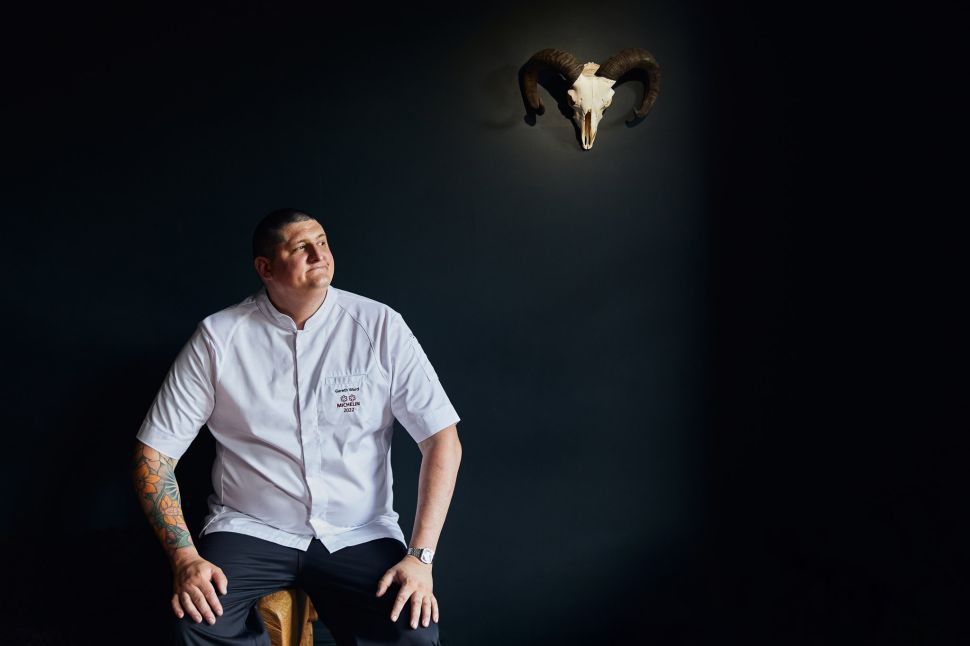
We’re partway through the 28-course tasting menu at Ynyshir, a two-Michelin-starred restaurant near the coast of North Wales, and the background music has started to amp up in speed and volume. Each course arrives at a staccato pace in tempo with the songs, which are being played on vinyl by a live DJ in the open kitchen. Everything is the best possible version of itself: a fatty bite of raw Fuentes blue tuna from Spain and A5 Wagyu from Japan, perfectly crispy Silverhill Farm duck breast in hoisin sauce, tiramisu soaked in Ethiopian coffee. It feels like a very exclusive party, especially when the disco ball eventually illuminates during one of the dessert courses.
“It should be fun,” Gareth Ward, who relaunched Ynyshir in its current form in 2016, tells Observer the next morning. “There’s no point in going out for dinner and it being really serious. I’m not that kind of guy. I want this to be a great experience where we all have fun, including the team. We take what we do very seriously, but we don’t take ourselves seriously. There’s no ego, no pretentiousness. Just a group of people who are absolutely obsessed with doing what we do, and we want to share that.”
Going to Ynyshir exemplifies dining as an experience, rather than just a meal. To get there, we drove five hours from London through winding country lanes. There are approximately three sheep for each person in Wales, and most of them seem to be grazing along these exact roads. The restaurant can be found in a verdant valley not far from the town of Machynlleth, down an even narrower country lane. An enormous T. rex statue greets guests on arrival, a gift to Ward from his pal Ed Sheeran. Most diners stay on the picturesque grounds in one of the 10 bedrooms, as stylish as the rest of the property.
Ward, 45, and his wife, Amelia Eiriksson, designed the spaces together, transforming the 15th-century building, once a country house hotel, into something singular and contemporary. There are black walls throughout the common areas, which Ward notes have “set off a trend of dark restaurants.” Fur coats hang on the walls as décor. There’s a fire pit outside branded with Ynyshir’s name. The chairs in the lounge, where drinks are served before the meal, look like something out of Game of Thrones. It’s all a reflection of Ward’s own predilections.
“It’s not for me—to sit in restaurants with tablecloths and no music and really stuffy service,” he says. “And I love cooking for people, but I’m not doing it for them. I’m doing it for me. I’ve sacrificed 27 years of my life to cooking. And I’ve done that because I’m obsessed with cooking. I’m obsessed with food. This is not a job. It’s a lifestyle. If I’m loving it and if I’m in it 100 percent, there’s a massive chance that you’re going to love it too.”
Becoming a chef wasn’t the inevitable path for Ward. He originally started cooking purely because he needed a job. As a kid growing up in Durham, England, he wanted to be in the fire brigade or the army, but neither materialized. He had no interest in food, but took a job in a local pub, the Seven Stars, to make money. Almost immediately, he fell in love with cooking. “You know when you do something, and you just feel at home?” he says. “This industry attracts a certain kind of human being. We’re like pirates or social rejects. We can’t survive in normal life.”
After working in the pub for a few years, Ward moved on to the much higher-end Hambleton Hall, located a few hours south in Rutland. At the time, he was a picky eater. “One of the chefs made this hare Wellington, which is one of the classic dishes they did,” Ward remembers. “He cut the end off and offered it to me. I was like, ‘No thanks.’ And he was like, ‘You want to be a chef?’ And it was one of the most delicious things I’ve ever eaten. I can still taste it. It was that Ratatouille moment where something switched on in my brain. It became an absolute obsession.”
Ward stayed at Hambleton Hall for five years, working under chef Aaron Patterson. He moved on to Seaham Hall, then Hart’s and then Restaurant Sat Bains, where he became sous chef in 2011. When Ward began looking for his first head chef gig, his search brought him to Ynyshir Hall, a traditional Relais & Châteaux property in Wales. He’d never been to the area. “I remember driving here and being absolutely blown away,” he says. “It was very different then, with manicured lawns, but I couldn’t believe it.”
Although it was a very classic British hotel, the owner, Joan Reen, was interested in hiring a chef who would do something unique. “She wanted somebody to come in and put their stamp on it,” Ward notes. “She was really good at selecting people who had their own personality.” When Reen died a few years later, Ward had the opportunity to take over and transform Ynyshir into his own restaurant, with rooms. He has co-owned the restaurant along with a silent business partner since 2016. It was then that the menu began to expand in length.
“I want to give people an ultimate experience of ingredients and to do that, everything has to be small,” Ward says. He compares it to the Japanese style of nigiri—a perfect bite of fish, rice and wasabi. “I thought, ‘We can do that with our menu without making nigiri,’” he says. “I can give you one or two mouthfuls of intense flavor with incredible ingredients over and over again. I started making dishes smaller, and the menu grew. One of the worst things is when you finish, you’re still hungry. I’d rather you leave and feel overly full than be fucking starving.”
He adds of the menu, “It’s not just us chucking a load of food on plates. It’s all in sequence. Things match. Things go after the other. It’s choreographed.”
Importing ingredients from around the world requires a high level of precision. Sometimes, the team has to plan six months in advance to ensure everything is available when they want. The Silverhill Farm ducks come from Ireland, where they are raised listening to jazz music. Ward dry-ages them for a week in a custom salt aging chamber, and two are cooked each night for service. The tuna comes in once a week from Spain. The A5 Wagyu comes in from Japan in portions. About eight months ago, Ward discovered that the female cows have more tender meat, with a buttery flavor. He now only serves cuts from female cows.
“I fell into it by accident because one of my suppliers sent me my beef for the month, and two pieces were completely different to the rest,” Ward explains. “He couldn’t figure out why. I said, ‘Well, it’s amazing. We need to find out what it is. So when I went to Japan, I went to visit the Wagyu farm, and I got to talking to the farmer. He went, ‘I think it’s female.’”
Sourcing that way is tough. “There are only two farms in Japan that actually kill 100 percent female beef,” Ward says. “The guy in Japan who selects my beef has to go to the abattoir and find female meat and buy it for me. So at the moment it’s a very difficult process.”
Four years ago, Ward visited Japan for the first time. The trip immensely influenced his cooking. He now considers Japan to be the best place for ingredients in the world. He’s been there eight times since, and sources many products from around the country, including mirin, soy sauce and melons.
“The care, love, passion and dedication they show for things is unrivaled,” he says. “Every process is done with such love. When you’re in Japan and you’re watching one person on their hands and knees with no shoes and socks on a mat, hand-selecting fruit and smelling it and feeling it and weighing it and checking for any blemishes, you really see the love.”
Although Japanese ingredients and cooking techniques are apparent on Ynyshir’s menu, particularly in the first half of the dining experience, Ward is clear that he is not cooking Japanese food. “I’ve never worked in a Japanese kitchen,” he says. “I respect it hugely, and I love it. It’s my favorite food in the world. All I’m doing is just taking my experiences of being in that country and eating that food. I’m bringing the ingredients back, and I’m doing it my own way.”
The menu I ate in early June opened with a series of raw fish dishes, including Japanese madai, Japanese hamachi and bluefin tuna. Each was seasoned with a particular flavor, including wasabi oil and Nuvo olive oil made from first harvest oils. As cooked dishes began to appear, the flavor broadened: barbecued lobster with punchy Thai nam jim seasoning, an elevated take on Singapore chili crab, French squab in Cantonese char siu style. There are hints of Wales, including birch syrup made on-site and dairy from down the road, but Ward wants to showcase the best of the entire world.
“I used to use Welsh Wagyu, which doesn’t really exist,” Ward says. “It started off really good, and then it declined. The more popular it got, the harder it got to keep its consistency. I decided to stop using it. I thought, ‘If I’m going to use Wagyu, why not use Japanese?’ Because it’s the best beef and the consistency is unbelievable.”
He adds, “I can go and buy limes from the grocery store. But why would I when I can buy the most incredible limes from the other side of the world? The best limes I ever tasted in my life come from Thailand, and they’re just fucking delicious. It is a dream lime. If you say, ‘What does the lime taste like?’ Well, it tastes like that.”
Ward is in the kitchen at Ynyshir for every service, four nights a week. The restaurant’s DJ, Jacob Kelly, is also there for every service—a full-time member of staff just like the servers and chefs. Ward believes that everything in the restaurant should have a soul and meaning, from the crockery and silverware (made by an on-site blacksmith) to the music. It was not long after opening Ynyshir that he had the idea to acquire vinyl DJ decks and hire someone to curate a nightly playlist of mostly house music. Kelly is the second DJ to have worked at Ynyshir; it’s all part of the vibe Ward wants to cultivate for himself and his staff.
“He starts off really atmospheric, around 5 p.m. before the guests are even in the dining room,” Ward says. “And then it just builds and builds and builds. The music is for us; it’s not for you. It keeps us going. We can lock into the music, and it becomes the driving force in the kitchen. I always say, ‘If you don’t like the music, fine. It’s not for you.’”
It’s the same with the food. Ward would never serve anything he wouldn’t eat. In fact, he won’t serve anything he doesn’t believe in completely. “I want to eat everything that comes off my pass,” he says. “Why do you think I’m so big?” He pauses, gesturing toward me. “You love your own art, your own music, your fashion. You prefer your coffee a certain way. We all love different things, so I can’t please everybody, right? All I can do is please myself. That’s what feels honest.”
As Ynyshir approaches its 10th anniversary, Ward has a lot of ideas for how it can grow. There could be a more casual pub added to the grounds, as well as more artisans like his blacksmith. In 2022, Ynyshir became the first restaurant in Wales to earn two Michelin stars. Three stars, he hopes, are on the horizon. All of Ward’s Michelin plaques are nailed to a tree outside, but he has other plans for the three-star plaque. “When I get three stars, I’m going to put it in the T. rex’s mouth,” he confirms.
He adds, “I thought we had three stars this year, but I think a few things might have messed us up. This restaurant is a three-star restaurant. I’m not being arrogant. It’s as simple as that. But we have to keep doing what we do. We’re better this year than we were last year. We haven’t gone backward. We’ve only gone forward.”
