
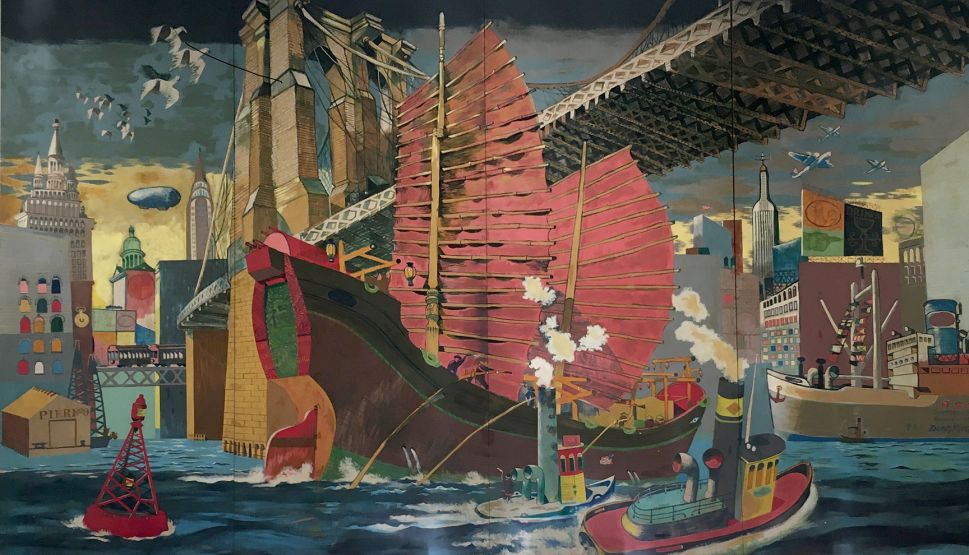
Earlier this year, the Museum of Chinese in America (MOCA) in New York unveiled a 10-foot by 15-foot mural depicting the Brooklyn Bridge rising over the Manhattan skyline with a traditional Chinese junk boat passing beneath it. That painting, East Meets West, was made in 1951 by Dong Kingman—one of the most significant American watercolorists of the 20th Century—for the Lingnan Restaurant on the Upper West Side. When the restaurant closed in 1980, the mural was damaged during removal and abandoned among construction debris. It survived because Roslyn Gamiel, a former student of Kingman’s at Hunter College and a regular at the restaurant, recognized what she was looking at and refused to let it be thrown away.
One of Gamiel’s conditions for donating East Meets West was that whatever institution held it had to display it, and the work spent years on view at the Brooklyn Public Library. But when the library underwent renovations in 2022, it took down the mural without plans to reinstall it. Gamiel and her family began looking for a new home, and when they consulted with Elaine Kingman, the artist’s widow, about where the work should go, she recommended MOCA.
“It’s such a monumental work by such an important American artist that we felt we had to take it, and that meant committing to put it on display,” Herb Tam, the museum’s chief curator and senior director of programs, told Observer. East Meets West arrived at MOCA at a transitional moment for the institution, which acquired its building at 215 Centre Street, on the border of Chinatown and Soho, in 2024, and is now mid-renovation, working out how best to use the five floors it does not yet occupy.
The museum was founded as the Center for Community Studies (or the New York Chinatown History Project) in 1980 by Jack Tchen and Charlie Lai, not as a philanthropic project with grand institutional backing, but as part of a community’s effort to save its own history in a period of transition. Tchen and Lai had watched a generation of Chinatown immigrants retire, close their businesses or move away, and rather than pass anything down, “a lot of people would just shut down and close,” according to MOCA president Michael Lee. Signage, personal effects and business records were being thrown out along with everything else, and the founders started collecting what they could.
Two years later, they mounted their first exhibition on Chinese hand laundries, at a public library. Hand laundries were the first real economic engine of Chinatown—a way to bring money into the community before restaurants took over that role. “Chinese Americans in 1982 had never seen any kind of exhibition where their life was put on show like that,” Lee said. “People talked about how grandmothers would walk up the library stairs with their canes and just see their lives and their contributions to the country being recognized.”
There were initially no plans to turn the Center for Community Studies into a permanent museum. Rather, the plan was to gather materials and eventually hand everything over to a larger institution such as the New York Historical Society or the Museum of the City of New York. The organization set up meetings with those institutions, but neither wanted what had been collected. “Nobody wanted to tell these stories because they didn’t think they were part of a bigger story,” Tam said. “I think that’s when the mentality of the institution changed from being a temporary project to something they wanted to establish as a permanent institution for that neighborhood.”
In 1986, the Center for Community Studies secured permanent space in the old PS23 schoolhouse at 70 Mulberry Street, alongside other local organizations. A rotating exhibition schedule took shape, along with a long-running permanent show called “Where Is Home?” And then for a long stretch after that, the collection simply grew. According to Tam, for several decades, the answer to any donation from the community was almost always yes: “People who lived in the neighborhood began to think of MOCA as a place where they could bring belongings of their relatives or businesses they’d been involved with, but whether there was enough space to care for everything and enough staff to document it all started to become a real concern.”
Today, MOCA holds more than 80,000 cataloged artifacts, and by Tam’s reckoning, the real number is considerably higher. Some 30,000 of those have been digitized and made keyword searchable through the museum’s online database, including oral histories in English, Toishanese, Cantonese and Mandarin dating back to the 1980s. And the collection keeps revealing new surprises.
A community member once salvaged decades of photo negatives shot by a local newspaper photographer who documented Chinatown almost daily from 1975 to 1985. “We have a picture of Chinatown every day for a decade,” Lee said, adding that a National Historical Publications and Records Commission grant is funding the slow work of cataloging and digitizing those images. A visiting dress designer, looking through the museum’s textile holdings, told staff they were sitting on one of the country’s most significant dress collections, tied to specific, prominent families whose stories the museum had not yet researched. And there are sculptures created by Chinese Americans who were detained during the Clinton administration. “A boat carrying a number of undocumented Chinese immigrants from China—it became known as the Golden Venture—came to New York and immigration officials wouldn’t let it dock,” explained Lee. “One of the detainees was an artist, and to pass the time, she taught all the other detainees how to create sculptures out of tissue paper and whatever materials they could get their hands on… It’s more common now to detain immigrants, but at the time it was shocking, and the U.S. government held them for a long while. You can see exactly what they did to pass the time.”
Then there is the story of the Moy family. A historian researching the museum’s holdings labeled a photograph of a gravesite, and a relative of the person buried there found the photo on MOCA’s website and reached out. That connection led to a book, The Moys of New York and Shanghai: One Family’s Extraordinary Journey Through War and Revolution, published in March 2026, chronicling a family whose history includes a member who worked as a radio host for Nazi Germany. “It’s really important that any item we bring into the collection does have these living narratives behind it,” Lee said, “so we can show the broad arc of how different Chinese people lived in this country.”
MOCA’s acquisition of a building in 2024 set off what the museum calls MOCA Rising. “We’re renovating the full building, but what’s opening to the public is the first three floors,” board of trustees member Minyi Su told Observer. “That project is kicking off in the fall, and then there’s an even longer-term project to do a more complete renovation.” McKinsey & Company is currently helping define how space gets divided among permanent exhibitions, rotating shows, community events and education. Su stressed, however, that she and MOCA advisory board member Jessica Wang aren’t waiting on the realization of future plans to position the museum as urgently needed in the present moment.
The expansion is happening as the history MOCA holds became, in a very literal sense, current events. In June, the Supreme Court reaffirmed that the Citizenship Clause guarantees citizenship to anyone born on U.S. soil, a constitutional protection that exists because of a case brought by a Chinese American man who was barred from re-entering the country he had been born in. “His grandkids didn’t even know he was part of that case,” Lee said.
During the COVID-19 pandemic, as anti-Asian violence and rhetoric spread, the museum responded by mounting an exhibition called “Responses,” collecting stories of harm and of mutual aid in real time and pairing them with a long timeline of anti-Asian policy and violence stretching back generations. “What we wanted to do was create a safe space for people to reflect and to share,” Tam said.
Alongside its physical expansion, MOCA has filled its board with people whose instinct is to meet audiences where they already are. Wang, who has a background in fashion, digital media and experiential events, said she was drawn to the museum because “there are a lot of people who may not necessarily think of themselves as museum-goers but care deeply about identity, culture and community.” Su, who joined around the same time, described wanting a “home for all different kinds of Chinese Americans, in terms of what generation they are, whether they just arrived as immigrants or have been here for five or six generations, whatever dialects they spoke or speak in their family.”
The museum has, in recent years, enacted a multi-pronged social strategy. “We’ve brought in a lot of incredible influencers and cultural leaders who have been sharing about the museum organically, because they loved the experience,” Wang said, though she was careful to frame the goal in terms of relevance rather than reinvention. “The goal isn’t to make MOCA trendy but to give the museum a new platform to connect with people and help people understand why this matters.”
MOCA’s more Instagrammable moments are, alongside initiatives like an annual program with the nearby P.S. 124 Yung Wing School and the museum’s searchable database of artifacts, simply another way to get people engaging with the museum’s massive collection. “We did a story about a menu from a New York Chinatown restaurant from probably 60 or 70 years ago, and young people found that really interesting,” Su said, describing the museum’s approach to social storytelling as taking past material and “packaging it in a more digestible, entertaining way for the new generation” without losing what made it worth preserving in the first place. She pointed to growing engagement among Gen Z audiences both online and at events as evidence the approach is working.
Underlying it all is the argument that Chinese American history is not a niche interest. It is an immigration story, a civil rights story, a labor story and a story about who gets to be American and under what conditions—topics that will resonate with many people in our current moment. “We want to be the institution, nationally, that people can come to and have our history recognized,” Lee said. “Chinese Americans are more than one story—there’s such a diversity of different pathways people took to get here.”
“So much of the Chinese American experience has either been simplified or stereotyped or left out of the broader American story,” Su said. “MOCA gives us the space where our history can be told with depth and humanity. And it bridges generations—it honors the sacrifices the earlier immigrants made while also creating space for us to tell a more modern story through identity and belonging.”
