
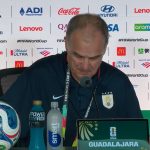
Uruguay’s 2026 campaign collapsed amid tactical disagreements, costly mistakes and an apparent disconnect between Marcelo Bielsa and his players.
For decades, Uruguay built its international reputation on resilience, competitive spirit and an ability to rise when expectations were low. At the 2026 World Cup, however, La Celeste looked like a shadow of its former self.
Eliminated in the group stage after draws against Saudi Arabia and Cape Verde and a decisive defeat to Spain, Uruguay left the tournament without a single victory. It marked the fourth time in the nation’s history that it failed to win a match at a World Cup and the second consecutive edition in which the South American side was sent home after the opening round.
The disappointing results were only part of the story. Uruguay struggled to impose any recognizable identity throughout the tournament, producing flashes of promising football only during the opening stages against Spain before gradually losing confidence, cohesion and composure.
The Muslera Decision That Backfired
One of Marcelo Bielsa’s most debated choices was the decision to recall veteran goalkeeper Fernando Muslera to the national team after four years away and immediately hand him the starting role.
The gamble proved costly.
Muslera committed decisive mistakes in every group-stage match, and his error against Spain became symbolic of Uruguay’s failed campaign. With the score still tied at 0-0, a relatively harmless effort from Álex Baena slipped through the goalkeeper’s hands, giving Spain the lead shortly before halftime. Had Uruguay preserved the draw, they would have finished second in the group and advanced to the knockout stage.
According to Bielsa, the goalkeeper himself requested to be substituted during the break.
“It wasn’t my decision to replace him, it was his request,” Bielsa explained after the match.
Muslera later addressed the media with visible emotion.
“I have never been someone who hides. I face things head-on,” the veteran goalkeeper said.
“I never imagined I could suffer so much because of this sport, especially after all the work I have put into it. I apologized to my teammates in the dressing room and I also apologize to all Uruguayans, even if now it is too late.”
Still, reducing Uruguay’s failure to a goalkeeping issue would oversimplify a much deeper problem.
A Team That Stopped Following Its Coach
The biggest concern surrounding Uruguay appeared to be the deteriorating relationship between Bielsa and his squad.
Several reports from inside the camp suggested that players and coaching staff disagreed over the tactical approach for the decisive match against Spain. Senior members of the team reportedly favored a more cautious strategy, defending deep and relying on counterattacks. Bielsa remained faithful to his philosophy of aggressive pressing, individual duels and high defensive lines.
The result was an uncomfortable compromise.
At times Uruguay tried to press high, while moments later retreating into their own half with what resembled a six-man defensive line. The lack of clarity was evident, and once Spain scored, the team seemed to lose all structure.
Uruguay managed only one shot on target after falling behind and increasingly resorted to frustration-fueled challenges, culminating in Agustín Canobbio’s dismissal.
Another decision that raised eyebrows was Bielsa’s choice to substitute captain Federico Valverde during the second half. The Real Madrid midfielder endured a disappointing tournament, but in a squad lacking creativity and leadership, taking off its most influential player appeared to highlight the growing distance between coach and dressing room.
Bielsa’s Rare Admission of Failure
Marcelo Bielsa has long been admired for his revolutionary ideas and uncompromising principles, but this World Cup may represent one of the few occasions in his career where those principles failed to resonate with his players.
The Argentine manager openly acknowledged that his three-year tenure cannot be considered a success.
“I leave nothing behind for Uruguayan football,” Bielsa admitted.
“Any theoretical contribution after three years of work has no real value if results are not achieved. I have left no trace.”
The tournament also featured several episodes that reinforced the sense of growing tension around the coach. Bielsa sparked discussion by looking down during FIFA’s official photo sessions, explaining simply:
“I am not an actor.”
He also drew attention for a remarkably brief media appearance consisting of only six answers in less than forty seconds and publicly criticized FIFA over hydration break policies.
An Unfinished Project
Uruguay undoubtedly faces limitations in terms of technical depth compared with previous generations. The decline of established stars and the absence of emerging leaders were evident throughout the competition.
Yet Bielsa was hired precisely because of his ability to maximize available talent and elevate teams beyond their perceived ceiling.
This time, the formula never clicked.
Instead of inspiring another chapter in Uruguay’s proud footballing tradition, Bielsa’s World Cup became a story of tactical uncertainty, fractured communication and missed opportunities. For a coach famous for transforming players and changing cultures, perhaps the harshest verdict is that he was unable to convince his own squad to fully believe in his vision.
Whether Bielsa remains in charge or not, Uruguay will now have to rebuild from one of the most disappointing World Cup performances in its modern history.
L’articolo Bielsa’s Uruguay Ends in Disarray: Muslera Gamble, Dressing Room Tensions and a World Cup to Forget (VIDEO) proviene da Soccer Made In Italy.
