
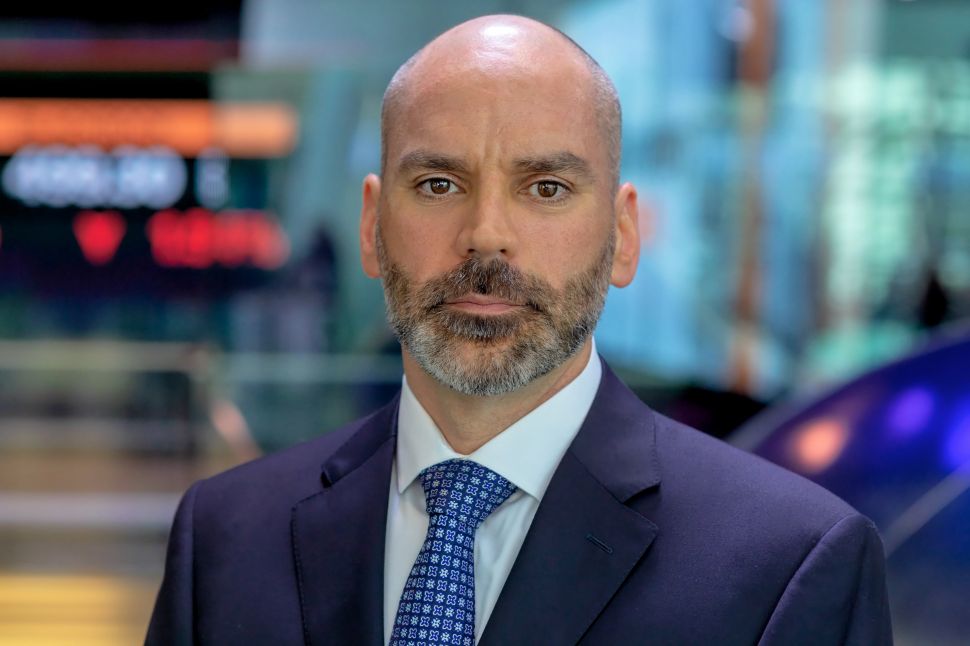
Bloomberg’s chief technology officer has, by his own admission, a job that is half about building the future and half about stopping the future’s more embarrassing impulses from getting anywhere near production. “Half my job is keeping out nonsense from the company,” Shawn Edwards tells Observer, and he is not entirely joking. The nonsense he’s referring to is the tidal wave of generative-A.I. hype that has swept through every boardroom with a Bloomberg terminal. His job is finding the narrow cross-section between what his engineers can dream up and what the people who actually trade bonds, screen credit and prep for earnings calls are desperately trying to get done—not what they’re doing today, but what they’re actually trying to achieve. In Edwards’ worldview, that distinction is the organizing principle behind ASKB, the conversational, agentic A.I. system Bloomberg has built directly into the terminal.
Ask Edwards for a use case, and he describes the old way of doing things. “Before ASKB, a user would have to go to different places in the Bloomberg terminal to look at company fundamentals, to look at what the street estimates are, to look at various performance measures, company KPIs, and a different place to look at print, peer analysis and alternative data for that quarter’s performance—reading lots of news about the company and invariably reading lots and lots of company documents and sell-side research.” Edwards pauses. “And then they would have to synthesize all this information.”
As of February, Bloomberg users can ask the system (ASKB) to synthesize information. “It knows where to fetch and knows where to find all this information and gives you a quite detailed analysis for you to be prepared.”
The machine does not replace the analyst, and Edwards is careful, almost insistent, on this point. “ASKB doesn’t do the entire job for the analyst, but it does 80 percent of the work of gathering and synthesizing this information. And it frees them up to do the value-added thinking—really deciding where they really dig in.” The workflows differ by desk. For equity analysts, it’s event preparation and thesis monitoring. For credit analysts, it’s liquidity analysis and bond screening. The common thread is a research problem.
Trust Isn’t a Feature
If there is a single obsession running through Edwards’ account of the last several years, it’s the reliability of an engineering discipline bolted onto a technology that was never built for finance in the first place.
“A big focus, essentially a focus for the last couple of years on my team, along with our core engineering team, has been how to build A.I. that’s trustworthy for our customers to make mission-critical decisions,” he says. Among the principles that went into developing ASKB was the refusal to let the model speak for itself. “We never want it to generate an answer from its world knowledge,” Edwards explains. Rather, ASKB is guided by and grounded in Bloomberg’s decades of proprietary data, risk analytics and pricing generators—what Edwards calls “sources of truth.”
Getting there means building validators into every step of the process—some checking facts in real time (“you didn’t make up a fact, I can check that… you summarized, and I can look at all the facts and compare the two”), others catching more subtle failures, like an inverted sentiment read. Layered on top of that is a continuous evaluation framework, “autonomous and manual evaluations to verify that we are actually continuing, nothing has drifted, and nothing is going wrong with our system.”
The last layer is transparency. ASKB points users to the source material—the paragraphs, out of millions of documents, that yielded the insight. It tells users the query that did it. It shares the analytic call that it made. Edwards is blunt about how underappreciated this is from the outside. “They’re underestimating this totality of these various layers that have to work in conjunction to get something that’s trustworthy,” Edwards says, of the handful of clients that have tried to replicate what Bloomberg does with off-the-shelf A.I. models. “It is not easy. It’s actually very hard to steer A.I. to do it. It wants to be very helpful, and sometimes it’s unhelpful.”
Part of the difficulty lies below the model, in the unglamorous work of making data sources speak to each other. “How do you link data? How do you rationalize all these different sources of information and rationalize a data model that you can join across disparate data sources?” Crucially, Edwards argues that the people steering that work can’t just be A.I. engineers. “Domain experts are increasingly building our systems. They are the ones helping guide the A.I.—who say, ‘No, you’re getting this wrong.’”
Even the CTO Has a Learning Curve
For all the engineering rigor, Edwards concedes something surprisingly human. The tools are harder to use than anyone initially expected—himself included. “There was a lot of expectation in the beginning that it’s just so natural to use, to have a conversation,” he says. “But I think we all learned that, actually, there’s a learning curve. You have to put energy and effort into learning how to be a good user of these tools, and the more you put in, the more you get out. That was maybe a little surprising from the get-go.”
Bloomberg is building toward more personalization to soften that curve, letting users tell the system their preferences, their coverage universe, their habits, so that “over time the system does get smarter on how the system will react to your questions.” But Edwards is candid that this is the early innings, and that it raises a genuinely unresolved question in the A.I. industry of how much memory is too much. “There’s a lot of research and lots of tools coming out about memory—how to compress memory, how to use memory, how much of the past interactions do you want to use? Right now, we are very strict about not keeping certain information, so it’s kind of a balancing act.”
Bloomberg’s current CEO, Vlad Kliatchko, started the same year Edwards did, and the two rose through engineering together—a detail Edwards offers as evidence of a company that you either “really get and you stay for a long time, or you leave pretty quickly.”
The culture traces to Michael Bloomberg’s open, deliberately flat working environment, where “anyone can come up with a big idea.” Edwards describes his own contribution as protecting and scaling that instinct, engineering the conditions for cross-functional collisions between a technologist, someone with an art degree, a former portfolio manager, and an operations person, all at the same whiteboard. Building ASKB required tearing up that org chart, at least temporarily. Traditional Bloomberg products were built by discrete teams owning discrete functions, with UX partners designing individual screens. An A.I. system that reaches across every domain in the terminal doesn’t fit that model. “The surface area of ASKB and how it works is different from how we build other systems,” Edwards says. “How you work together, how you build this, is completely different… applying our old structures to this new way of product build just didn’t work. We had to change our thinking.”
Hiring for the Ability to Explain
Asked what he looks for in the people he hires, Edwards doesn’t mention credentials. He recruits for communication—the ability to take a complex idea and explain it at multiple levels, as a physicist might to a child, a college student or a PhD student. This requires the capacity to listen and be flexible with your own ideas, especially inside cross-functional teams where the value often isn’t the new idea itself but the discipline it forces. “There’s some research that says cross-functional teams work better with a diversity of backgrounds, not necessarily because there are just new ideas, but because it makes each player work harder at expressing their ideas, and they therefore think about the problem better.”
As for why talent wants to work at Bloomberg in the first place, Edwards points to the sheer breadth of the data—weather data feeding commodity models, document analytics powering research, real-time streaming pricing, because “finance is the world” and “many, many different aspects of the world affect finance.” Edwards also notes Bloomberg’s speed of impact. “You can build a feature or a product or a capability and actually go see clients using it, talk to them, get feedback from them. That’s thrilling.”
Pressed on what’s shaped his own thinking, Edwards cites a history of Bell Labs and its cross-functional glory days—unsurprising, given his fixation on collision-prone teams. Less expected is his other pick: Hermann Hesse’s Steppenwolf, a novel that taught him that people box themselves into a limited view of who they are, when in fact “we can take different forms and use different parts of our personalities and our minds to grow, and we can pull the different capabilities out at one time.” His career has advanced almost exclusively through periods of self-imposed discomfort. “Uncomfortable challenges,” he calls them.
What comes next for A.I. at Bloomberg? Edwards responds with something close to wonder. “We’re just scratching the surface of what generative A.I. and our approach are going to do,” he says. “There’s so much more that we have in our vision of what we can achieve. This technology has allowed us to dream bigger and tackle the problems we had the dreams for but just couldn’t build. Now we’re able to build it.”
