
When restaurateur Steve Antonatos found out the city was planning to lock delivery trucks out of Midtown blocks — for hours at a stretch, on eight separate days during World Cup matches — the warning came not from a city official or street sign, but from his Budweiser distributor.
The beer company had sent emails to their customers informing them that deliveries needed to be rescheduled due to the city Department of Transportation’s (DOT) restrictions on trucks during game days, Antonatos said. When The City Reporter stopped by his restaurant, Galaxy Diner, to ask about the restrictions, he said it was the first time anyone had approached him in person about them.
With area World Cup matches set to begin this Saturday, the DOT will ban trucks from making deliveries across a wide swath of Midtown — from the Hudson River to the East River, between 30th and 60th streets — for hours at a time, on eight match days running through July 19.
Truck drivers make deliveries in Midtown on Thursday. Credit: Carol Chen/The City Reporter
The restrictions start six hours before every game at MetLife Stadium in New Jersey and lift three hours after games end. On some days, the ban will stretch 11 hours or longer. On June 22, for example, trucks are shut out of Midtown blocks from 2 p.m. to 1 a.m.
The pause will affect one of the densest delivery corridors in the country. New Yorkers received roughly 2.5 million packages a day citywide in 2024, up from about 1.8 million before the pandemic, and nearly 90% of the city’s goods move by truck, according to a New York City Department of Transportation spokesperson. Inside the restricted zone in East Midtown, large box trucks handle 64% of parcel deliveries, according to the U.S. Department of Transportation.
DOT commissioner Mike Flynn said at a press conference last Thursday that the overall goal of the restrictions aimed at “the most intensive match day transportation activity focused in a defined area in Midtown,” thus “reducing impacts across the city.”
City officials have promised the restrictions would come with an aggressive outreach push — door-knocking, emails, multilingual flyers.
But interviews with a dozen business owners and managers in the restricted zone found that almost none had heard about these rules from the city. Several owners only heard about the rule changes from The City Reporter or local news on television.
Even the NYC Hospitality Alliance, the city’s largest restaurant and bar group, was kept in the dark until the DOT announced the restrictions. “We basically learned about it in real time,” Andrew Rigie, the executive director of the Alliance told The City Reporter.
He called the DOT’s rollout “extraordinarily frustrating,” noting the city has known the World Cup was coming for years, yet gave small businesses less than two weeks’ notice of the disruptions.
“The fact that they haven’t informed anybody — it’s disgusting,” said Pedro Santana, who manages Manhattan Plaza Winery in Times Square. He had asked to take a picture of the official flyer, shown to him by The City Reporter, so he could call his suppliers.
“Nobody emailed me,” Peter Johns, the manager of Big Apple Market near the Port Authority Bus Terminal, said when he learned about the restrictions on the news.
Rob Byrnes, president of the East Midtown Partnership, said the city did not consult his business improvement district before announcing the plan and that printed materials he could hand to merchants only began arriving this week, days before the first closure.
Workers make a delivery in Times Square. Credit: Carol Chen/The City Reporter
“The city did not communicate with us before making the announcement,” Byrnes said, though he credited the city with providing “plenty of information to share with our businesses” since the announcement.
The task of informing every small business is a daunting one, according to Byrnes. His district covers roughly 800 storefronts, and he only has two staff members.
“There’s no way I’m going to hit more than 50 or 60 before we get into it,” he said, adding that he’d be relying on his group’s security guard to drop flyers door to door. Still, he is sympathetic to the DOT’s predicament: “I think they’re doing what they can.”
Perishable Goods
For the restaurant industry, the traffic restrictions are likely to be especially disruptive. Rigie pointed out that most restaurants and bars cannot stockpile their way around the closures.
“We’re receiving multiple deliveries, sometimes every day, of perishable goods,” that would lose their freshness in storage, he said.
The Alliance has asked the city to add perishable food and beverage deliveries for bars and restaurants to its list of exempt “essential” goods. The industry was deemed essential during the pandemic, Rigie noted. As of this week, he said, the city had not granted the request.
Jeremy Merrin, who owns Havana Central on West 46th Street inside the Times Square zone, learned of the restrictions the same week the public did — and so did his suppliers.
“It took us all by surprise, and I deal with some of the biggest vendors,” he said, including Sysco and Dairyland. “They had no idea.”
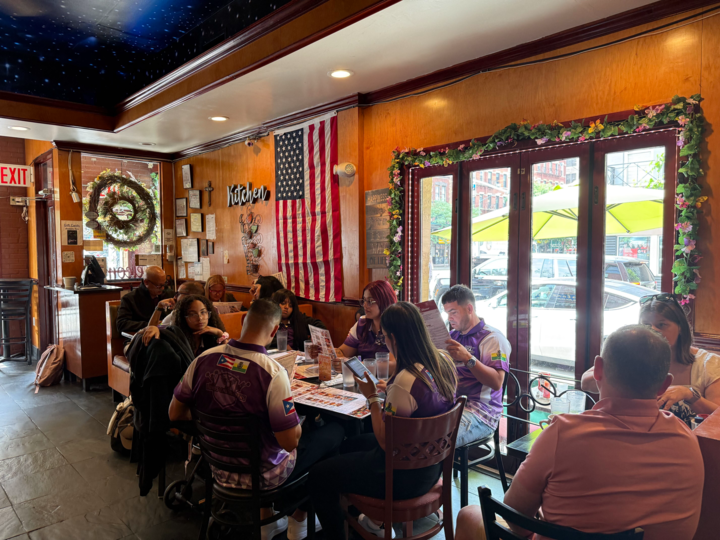
People eat at Havana Central in Times Square on Thursday. Credit: Carol Chen/The City Reporter
Havana Central normally receives perishables three or four times a week, and the World Cup crowds mean it will need even more. To work around the restrictions, Merrin expects larger, less frequent orders and deliveries at odd hours, when no one is normally on the clock to shelve and prep them, which will lead to inevitable overtime work for his employees.
The vans and cargo bikes the city still allows are not a practical substitute, Merrin said: “These are big boxes. There’s a lot of them. You need a truck. You need refrigeration.”
Amidst the scramble to welcome visitors, businesses are questioning whether the promised World Cup windfall will materialize at all. As the tournament kicked off, the much anticipated economic boost had yet to show up for many businesses. Burga, the souvenir wholesaler and a self-described soccer fan, said the spike of traffic he counted on to sell to his customers has not appeared. “So far we see no action,” he said. “No uptick.”
At Poseidon Bakery, a 103-year-old Hell’s Kitchen institution of Greek baked goods, owner Paul Fable said he’ll plan around the new restrictions the way he plans around everything else.
“What can I do?” he said. “They set the schedule. I just know: Okay, if I need certain things, I better take a good look and work it out.”
It is, he shrugged, the life of a business owner in the big city.
Our nonprofit newsroom relies on donations from readers to sustain our local reporting and keep it free for all New Yorkers. Donate to THE CITY today.
The post City to Restrict Midtown Deliveries During the World Cup. That’s News to Local Businesses. appeared first on The City Reporter.
