
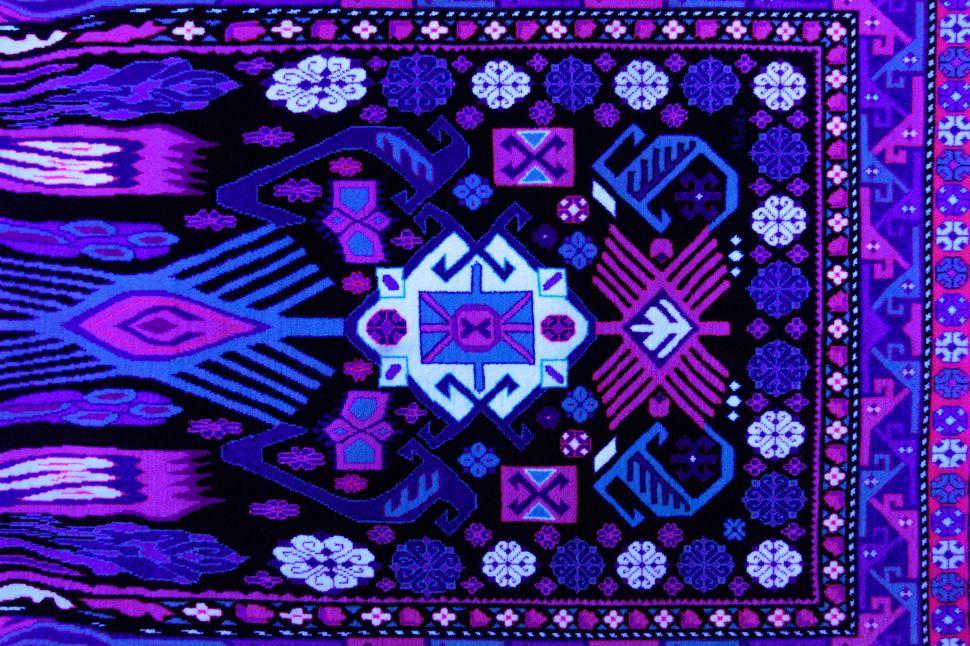
Azerbaijan seldom registers on the art world’s map; for many, it remains shrouded in mystery, a place whose traditions and symbologies have not yet been colonized by the collective imagination. Yet with the opening of this year’s Venice Biennale, the image it wanted to project with its national pavilion exhibition, “The Attention,” was not just one of a country still tied to centuries-old craft traditions but also as a hub of technological and digital innovation. Installed across seven interconnected rooms at Campo della Tana, near the Arsenale, the works of artist Faig Ahmed transform the historic rope-making complex into an immersive environment that reimagines the traditional Azerbaijani carpet as a coded surface bridging craft, metaphysics and computational logic.
Azerbaijan is currently trying to move its economy beyond oil and gas by developing digital and A.I. infrastructure, supporting startups and space technology and establishing clear innovation policies. Its Digital Economy Development Strategy for 2026-2029 lays out a plan for increasing the sector’s share of GDP and expanding the use of technology across the economy, with 51 initiatives focused on human capital, innovation, business digitization and advanced technologies, including A.I. and blockchain.
National pavilions often reveal interesting things about the future a country envisions and seeks to create through its contemporary artists. In “The Attention,” Ahmed has transformed the carpet into a total organism—something that breathes, collapses, expands and reacts to the viewer. In conversation with Observer, he described the traditional carpet as a form of technology that has accompanied human civilization, an early form of cultural coding that developed a language through making and fibers, in relation to a place. “The carpet in this space guides the viewer, just as it guided our ancestors for thousands of years, along a path that has led humanity toward the technologies and knowledge we have today. It is a single carpet that covers the entire pavilion, where the viewer can walk, observe, sit, and even sleep.” The carpet, in his hands, is an embodiment of ancient and living ritual, ancestral knowledge reactivated in contemporary making.
The exhibition centers on the growing gap and tension between the domains of art and science, which have each developed into vast systems with their own institutions, structures and centers of knowledge, despite coming from the same fundamental source: the connection between the human mind and consciousness with the cosmic order.
Ahmed has long been deeply interested in understanding how we shape it and structure our reality, particularly through physics and biology. “The nature of consciousness remains one of the most closed and incomprehensible subjects in science, as it is almost impossible to measure its nature using known scientific instruments and methods,” he reflects. “I see great potential for art within this question, because I believe that only through an interdisciplinary approach can we move closer toward understanding the nature of consciousness.”
The exhibition pamphlet cites as a reference the verses of the Azerbaijani poet Nasimi (d. c. 1417), who introduces the idea of alphabetical letters and numbers functioning as the fundamental building blocks of humanity and the universe. Emerging in the late medieval period, Hurufism envisioned a universe in which letters, signs and forms carry meaning, where the universe itself acts as a coded structure, a text to be read attentively, and attention is a primary path to knowledge.
Drawing on this prescient ancestral wisdom, the exhibition highlights the parallels between the discoveries of modern science, particularly in quantum physics and the way the creative process translates both the inner world and the mysteries of the cosmos. Science and art each use alphanumeric expressions and symbolic code to reveal phenomena that are not immediately apparent and often contradict intuitive logic, reassembling the waves of the subconscious.
Throughout the exhibition, Ahmed brings together Azerbaijani carpet traditions, Hurufi mysticism, neuroscience and quantum physics—fields rarely placed in dialogue. “We live in a very interesting time, when scientific knowledge and spiritual practices increasingly intersect,” he asserts, describing art as a unique form of thinking where these disciplines can create new directions and new knowledge.
However, he is not interested in the public as a mass, but in each individual. “I see art not as an object, concept, event, or even performance, but as an inner experience,” he explains. “I think art has lost its power everywhere except within the inner world of the human being, because no one except the individual truly knows what exists inside them, and nothing can be closer than that.”
The pavilion presents a journey guided by a carpet, unbound by form or predictability, by present and future. At the center of Ahmed’s installation is the notion of the “inner observer.” From room to room, the carpet might transform into a particle, dissolve into viscous formations of color that evoke the invisible quantum entanglements and frequency waves that surround us or gain monumentality as a solid pile, forcing one to confront scale and density. The central work, I Can Contain Both Worlds, but I Do Not Fit Into This One (2026), unfolds as a continuous carpet spanning the pavilion, forming a “breathing body” that spills, knots, collapses and climbs the architecture.
In the Garden of Awakening, Ahmed cultivates a soundscape from Nasimi’s poetry, recited in many languages, making the complexity of language, as well as its fertile entanglement, palpable. In the Golden Limit, Ahmed draws on the practice of the great mathematical physicist Chris Isham, who performs long calculations while slipping into a dream state as the boundaries of rational language progressively dissolve into a contemplative vision, one in which more spiritual and mythic dimensions can emerge through symbols unbounded by our earthly existence. Staging the same dissolution in art and symbol, lines drawn from Ahmed’s own EEG readings during meditation transform here into a landscape set against a gold-leaf sun, as scientific knowledge and contemplative experience converge.
The exhibition’s engagement with craft and data, tangible and intangible, tradition and future innovation, culminates in Entropy Altar (2026). Here, Ahmed presents the quantum events that unfold in the space through the same oracular relationship that ancient altars once created between ancestors and higher realms: each visitor receives an individualized thread of seven words, which emerges in the moment of encounter and meditation with a system powered by a Quantum Random Number Generator (QRNG), translating subatomic randomness into evolving language shaped by the visitor’s energetic and physical presence.
All of the works are deeply rooted in Azerbaijani cultural heritage, but Ahmed reinvents that tradition through distortion, digital logic and conceptual frameworks. “Azerbaijan is a unique place where strong connections to tradition coexist with a global mindset and an active interest in the development of modern technologies,” he says. “This gives me the opportunity not to choose between the past and the future, but to exist in the present in a space where ancient knowledge and advanced scientific research can coexist.”
Ahmed also represented Azerbaijan in the 2007 Venice Biennale. Since then, his work has entered major international collections while also influencing how younger artists think about craft and contemporary art. Asked about the art scene in Azerbaijan, he acknowledges that he might have encouraged a new generation to become more confident in using traditional forms not as folklore, but as a language for experimentation and critical thought. “Just as the older generation of artists once became an example for me, I understand that I have also become an example for younger artists,” he says, sharing how he sees an entire layer, and even generations, of artists in Azerbaijan and beyond who are more boldly approaching tradition and culture within the context of contemporary art in ways unique to them. “I do not believe that art can be inherited, but I do believe it can be experimental.”
