
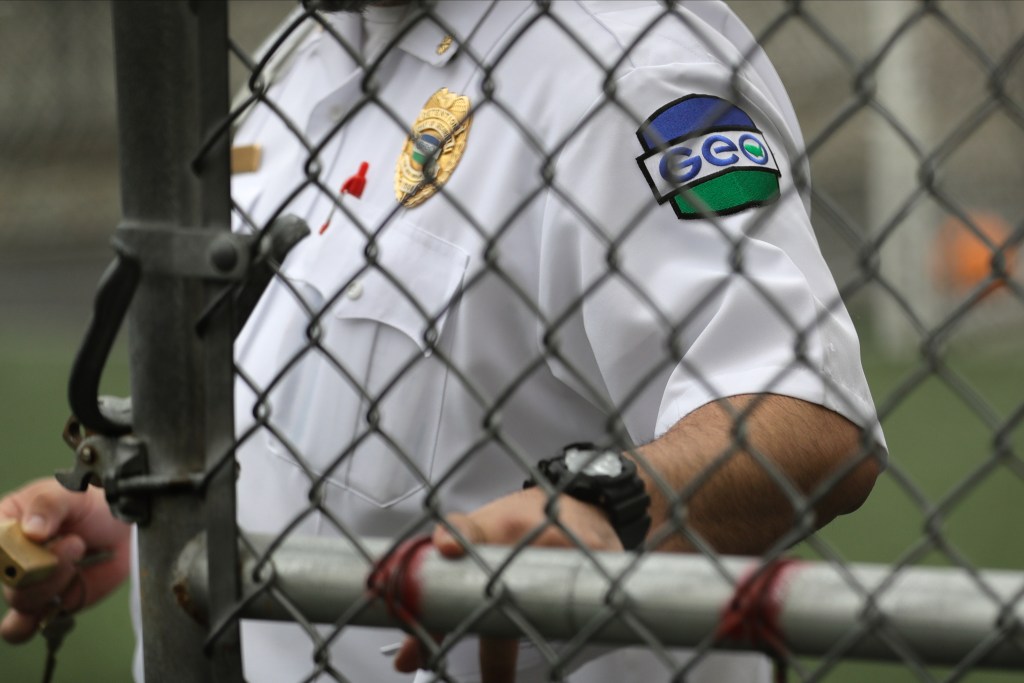
ICE has been holding a child in an ICE detention center meant for adults for nearly two months due to a clerical error, the boy’s attorneys allege in a federal lawsuit filed in May.
Federal Judge Marilyn J. Horan in Pennsylvania on Thursday ordered ICE to transfer the individual, known as A.D. in legal filings, into the custody of the U.S. Department of Health and Human Services, which oversees the Office of Refugee Resettlement, while ICE conducts a reassessment of his age.
Arrested in mid-May, A.D. will have spent nearly two months at an ICE facility in Pennsylvania, where he turned 17, according to documentation provided by his attorneys.
“We are pleased the Court has recognized the irreparable harm our client will continue to suffer at Moshannon Valley Processing Center,” Tania Cohen, the Legal Director at Safe Passage Project, one of the lawyers working on A.D.’s case, said in a statement to The CIty Reporter. “This is a child who has been detained in an adult carceral facility for almost two months…We will continue to fight for the rights and safety of this client and for every child entitled to protection under the law.”
Originally from Guinea, A.D. had been living in a foster home overseen by New York City Administration for Children’s Services on Long Island. Suffolk County Police arrested him there in relation to an alleged attempted assault several months earlier and then quickly passed him off to ICE agents several hours later, according to federal filings and state court records.
His attorneys urgently tried to explain to ICE officials that he was a child and immediately filed a habeas corpus lawsuit in federal court in Manhattan seeking his release. But ICE had already sent the teen to the Moshannon Valley Processing Center and refused to release him in the weeks that followed. Children in ICE custody are supposed to be transferred to the Office of Refugee Resettlement, which runs its own shelters intended for children.
“ICE mistakenly believes he is over 18 years old despite federal and state documents to the contrary,” his attorneys wrote in a habeas corpus petition filed on May 17, the same day as his arrest. “His detention in adult ICE detention contravenes federal law and is endangering his physical and mental wellbeing.”
The origin of the confusion over A.D.’s age stems from a secondary school entrance exam document from Guinea that erroneously stated his birth year as 2000, which would put him at 26-years-old at the time of his arrest, his attorneys said in federal filings.
But copies of A.D.’s passport, his birth certificate from Guinea, New York family court records and the federal government’s own Health and Human Services record of his entry into the United States in 2023 — all submitted into federal court as part of his lawsuit — showed he was born in May 2009, making him 16 at the time of his arrest.
Judge Horan had earlier instructed ICE to keep A.D. separate from other adult detainees while his age was being verified. Since mid-June, he has been held in a medical unit at Moshannan, sometimes in conditions similar to solitary confinement, court records described.
On Thursday Horan ordered ICE to transfer A.D. into HHS custody and told them to reconsider his age determination yet again, this time “considering the totality of the circumstances” which included testimonials from multiple family members and New York State Family Court records.
In a statement to The City Reporter in June, ICE disputed A.D.’s age, saying he “is NOT a minor.” On June 17, ICE subjected the teen to dental x-rays, which they claim determined he was an adult, and suggested in legal filings that his passport and other identifying documents from Guinea were forged.
“He is a 26-year-old criminal illegal alien from Guinea with multiple arrests for robbery, assault and possession of a weapon,” the unnamed spokesperson said.
A spokesperson for ICE didn’t return a request for additional comment right away following the judge’s order in A.D.’s favor.
Lost in New York
A.D.’s tumultuous time in the United States began in December 2023, after he fled Guinea when local police broke into his family home and threatened to burn it down because of the family’s Fulani heritage, legal filings said.
He was taken into the custody of the Office of Refugee Resettlement, which determined he was 14-years-old at the time, based on his passport and other travel documents. He was later released to the custody of an adult brother who lives in Queens.
There the boy endured several months of abuse, according to his federal lawsuit, and after an incident in which his brother beat and strangled him until he vomited, the teen managed to escape through a window and fled to a nearby school.
A security guard called the police, and A.D. was taken to the hospital and then to a shelter for children in Manhattan. But he left the shelter the next morning, wandering through the streets of New York City and eventually making his way to Times Square.
“He had no money and no phone, but was amazed by how beautiful Manhattan was,” one of his attorneys Maria Possidente, wrote in legal filings. In Times Square, he met other African migrants who were staying at a shelter in the Candler Building. An older man from Guinea befriended him and bought him pizza. He spent several nights sneaking into the Candler shelter using his older friend’s ID, his lawsuit says.
An arrow security worker stands guard near a back entrance for the Candler Building migrant shelter in Times Square, Aug. 14, 2024. Credit: Ben Fractenberg/THE CITY
Several days later, the friend took A.D. to 26 Federal Plaza to try to help him get help with “minor immigration.” He had a brief conversation with ICE agents there and handed over all of his documents, including his passport, birth certificate, the HHS record that showed his 2009 birth date and the erroneous school document from Guinea.
Wanting to stay with his new friends at the adult shelter, the boy told officials there, “my passport is not good, and this paper is good,” referring to the school document. A.D. barely spoke English at the time, his attorneys pointed out, having arrived from Guinea only a few months earlier.
After a brief conversation, ICE agents there issued a new Notice of Appearance in immigration court and a parole document that showed his birth year as 2000. A.D. then used that paper at the Times Square shelter, where staff allowed him to stay.
“After showing the Times Square shelter staff the paper he had been given, they let him stay at the shelter,” his attorney said.
In their account of this interaction, an ICE spokesperson said A.D. had “admitted to ICE officers that his brother purchased him a counterfeit passport from Guinea showing him to be a minor.”
A.D. then spent several months bouncing between adult migrant shelters in Times Square, the Hall Street shelter near Brooklyn Navy Yard and the massive tent on Randall’s Island, his attorneys wrote.
Bicycles sit outside the Hall Street migrant family shelter, March 5, 2025. Credit: Ben Fractenberg/THE CITY
His time in New York City coincided with the peak of the migrant crisis, with more than 60,000 newly-arrived migrants living in a patchwork of ad hoc shelters. At the time The City Reporter covered how the city’s specialized youth shelter network was overwhelmed.
It was not uncommon, advocates told The City Reporter, for unaccompanied children to end up living in mosques or shelters meant for adults, as was the case of A.D.
Conditions Like Solitary
By the summer of 2024, word that a child was living in an adult shelter spread through networks of activists and mutual aid volunteers who were providing direct relief at city shelters. Charlotte Soehner, who at the time worked at the Asylum Seeker Help Center and was also involved with various mutual aid efforts, got A.D.’s contact through WhatsApp networks and met with him.
“This kid is alone and someone has to do something about it,” she recalled thinking. With his permission, Soehner started talking to other advocates and the Administration for Children’s Services, who eventually placed him in foster care.
“It’s really really sad to hear where he’s ended up now,” Soehner said, who said she hadn’t been in touch with A.D. since 2024.
His ACS caseworkers didn’t let him attend an immigration hearing virtually because he was supposed to be in school, and an immigration judge ordered him removed in absentia last fall, his new immigration attorneys said in federal filings. His current immigration attorneys are attempting to reopen his case.
A.D. had been arrested several times over the past several months, twice for robbery and a strangulation charge. On May 16, he was arrested by Suffolk County Police for a third degree assault that occurred months earlier, court records show.
According to a declaration submitted in court by ICE supervisor Derek Lynch, Suffolk County Police Department notified ICE he was in their custody, and ICE came to pick up from the precinct several hours later. A spokesperson for the Suffolk County Police Department, who are not subject to the strict sanctuary protections as New York City police, said they’d initially arrested A.D. in February charging him as a juvenile with attempted robbery and later rearrested him in May charging him as an adult.
“The Department is responsible for notifying federal immigration authorities, the prosecuting attorney, and the judiciary when an undocumented individual is arrested for a criminal offense,” the spokesperson said.
In the nearly two months A.D. has been in ICE detention for adults, his mental health has deteriorated, according to his attorneys and incident reports from staff at Moshannon.
After Judge Horan told ICE to separate A.D. from other adults on June 17, ICE placed him on the medical unit. Horan gave further instructions that A.D. be held “within the least restrictive setting of the medical unit,” but after a confrontation with staff there, it appears A.D. was sent into conditions similar to solitary confinement.
Two incident reports from June 24 describe that A.D., while being held in what was referred to as a “suicide cell,” covered a security camera inside his cell in own feces and then smashed it until it broke, flinging it across the cell. He was later barred from using phones or tablets for two weeks.
“They are locking me in here for no reason,” he told an officer investigating the incident, in a report submitted in court. “They are treating me like an animal.”
Our nonprofit newsroom relies on donations from readers to sustain our local reporting and keep it free for all New Yorkers. Donate to THE CITY today.
The post ICE Held a Minor in Adult Detention for Nearly Two Months, Attorneys Allege appeared first on The City Reporter.
