
Following London’s contemporary sales, the major auction houses turned to the timeless beauty of the classics, with Christie’s and Sotheby’s staging their Old Masters sales in close succession. The category has seen a significant rebound in recent years. Christie’s year-end results reported $182 million in Old Masters sales in 2025, up 24 percent year-on-year, while its broader Classics category rose 15 percent, making it the department with the strongest year-on-year growth across the house. Earlier this year, Sotheby’s first Old Masters Week at the Breuer in February brought $94.8 million, above its $93.1 million presale high estimate. Together, the two houses moved more than $200 million of Old Masters material that week.
Yet the London session showed what a buyer’s market can mean for the Old Masters market: a focus on quality, with solid demand for historically validated names, exceptional condition and provenance, fresh-to-market works and rediscoveries. Buyers, in other words, remained extremely selective. In many cases, a big name was not enough to inspire bidding wars. Every lot had to be the right picture, with the right combination of those conditions.
The session began at Christie’s on Tuesday, June 30, with the Old Masters Evening Sale and The Exceptional Sale: Masterworks Across Cultures, which generated a combined total of £50,717,740 ($66,947,417), with a solid overall sell-through rate of 96 percent by value and 90 percent by lot.
The evening sale, meanwhile, brought £38.9 million ($51.4 million), surpassing its £25-37.5 million presale estimate and closing with only three bought-in lots—a panel of The Resurrection of Christ by the Master of the Oberstenfeld Altarpiece, Thomas Gainsborough’s Portrait of Dorothea, Lady Eden and Canaletto’s Venice, San Giorgio Maggiore from the Bacino di San Marco—and one withdrawn lot (Michiel van Musscher’s A Portrait of the Artist in His Studio). Beyond that, the sale proceeded with a measured rhythm of moderate bidding activity across its 40 lots, becoming more spirited around the evening’s highlights and some exceptional rediscoveries.
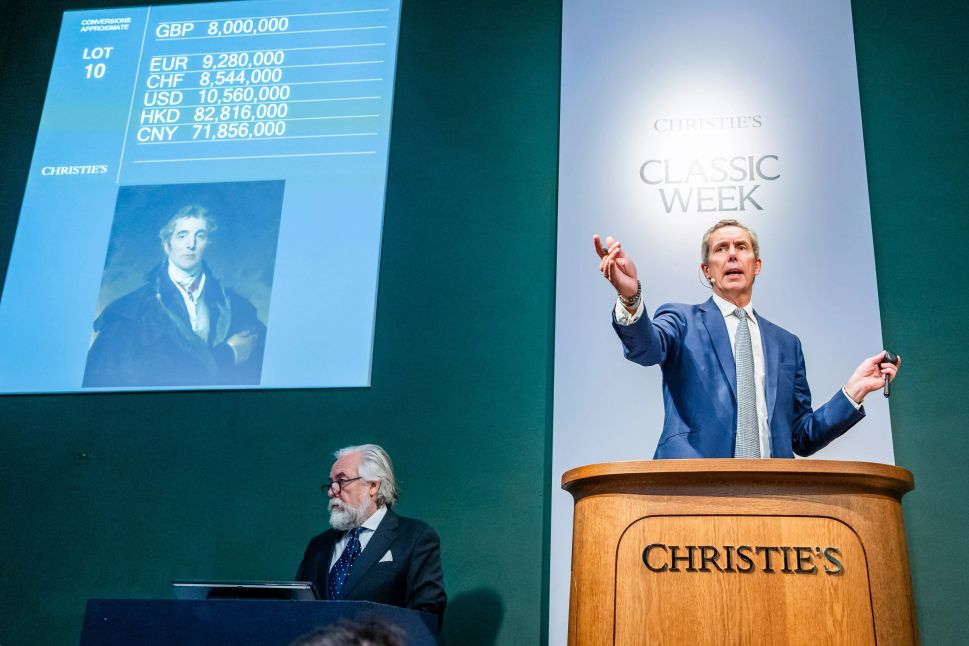
Leading was Sir Thomas Lawrence’s celebrated portrait of the Duke of Wellington, Britain’s greatest military hero, which sold for £9,670,000, falling comfortably within its £8-12 million estimate and establishing a new world auction record for the artist. Painted in 1820, five years after the Duke’s defeat of Napoleon at Waterloo, and in the same year Lawrence became president of the Royal Academy, the work was described by Christie’s as an extraordinary piece that helped cement the artist’s reputation. The painting last sold at auction, also at Christie’s, in November 2006 for £1.9 million, where it was acquired by the current consignor. It was later exhibited in the 2011 Lawrence survey Thomas Lawrence: Regency Power & Brilliance, which traveled between the National Portrait Gallery in London and the Yale Center for British Art in New Haven.
The Old Masters Evening Sale also set seven artist records. Among the star lots were two vanitas still-life paintings by the 18th-century Dutch master Jan van Huysum, each rendering with vibrant color and meticulous precision its lush composition of fruit and flowers, and each breaking the previous record for the artist. Fruit and Flowers in a Wicker Basket fetched £6,516,000, followed by Flowers in a Terracotta Vase, which sold for £5,540,000. Both carried third-party guarantees and had last been seen at auction more than a decade ago: the first was bought by the current consignor at Sotheby’s London in December 2003 for £4.4 million, while the second sold in the same sale for £2.7 million.
Other record-breaking lots included Jan van Mieris’ elegant allegory of painting, The Art of Painting (Pictura), new to auction, which achieved £355,600 against its £200,000-300,000 estimate. A new high was also reached by an epic Constantinople court scene, Mehmed II and the Patriarch Gennadius Outside the Walls of Constantinople, by Girolamo da Santa Croce, a 16th-century Bergamo-born Renaissance artist and pupil of Giovanni Bellini. Interestingly, when it was cataloged in 1852, it was attributed to Bellini himself. Fresh to auction, it sold for £673,100, well above its £100,000-150,000 estimate.
A new record was also set for John Melhuish Strudwick, whose Thy Music, Faintly Falling, Dies Away… sold for £1,514,000, its exquisitely seductive Pre-Raphaelite beauty carrying it past its £1 million high estimate. One of the most compelling rediscoveries of the night, however, was a painting by Adélaïde Labille-Guiard, the talented French miniaturist and portrait painter who worked for the Parisian aristocracy in the age of revolution while remaining an outspoken advocate for women’s equal opportunities in the arts. Long unseen in public, her half-length Portrait of Marquise Marie-Thérèse-Odile de la Valette exceeded all expectations, selling for £1,117,600 against its £300,000-400,000 estimate. Fresh to auction, the painting was in the family of the sitter for centuries.
A monumental canvas from Reformation-era Swabia achieved £177,800 from a £60,000-80,000 estimate, followed by two paintings by Pieter Brueghel selling for £330,200 and £762,000 respectively, with the only casualty of the opening group being an altarpiece by the Master of Oberstenfeld, a German artist in the orbit of Dürer’s Nuremberg, which passed. A further fresh-to-auction Brueghel later in the sale also exceeded its high estimate, selling for £406,400.
Right after this initial group came an uncannily grotesque 17th-century Dutch vanitas still life, complete with two skulls resting on a dark, veined marble ledge. Unattributed and fresh to auction, it ignited an unexpected bidding war that pushed it well beyond its £80,000-120,000 estimate to land at £431,800. Christie’s catalog noted that “the combination of stylistic characteristics resists straightforward localization,” but some bidders may have had other ideas, seeing potential for revaluation after reattribution. The entry mentions Leiden affinities, with the warm amber tonality, dark-veined marble ledge and pronounced chiaroscuro finding closer analogies in Flemish painting, particularly within the orbit of Carstian Luyckx, as well as in the work of painters active in The Hague at mid-century, such as Aelbert Jansz. van der Schoor and the still incompletely cataloged N.L. Peschier.
Another top result was Rubens’ sketch Aeneas Helping Dido from Her Horse, from the Grosvenor Family Collection. One of the few surviving oil sketches by the artist to so completely embody the spontaneity of his creative imagination, it comfortably met its £2-3 million estimate, covered by a third-party guarantee, to sell for £2,734,000. Having appeared in an anonymous sale at Uppsala Auktionskammare in December 2006 as “Manner of Rubens,” it was acquired by the consignor through Hazlitt, Gooden & Fox, London.
Christie’s Classic Week continued with The Exceptional Sale: Masterworks Across Cultures, led by an exceptional pair of Egyptian limestone statues from the Hovingham Hall Collection, dated to the Old Kingdom, which achieved £3,710,000. Presenting a vast and extremely diverse range of exceptional works, curious artifacts and rare discoveries, the sale saw competition across categories and geographies, with 38 percent of bidders being Millennials.
Another top result was the first edition of Emily Brontë’s Wuthering Heights, together with Agnes Grey, in its original 1847 publisher’s cloth binding, which achieved £1,206,500—a new world auction record for the author, and the highest price ever achieved for 19th-century literature and for any printed book by a woman. A group of four boxes owned by Winston Churchill also sold for a combined £584,200, led by a cigar humidor, a gift from Franklin D. Roosevelt circa 1940-45, which sold for more than eight times its presale high estimate, realizing £330,200 after five minutes of competitive bidding.
Asian art and antiques performed particularly well, with most lots landing within estimate. Eight lots went unsold, mostly on the decorative arts side, along with a monumental bronze bust of the painter Giovanni Segantini by Prince Paul Troubetzkoy, which failed to find a buyer against its £200,000-300,000 estimate. Perhaps more surprising was the saber-toothed tiger failing to sell against its £1-1.5 million estimate, given the current enthusiasm around dinosaurs and fossils—most likely a failure of targeted marketing rather than of appetite. The following day, Pharrell Williams’ auction and content platform JOOPITER sold Sofia, a newly unearthed and exceptionally complete associated Triceratops skull from the Hell Creek Formation of North Dakota, for $840,000, establishing a new record for a Triceratops skull sold at auction.
Sotheby’s buyers gravitate toward rarity
The following day, July 1, Sotheby’s opened its Classic Week evening session with a standalone sale of Auguste-Jean-Marie Carbonneaux’s The Hamilton Laocoön. One of only four known early life-size bronze casts of the legendary antique sculpture of Laocoön and his sons—described by Michelangelo as “a singular miracle in art”—the monumental bronze was made in Paris in 1817 by Carbonneaux, a leading master of Neoclassicism who had direct access to the original sculpture. Having belonged to some of the most celebrated British collectors of the 19th century, the Hamilton Laocoön was appearing on the market for the first time in nearly 150 years. Carrying a £2-3 million estimate and opening at £1 million, the work quickly climbed past its high estimate, then seemed almost ready to close at around £10.2 million—until another bid came in at the last minute. “You’re very annoying, Charles,” auctioneer Harry Dalmeny joked, as the contest restarted and pushed the sculpture to a final £11.6 million hammer, rising to £13.6 million with premium—nearly seven times its low estimate—driven by active bidding from Asia. The result was the second-highest price ever paid for a pre-modern sculpture at auction.
Sotheby’s then moved into its Old Master & 19th Century Paintings and Sculpture Evening Auction, which totaled £37,811,600 across its 47 lots after two were withdrawn. The final total was broadly in line with Christie’s the previous day; the auction house described it as the highest total for an Old Masters evening sale at Sotheby’s London since July 2019, and the third-highest in a decade. Yet the number of unsold lots—11—was higher than at its competitor’s sale, revealing a market that remains extremely selective, with buying activity concentrated around top provenance, condition and genuine rarity, rather than attribution to a big name, which can always be disputed over time.
That selectivity was made plain by Rembrandt Harmensz. van Rijn’s Let the Little Children Come Unto Me, which met its £8-12 million estimate only just, hammering relatively quickly at £7 million and likely going to the guarantor. With fees, the result reached the £8 million low estimate. Provenance was not the issue, and the painting was relatively fresh to the market, having been in the same private collection in West Berlin for years before passing by descent and selling anonymously at Lempertz in Cologne in 2014 as “Netherlandish School, mid-17th century,” where it was acquired for €1.5 million on behalf of the present owner.
Discovered just over a decade ago and carefully restored in the intervening years, the painting revealed Rembrandt’s original scheme and intentions, though it remains largely unfinished, interrupted by his death in 1669. The work’s marketing emphasized a further point of exceptionality: the way Rembrandt made a biblical scene intensely personal, including not only a vivid self-portrait but also depictions of his family—his mother and father and, quite possibly, his godparents and god-sister. The unfinished painting stands as a testament to his worldview, carrying a deep existential reflection and a message of religious tolerance at a crucial moment in Dutch history and in the artist’s own life. One can only hope that its failure to ignite more competitive bidding points to some prearrangement for a future life in an institution.
Sotheby’s sale had opened on a steadier note. A Swabian School painting dated circa 1512 hammered at its high estimate of £200,000, followed by Hans Memling’s delicate The Virgin Mary Nursing the Christ Child. Starting at £2.5 million, the painting hammered at £2.8 million, reaching its low estimate only after fees but setting a new auction record for a Memling at £4.8 million. The previous record had been set at Sotheby’s New York in 2013 for $4,114,500 (£2,609,301).
Three further artist records came later in the sale. An Adoration of the Magi pala by the Master of the Prodigal Son sold for £339,392, just above its £300,000 high estimate and well beyond the artist’s previous record of £133,500. This was followed by Bernard van Orley’s Virgin and Child, which fetched £2.7 million, and Cosimo Rosselli’s Christ as the Man of Sorrows, which sold for £960,000 against its £400,000-600,000 estimate.
From there, the sale reached another star lot: The Virgin and Child with the Young Saint John the Baptist by Alessandro di Mariano Filipepi, known as Sandro Botticelli. Opening at £1.6 million, it quickly hammered at its £2 million low estimate, which became £2.53 million with premium. Provenance and relevance were indisputable. First recorded as a Botticelli in the mid-19th century, when it hung in the Livorno collection of Francesco de Larderel, Count of Montecerboli, the painting vanished from view until 1946, when it was rediscovered by Roberto Longhi, one of the most respected Italian art historians, who described it as “a very important addition to the early work of Botticelli.” Held in a private collection until circa 1950, it was then bequeathed to a charitable institution, from which the present owner acquired it in 2004.
The middle section of the sale was more uneven. Sebastiano Luciani, called Sebastiano del Piombo, and his assistant failed to sell at £110,000, while a strong example by Palma il Vecchio hammered below estimate at £580,000, reaching its low estimate only with premium—though it still set a new record for the artist. The sale brought 11 artist records in total, including works by Gillis Mostaert the Elder, Michiel van Musscher, Foggini, Giovanni Antonio Guardi and Sir Edwin Landseer, all of which came later in the evening.
Guardi’s The Greek Favorite in the Harem more than doubled its high estimate, selling for £614,400. Unseen in public for over three decades and making its auction debut, the work forms part of a celebrated series of 43 canvases depicting Turkish history, customs and courtly life, commissioned between 1741 and 1743 by Field Marshal Count Johann Matthias von der Schulenburg, one of the most important patrons in 18th-century Venice—and a revealing instance of the European imagination’s interpretation of Ottoman life. Sir Edwin Landseer’s monumental Scene in Braemar—the sister painting to the British icon The Monarch of the Glen, unseen in public for more than two decades—fetched £5.9 million against its £3-4 million estimate. Described as among “the best works of the artist” when first exhibited at the Royal Academy in 1857, Scene in Braemar represents the very essence of the Highland stag, one of the most recognizable symbols in British art.
A portrait of a man from the workshop of Bernhard Strigel also surpassed expectations, fetching £516,000 against a £100,000-150,000 estimate, likely driven by bidders hoping for a reattribution to Strigel himself or drawn by its provenance from the renowned Lauder Collection, as suggested by its exhibition history at the Neue Galerie. Willem Key and Gillis Mostaert the Elder also sold above estimate with premium, while Hans van Wechelen passed.
The room fired up again with an early 17th-century Flemish School work, The Seven Days of Creation—an oil on copper composed of six oval panels and one circular panel, all inscribed in Hebrew with יהוה. Estimated at a far more modest £120,000-180,000, it triggered one of the evening’s liveliest bidding contests. After roughly ten minutes and a battle among six bidders, it hammered at £600,000, far above expectations.
Pieter Brueghel the Younger’s Village Scene with Peasants Carousing and Dancing Around a Maypole closed more quickly, hammering at £2.4 million and reaching its £2.5 million low estimate after fees. The auctioneer then moved to Sir Peter Paul Rubens’ Christ on the Road to Calvary, which sold by phone for £220,000. William Dobson’s imposing portrait of an English soldier, courtier and politician failed to sell, followed by quieter results for works by Gerard ter Borch and Pieter Claesz and a pass for Salomon van Ruysdael.
After more than an hour and a half on the rostrum, the auctioneer finally reached lot 47, though he already seemed ready to call the sale before it. “Tonight, I feel I’ve had three sales,” Dalmeny joked, catching himself before skipping it. The extra effort paid off with one final burst of energy, as Petr Petrovich Vereshchagin’s A Panoramic View of Saint Petersburg immediately drew strong interest, eventually selling by phone for £350,000 before fees.
Overall, results suggested that scarcity, provenance and rediscovery can still generate decisive competition. But beyond exceptional trophy objects, the Old Masters market proved more selective and unforgiving: several works needed the premium to reach their low estimates, and others failed to sell altogether—suggesting a market still willing to chase masterpieces, but far less forgiving of anything below that level.
