
A Manhattan judge has blocked a city law that is designed to shield Uber and Lyft drivers from being abruptly deactivated from the ride-hailing apps just days before it was set to take effect.
The preliminary injunction issued Tuesday by United States District Court Judge Gregory Woods pumps the brakes on Local Law 52, which was set to take effect July 28 as a way to shield more than 80,000 for-hire vehicle drivers from getting booted off the apps without advance notice.
The City Council overwhelmingly approved the measure in January, but Woods noted in his 53-page decision that wrongful deactivation affects no more than a “narrow group” of drivers. Uber and Lyft had filed suit in federal court last month and lawyers for the companies argued before Woods last week that the law could force them to keep drivers who are a threat to the safety of passengers and the public.
“The record shows that the City Council did not consider the law’s effects on the broader citizenry of New York City, such as passengers and pedestrians — groups whose safety depends in part on swift deactivation of drivers accused of fraud, assault or dangerous conduct,” Woods wrote in the page decision.
“Nor did the city consider whether the cost of compliance with the law would result in increased costs for the millions of monthly users of Uber and Lyft’s services,” he added.
Representatives for the ride-hailing apps praised Woods’s opinion, which pushes back on legislation that then-Mayor Eric Adams vetoed Dec. 31 during his final hours in office. The City Council overwhelmingly revived the bill in January, only for it to be challenged again by the tech giants in federal court.
The legislation would require the app companies to specify why drivers are being cut out from the apps, require 14 days’ notice and also establish an independent appeals process.
Court papers point out that Uber safety issues accounted for more than half of its New York driver deactivations in 2025 and that safety and fraud — including identity and document fraud — account for more than 92% of that total.
“We’re pleased the court recognized the importance of preserving our ability to exercise discretion to protect the safety and integrity of our platform,” said Josh Gold, an Uber spokesperson. “The opinion underscores that driver fairness and rider safety can and must go hand in hand.”
CJ Macklin, a Lyft spokesperson, added that the company is pleased that the judge recognized “the serious safety concerns at the heart of this challenge.”
“We now look forward to making our full case,” Macklin said.
In a statement, the city’s Department of Consumer and Worker Protection said the agency “respectfully disagrees with the decision.”
“Fairness in the workplace starts with guaranteeing stability — not allowing an algorithm to determine whether drivers can earn a living,” spokesperson Stephany Vasquez Sanchez said.
The bill’s sponsor, Councilmember Shekar Krishnan (D-Queens) blasted the judge for siding with Uber and Lyft, whose drivers completed more than 22 million trips in May, according to New York City Taxi & Limousine Commission data.
“We strongly disagree with the court’s decision,” Krishnan said in a joint statement with Council Speaker Julie Menin. “We are evaluating this latest ruling and considering next steps to ensure these protections are upheld.”
The City Council approved a similar measure last year for food delivery workers who work for the apps.
Bhairavi Desai, head of the New York Taxi Workers Alliance, called the judge’s move to block the law “misguided, wrong” and marked by “extreme pro-corporation bias.”
“It took three years to win the law,” Desai told The City Reporter. “The drivers had been suffering for far longer.”
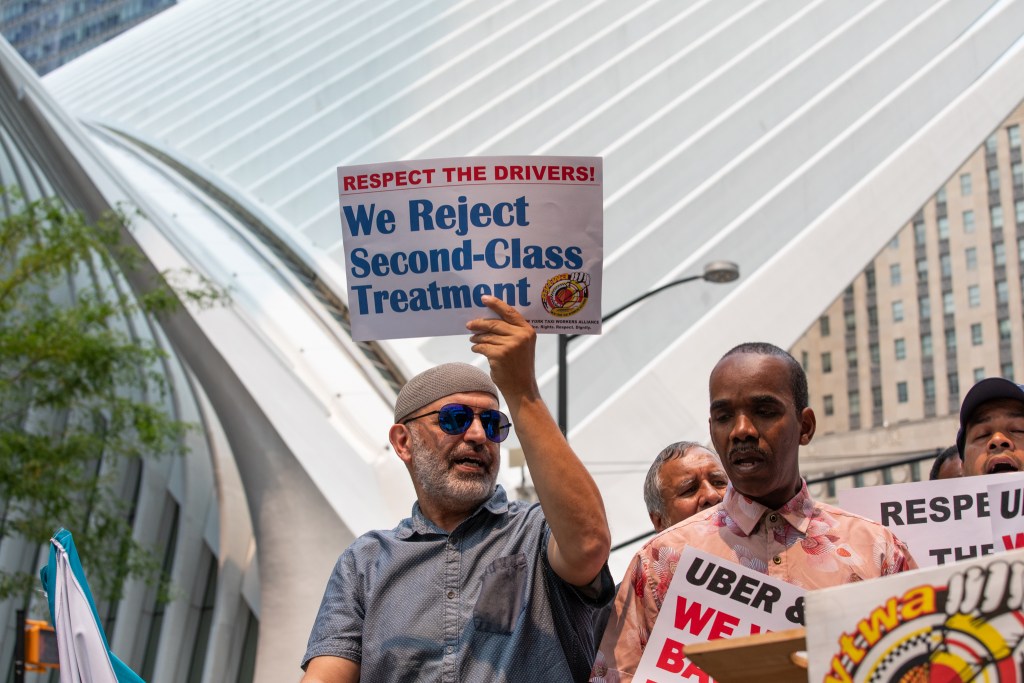
At a rally last week in front of Uber’s Lower Manhattan headquarters, several drivers who contend they were wrongly deactivated from the apps said the measure would bring them out of the dark about why.
Md Azizul Haque, who drove for Uber from 2018 until mid-2019, called the suspensions “one-sided judgements” that left drivers exposed to overheated accusations from passengers,
“[Uber] just texted me a message that I broke their community guidelines,” said Haque, who now drives a yellow taxi. “That’s about all I know.
Our nonprofit newsroom relies on donations from readers to sustain our local reporting and keep it free for all New Yorkers. Donate to THE CITY today.
The post Judge Blocks Law Made to Protect App Drivers From Abrupt, Unexplained Firings appeared first on The City Reporter.
