
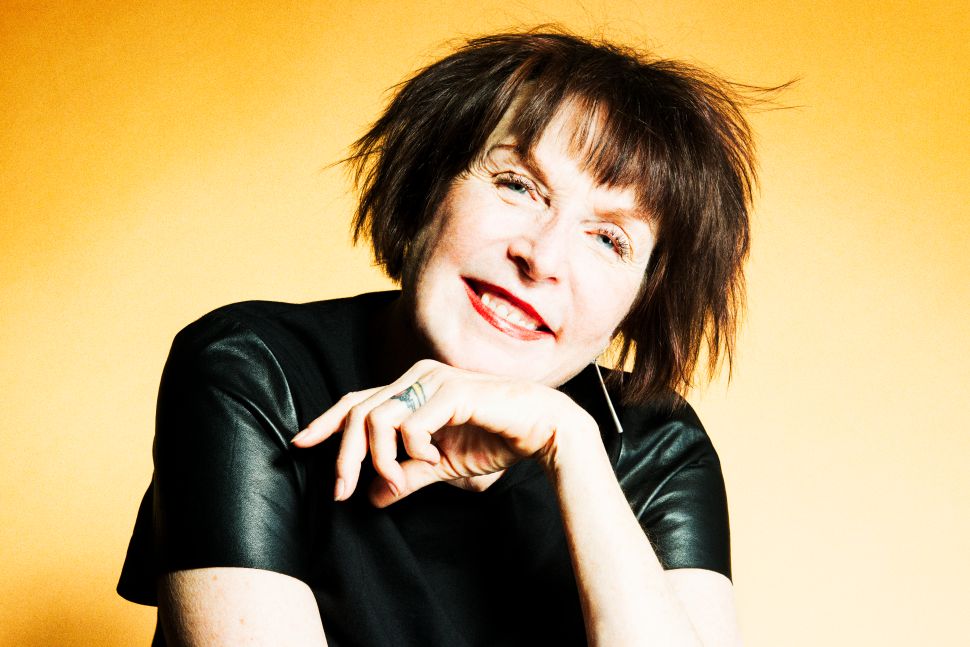
Marilyn Minter smiling at the camera with a yellow background, resting her arms on a surface.” width=”970″ height=”647″ data-caption=’Exaggerated commercial aesthetics have always been this artist’s most subversive tool. <span class=”lazyload media-credit”>Photo: Ryan McGinley</span>’>
This month, Anderson Ranch Arts Center will officially name Marilyn Minter its 2026 International Artist Honoree, a distinction it reserves for “globally recognized artists who demonstrate the highest level of artistic achievement and whose careers have fundamentally influenced contemporary art.” Minter checks those boxes. For more than four decades she has made lush, photorealistic paintings of glamour and grit, turning her lens on figures like Monica Lewinsky, Pamela Anderson, and Miley Cyrus, mixing grit with glamour, and doing the hard work of bringing sex into American society. The nonprofit Anderson Ranch will present the honor during its Ranch Week celebration in July, alongside a gala and a screening of Pretty Dirty (2025), the new documentary tracing Minter’s life and career. The week includes a talk between Minter and Lisa Phillips, former director of the New Museum. We caught up with Minter to hear more about her relationship to Aspen.
Let’s start right with Aspen. One of your first dealers was there, Baldwin Gallery, before you even had a New York gallery. How did that happen?
One of my first dealers, before I even had a New York dealer, was Baldwin Gallery. I showed with Baldwin even before SFMOMA, when I didn’t have a New York gallery, and Harley Baldwin was a total believer. He saw my work at a fair early on, then came to my studio and offered me a show. It was heaven, and he sold a lot of it. He had a significant following, and it was basically the only gallery in town. This was the early aughts. Harley was such a great guy. I had my show, and then at Thanksgiving he got sick, he had to leave, and he died about three months later. His husband, Edwards, took over the gallery, and he was the one who had actually turned Harley into an art lover.
Aspen is a luxury town, all fashion flagships and second homes. Why do you think your work landed there so fast, before collectors elsewhere caught up?
In Aspen they have Dior, they have branches of all the big houses. The only way I could figure out why they liked it, even though the images were disturbing, is that they’re well done. I make them beautiful. And I was working with the world of fashion and glamour, which the art world has nothing but contempt for. It’s one of the biggest industries in the world, an engine of the culture. Like everything it has two sides: it creates body dysmorphia, and it gives people enormous pleasure. My whole job was to get rid of shame. All my work is about dragging it into the light. So they responded to that. People always responded to my work, because there’s so much hatred for popular culture, and I never understood why. I’m just taking tropes from the culture and pushing them a little further.
What strikes me is that the glamour and the grit in your work were practically neighbors in Aspen, your gallery and the Dior store on the same block. Did that proximity actually feed the work?
Because of Harley, I could get all those products. Dior, the houses on that block. He would say, give Marilyn these shoes, give Marilyn jewelry. I kept it all, and I still use it all the time. That’s how I supported myself, doing commercial jobs. I would shoot really expensive shoes in water for New York Magazine, and then I would shoot the exact same shoes in mud, and then clean them all off, because I had a day in between. I piggybacked every time I got a commercial job.
Do you ever see your paintings hanging in the ski chalets out there?
No, never. But I have collectors who buy provocative art from everybody. I’m just one of the artists they buy. They buy Andres Serrano, too. I think they collect things that look beautiful. They’re more into beauty than content. That’s why they collect me. The content they’re not so sure about.
Colorado is a purple state, and you’re not exactly quiet about your politics. Do you ever worry that a collector might find out about your activism and decide not to buy?
No. I know collectors who are Republicans. They follow me on Instagram, and they own my work. If they’re real collectors, they know art breaks rules. I have had maybe one person not like something I did and put it up at auction. That was more like revenge.
At the Ranch on July 14 you’re in conversation with Lisa Phillips, who ran the New Museum. There’s a photo of the two of you from decades ago in the documentary Pretty Dirty. How far back do you go?
I met her in Washington, D.C., for a Colab project. Colab was a movement in the 80s that took over abandoned buildings to put on shows. She wasn’t at the Whitney yet, she was just down there looking at the work at an alternative space. We have been friends for 40, 45 years, something like that. She knew me back when I was on a collaboration team with Christof Kohlhofer. She’s the most effective person I know.
For someone whose work is steeped in fashion and glamour, are you a fashion person yourself?
No, it’s too time-consuming. I live across the street from Marni and next door to Dries van Noten, so I just go in and get something for whatever the occasion is. But no one would ever call me a fashionista. I once got invited to a party and didn’t realize it was a pre-Met Ball party. I was dressed all wrong. I didn’t know the Met Ball was that Monday, and the party was that Saturday.
