
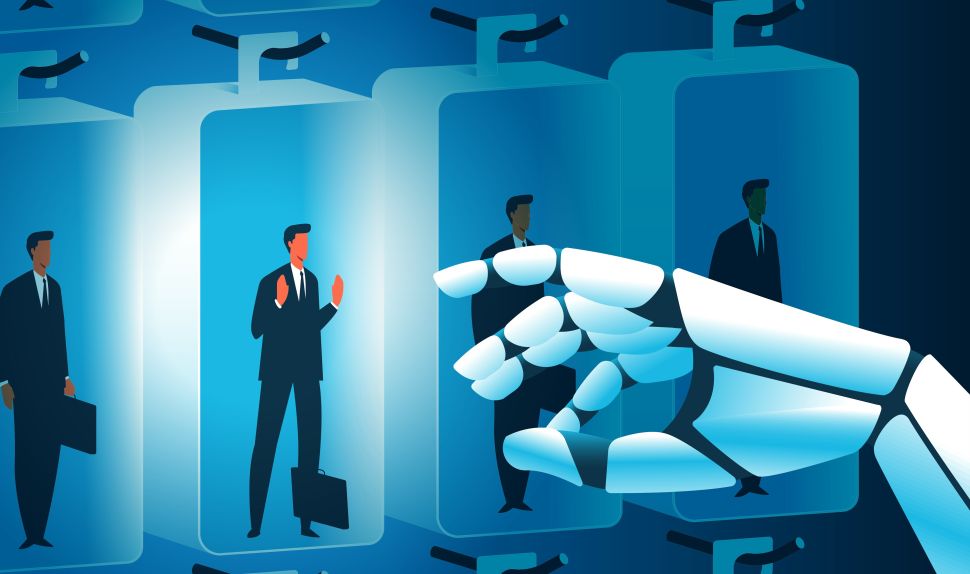
How do we prevent technology designed to help us scale from scaling our biases instead? Thanks to fresh research from the Stanford Institute for Human-Centered AI, the question has become even more urgent, and the answer even more complex and uncomfortable. Researchers found that a widely used screening tool systematically rejected candidates in patterns that clearly correlated with race.
In theory, A.I. screening tools allow recruiters to spend less time on rote decisions and more time getting to know the people in their pipeline. In practice, however, as the Stanford study illustrates, setting and forgetting any tool designed to make decisions on a recruiter’s behalf can produce systemic biases and ultimately diminish the quality of hiring outcomes.
Getting precision at the top of the funnel requires something many A.I. hiring solutions still lack: a structured evaluation framework that measures every candidate against the same job-relevant criteria. Without that foundation, an A.I. screener just learns the inconsistencies and biases embedded in past hiring decisions and reproduces them faster.
The industry’s responses to this challenge have ranged from reactionary to paralyzed. Some conclude that if the tool produces biases, the answer is to abandon it altogether. Others, overwhelmed by the influx of applications and the growing pressure to deliver better hiring outcomes faster, continue layering new A.I. tools on top of their existing systems, without fully understanding how those systems make decisions or how they should be governed.
In my conversations with CHROs, the question is no longer whether A.I. belongs in hiring, but how to implement it safely and effectively. Their top concern is building A.I. fluency and governance: they know A.I. is transforming the hiring landscape, and they have a keen sense that their teams are underprepared for an inevitable wave of A.I. enablement. Before they rely on AI. to influence decisions as consequential as hiring and promotion, they want to know that accountability has been built into the process.
Here’s the uncomfortable reality: human judgment is both the antidote to bias and its source. At its best, A.I. can surface patterns that people routinely overlook. It can reveal that high-performing employees come from less prestigious institutions, have unconventional career paths or possess transferable skills that traditional screening methods undervalue. It can challenge long-held assumptions about what success actually looks like inside an organization and expand the pool of candidates considered qualified.
But A.I. is not inherently objective. With the wrong data, poor design or weak oversight, it can just as easily reinforce blind spots, quietly filtering our exceptional candidates through an invisible maze of arbitrary filters that reinforce our worst prejudices. With the right data, design, training, and accountability frameworks, though, A.I. can complement human judgment, allowing recruiters to quantify their blind spots and make fairer decisions that produce better outcomes.
Responsible A.I. is fundamental to the viability of any A.I. hiring tool because it provides organizations with the knowledge, infrastructure and capabilities to move forward credibly and critically in today’s hiring landscape. But our industry is still struggling to understand what responsible A.I. looks like in practice.
As someone who has spent my career asking who gets seen throughout the talent lifecycle, I think about responsible A.I. through three interconnected layers: how we design it, how we use it and how we continuously evaluate it for bias.
First, systemic bias doesn’t emerge from nowhere. It is baked into the data used to teach these A.I. systems what a qualified candidate looks like. When that training data reflects decades of historically exclusionary hiring, the model learns exclusion. Rigorous oversight at the design stage is not optional; it is foundational. If you do not audit what goes in, you cannot be surprised by what comes out.
Second, the talent practitioners using A.I. must have a clear understanding of each tool in their stack, the data it draws on and the decisions made at every stage on their behalf. When HR leaders can’t explain to a candidate why they were ranked or filtered, the system becomes a black box, and black boxes erode trust and encourage complacency. We need talent teams who can interrogate A.I. outputs, not just accept them. That means investing in education that builds the fluency to use these tools critically and recognize when something is going wrong.
Finally, even with expert-labeled data, clear standards trained into the model and users who understand and adhere to best practices, bias can still creep in over time. Responsible deployment means building feedback loops that surface disparate outcomes in real time, running independent third-party audits on a regular cadence and treating fairness as a living standard rather than a one-time certification.
The Stanford study is a gift, if we treat it as one. It gives us language for a problem that has been happening quietly and instills us with the urgency we didn’t have yesterday. Our response can’t be to throw up our hands and blame the algorithm. We must start with understanding how it was built, trained, deployed and trusted without questioning and how, as an industry, we can change course.
The most powerful promise of A.I. in hiring is strengthening human judgment. But that only happens when organizations are willing to apply the same care, accountability and critical thinking to A.I. that they expect from the people making hiring decisions. In the end, responsibility has never belonged to the algorithm. It has always belonged to us.
