
Justin Bua’s disembodied head is floating at the bottom of my phone’s screen, his tousled grey hair framed against a video of an artist smashing a mirror with a hammer. “What you see is not you–deeper than you know–” is printed on one side of the mirror. With a hammer, the artist smashes the other side. In the mirror’s reflection, a half dozen people are standing in an austere gallery, intently watching the artist create his piece. Beneath him, Bua explains how this piece is a “devastating intervention of the economy of the gaze.” He goes on to spew a few semesters’ worth of art school dialectic, talking about the “consolation of a coherent reflection,” the “ego fractured against the very apparatus that once produced it,” how “each shard is the indexical trace with the self; a meditation on fragmentation as the only honest portrait available to the civilization that long ago forfeited its self-reflection.”
“Pure genius,” he calls the piece, before his furrowed brow morphs into a subtle smirk. “Nah, I’m playing,” he says. “Somebody smashed a mirror and slapped a price tag on it. This is dogshit. Complete dogshit.”
For the last three years, Bua has been posting these critiques (takedowns, really) to his Instagram. They’re almost always the same, with Bua appearing at the bottom of the screen, explaining why he thinks the work is, for lack of a better term, dogshit. Behind him, a video of some contemporary artist or another plays. In one, an artist topples a stack of sand-filled buckets. In another, two women scribble on a wall, their arms connected by a rigid glass rod. One artist smacks a pile of butter with a microphone while another kayaks in a small pool at the center of a gallery. And almost always, the observers present stand in rapt attention as the artist rolls in puddles of paint or crushes charcoal into a white wall.
Bua’s critiques are as much about us, the viewing public and, perhaps to a larger extent, the art industry, as they are about the contemporary artists themselves. It’s not just the work that bothers him—though the work definitely bothers him. It’s the self-proclamation of many of these artists, who present themselves as something Bua feels they may not have earned. By smacking butter with a microphone, can a person really call themselves an artist? So long as the mound of butter happens to be in an art gallery, it would seem.
He lays out an analogy in which he suddenly decides he’s a fighter and, because of this proclamation, is allowed in the ring with UFC Hall of Fame mixed martial artist Jon Jones. “I could die,” he tells Observer. “He could kill me. And so, we don’t let just anyone call themselves a fighter. Yet everyone feels okay saying they’re an artist.”
To Bua, who is himself an artist, it’s not only an earned title—one achieved through study, practice, mastery of the foundations and of relearning the magic of childhood that we all seem to lose along the way—but also one that comes with a compulsion. The artist is the DJ who spins no matter what, the guitar player who plays on the roof even though no one’s listening, the hoopers at the playground with no hope of making it to the NBA. “Look, people can do whatever the fuck they want to do,” he says. “I just think we have to be a little more guarded about calling everything ‘art’ just because someone did something in a gallery.”
He grew up a New York City street kid in the ’70s and ’80s, eventually finding his way to the center of the city’s legendary graffiti and breakdancing scenes. His childhood was filled not just with street art but with the classics and the foundational building blocks on which all art was built. At home, he was schooled by his mother, who was an artist, and his grandfather, a sculptor and renowned letterer who worked on early comics like Felix the Cat and Prince Valiant.
Bua spent as much time learning graffiti and breakdancing from the local masters as he did from the capital-M masters. It’s a mélange that permeates his outlook today, as, in the same sentence, he’ll talk about Caravaggio, Bruegel, Camille Claudel, Cubists and Futurists, landmark graffiti artists Doze Green, Bill Blast and Futura 2000, the seminal 1984 breakdancing movie Beat Street (in which he appears as a dancer) and breaking groups like the Rock Steady Crew. In conversations, he doesn’t move between topics or eras so much as he wraps everything into singular ideas. If Doze Green is just as important as Picasso, why not reference both to express a concept?
After graduating from New York City’s Fiorello H. LaGuardia High School for Music and Performing Arts, Bua studied painting at the Art Center College of Design in Pasadena, California. It was in college that Bua first encountered artists explaining away their work, much of which appeared to possess little to no skill, and, in one case, little of anything at all. He remembers one critique session, during which a classmate talked about how their piece reflected the emptiness and hollowness of modern existence. The piece, he explains with a laugh, was a blank white canvas hanging on the wall. “And we learn this in school. The institutions are designed so that ‘if it’s on the wall, it’s great.’ And that’s bullshit.”
After graduating, Bua stayed in Southern California and began his career as a commercial artist. He collaborated with Plan B and New Deal skateboards, EA Sports, MTV, Toyota and myriad musicians and rappers to create album art. He hosted a reality TV competition and even served on a committee with the United States Postmaster General to recommend subjects for official postage stamps.
Early on, Bua was selling prints and posters of his work, with the aim of making art more accessible to young people, broke college students and anyone who couldn’t afford to put a five-, six- or seven-figure piece on their walls. More than three decades later, he is perhaps best known for his painting The DJ, which, according to Bua’s website, has sold more prints than any other piece in modern art history.
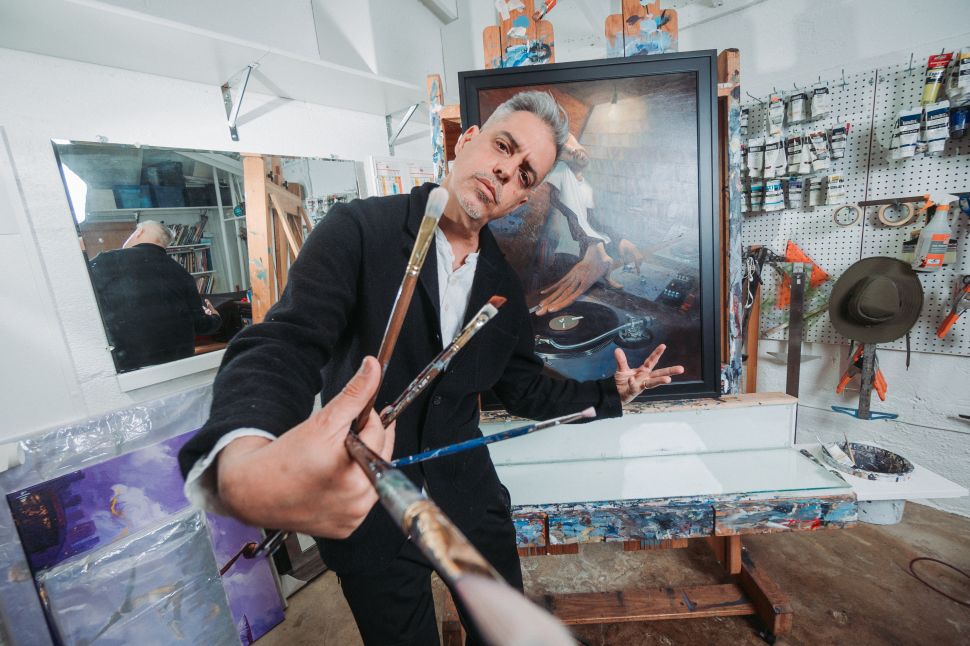
The piece depicts a Dutch-angled turntablist, mixing on a pair of Technics SL-1200 turntables beneath a single lightbulb in front of stacks of LPs, in what I always presumed was his own basement. To Bua’s point, the DJ isn’t mixing at a party or a show. Rather, he’s alone in his space, compelled to create something new. Therefore, according to Bua’s explanation, The DJ is a painting of the artist defined.
Bua’s art moves. Not literally, of course. By all definitions, his work is traditional. But, in his paintings and illustrations, he captures movement and sound and the beat of hip hop and the rhythm of breakdancing in a way that makes his work appear alive. His subjects are all elongated limbs and jutting jawlines with deep-set eyes that stare directly at the viewer, as if we’ve caught them in their heightened state of creation and release. “Dance, more than graffiti, really affected my work, in terms of the rhythm of everything,” he says.
His closest comp is perhaps Ernie Barnes, whose famous 1976 painting The Sugar Shack provided both the cover for Marvin Gaye’s I Want You record and the image for the closing credits of the hit 1970s sitcom Good Times, which Bua watched daily growing up. Like Bua’s, Barnes’ paintings possess a movement, a momentum and a soul that transcends the static images, frozen in time.
Bua, who recently moved to Texas after nearly 40 years in L.A., acknowledges the comparison. It’s one he’s no doubt heard a million times before and one that he welcomes. “Look, everybody is influenced by somebody else. Nobody created the fucking wheel. Everybody is a spoke.” But as quick as he is to acknowledge that he was influenced by Barnes, it was Barnes’s predecessor, the American painter Thomas Hart Benton, who Bua says has had a bigger impact on him as an artist.
Influence, he says, is impossible to avoid, whether it’s coming from other artists or the everyday. But, he adds, it’s essential for artists to filter those influences through their own lenses, to use the work of Caravaggio and the Rock Steady Crew, the sublime leap of Kobe Bryant or the expressionism of de Kooning to create something that is new, unique and the provenance of the artist’s singular point of view. Otherwise, it might just be performative bullshit. “There’s only one William Bouguereau,” Bua says. “The guy breaking the mirror? You or I can break the mirror.”
