
A kid from the Bronx once pressed his face to a department-store window, memorizing how Fred Astaire knotted a tie and how Cary Grant wore tweed. That kid was Ralph Lifshitz, born in October 1939 to Ashkenazi Jewish immigrants from Belarus, and the world he could only watch through glass became the one he sold to everyone else. He changed his surname to Lauren at 16. In 1967, a necktie salesman with no design schooling persuaded tie manufacturer Beau Brummell to let him cut his own neckwear—wide, opulent, four inches across when the era wanted skinny—and christened the line Polo, a sport he had never played. Bloomingdale’s bit. A menswear collection followed in 1968 on the strength of a $50,000 loan from Manhattan clothier Norman Hilton, then the mesh Polo shirt with its embroidered pony in 1972, and an empire took shape on a single idea: that American style could be invented, then exported.
What Lauren built was a fantasy of belonging—preppy Ivy, English country gentry, Old Hollywood glamour and the open range, all filtered through an outsider’s longing. Where Halston chased disco modernism and Calvin Klein stripped sportswear to sex and minimalism, Lauren sold heritage that never quite existed; Tommy Hilfiger later borrowed the blueprint at a younger price. He clothed Robert Redford’s Gatsby in 1974 and put his menswear into Diane Keaton’s Annie Hall in 1977. He turned the runway into a full-on spectacle, capped by the 50th-anniversary show at Central Park’s Bethesda Terrace in September 2018.
His vocabulary is instantly legible: the navy gold-button blazer, cable-knit and American-flag hand-knits, patchwork madras, bandanas and Western fringe, the cricket sweater, worn denim. He outfits Wimbledon, the U.S. Open and Team USA’s Olympians. In January 2025, President Biden gave him the Presidential Medal of Freedom—the boy at the window, now the dream itself. America turns 250 this year, and the look the country claims as its own came from one Bronx kid—clearest of all in how he dressed himself, decade after decade.
Ralph Lauren Style Evolution
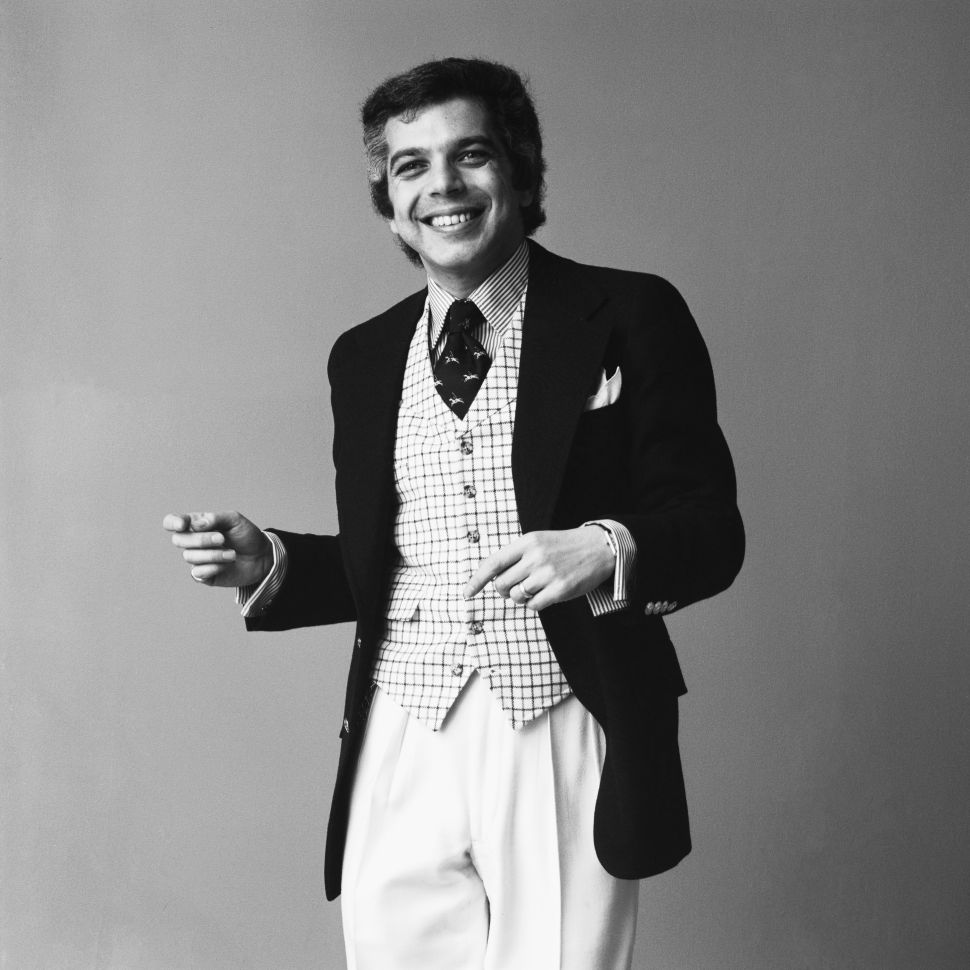
Early Polo Portrait
New York, c. 1970
Around 1970, the necktie salesman who had just launched Polo posed as his own best advertisement: a dark jacket open over a windowpane waistcoat, a bengal-striped shirt, pale trousers and the fat four-inch printed tie that made his name when the rest of Seventh Avenue had gone skinny.
Ralph Lauren in New York.
Jack Robinson/Getty Images
“Lauren: Candid Comments”
New York, 1973
By 1973, Lauren had a womenswear line, a freestanding store and a magazine profile headlined “Lauren: Candid Comments,” the soft, close-cut tailoring already locked in. Bloomingdale’s had just given him its first-ever in-store designer shop, and Hollywood was circling: within months, he would dress the men of 1974’s The Great Gatsby, including the custom pink suit worn by Robert Redford.
Ralph Lauren in New York.
Fairchild Archive/Getty Images
Resort 1978 Collection Presentation
New York, 1977
For the Resort 1978 shoot, Lauren balanced on a ledge against a riveted iron bridge in a denim-blue blazer worn like a chore coat, over faded jeans, a plaid shirt, knit tie and tan boots. Below him, his models worked the new prairie look in slip dresses and cowboy boots, the same season Diane Keaton’s Annie Hall sent his shirts and ties into every woman’s closet.
Ralph Lauren at his Resort 1978 photo shoot.
John Bright/Getty Images
“Man and the Horse” Met Gala
New York, 1984
On Dec. 3, 1984, the Costume Institute’s gala opened “Man and the Horse,” an exhibition of equestrian dress that Lauren himself bankrolled—a museum show devoted, more or less, to the source code of his own clothes. He wore black tie that night beside Diana Vreeland, the Costume Institute’s monarchical special consultant, as his English-saddle obsessions went under glass at the Met.
Ralph Lauren at the Metropolitan Museum of Art Gala for “Man and the Horse” Costume Exhibit.
Roger Eller/Getty Images
At Home in Montauk
Montauk, 1986
Photographed at his Montauk house, Lauren folds into a wicker chair by the windows in a navy “Mariner USA” crewneck with a striped cuff, a white shirt collar underneath, pale blue jeans and bare feet, a watch the only hardware. It is one of the few frames of him fully off the clock, lounging among the lacquer boxes and Imari of a house he composed as exactingly as any collection.
Ralph Lauren at his home in Montauk.
Dirck Halstead/Getty Images
Portrait with Audrey Hepburn
New York, c. 1990
Photographed with Audrey Hepburn for Women’s Wear Daily around 1990, Lauren plays host in a gray flannel double-breasted jacket, striped shirt and dark repp-stripe tie, the patrician foil to her ivory cowl-neck and white skirt. Two years on, Hepburn would present him the first Lifetime Achievement Award the CFDA ever gave—one of his lifelong muses handing him the trophy for a wardrobe she had half-inspired.
Ralph Lauren and Audrey Hepburn.
David Turner/Getty Images
Family Portrait
1992
Summer 1992, and Lauren turns up in the plainest possible dialect of his own label—a heather-blue crewneck tee, white shorts, rubber flip flops and a gold watch, sunglasses hooked in one hand. His wife and three children flank him in full Polo grammar: knotted oxfords, a plaid bandeau, crew socks with sneakers, penny loafers. The family wears the catalog; the founder wears his Sunday off.
Ralph Lauren and his family.
James Andanson/Getty Images
The Goldman Sachs Interview
1994
In 1994, Lauren sold 28 percent of his company to Goldman Sachs for a reported $135 million, the deal that teed up his 1997 IPO. He marked the occasion perched on his desk in a putty double-breasted suit thrown open over a black-and-white Breton-striped tee, no tie, sunglasses set down beside him, while the banker next to him wore the obligatory dark suit. Even signing away a chunk of the business to it, he refused to dress like Wall Street.
Ralph Lauren and executive Stephen Friedman.
David Turner/Getty Images
Fall 1996 Fitting
New York, 1996
Decades in, Lauren still worked the fittings himself, here adjusting a model in a suede safari jacket and liquid-bronze trousers, himself in the uniform he would wear for the rest of his life—a white logo crewneck, slim black jeans, a black Western belt and wingtip loafers. The clothes promised inherited leisure; the man pinning them had never taken a day off.
Ralph Lauren at his Fall 1996 Ready To Wear fitting.
George Chinsee/Getty Images
Fall 1998 Finale
New York, 1998
The finale walk had become Lauren’s standing cameo by 1998, and for it, he wore a dark shirt with the sleeves shoved back, dark pleated trousers and a pair of chunky running sneakers. Gym shoes under a designer’s curtain call looked like eccentricity then; he was early, by two decades, to the technical-sneaker gospel.
Ralph Lauren at the finale of his Fall 1998 Ready to Wear Runway Show.
Thomas Iannaccone/Getty Images
Fall 1999 Finale
New York, 1999
A year later, Lauren slipped into the Fall 1999 finale so far down he nearly vanished into his own lineup. This was peak Polo—the era when the label surfaced equally on Lo-Heads in Brooklyn and WASPs at Greenwich clubs, a demographic straddle almost no brand has pulled off before or since.
Ralph Lauren at his Fall 1999 Ready to Wear Runway Show.
Thomas Iannaccone/Getty Images
Spring 2000 Finale
New York, 2000
At the turn of the millennium, Lauren closed his Spring 2000 show in the shirt-and-jacket shorthand he had settled on back in the 1970s. While the runways around him chased Y2K futurism in vinyl, chrome and cargo straps, he sent out chambray and cable knit, betting, correctly, that the new century would still want a clean oxford.
Ralph Lauren at his Spring 2000 Ready to Wear Runway Show.
Robert Mitra/Getty Images
Fall 2001 Collection
New York, 2001
By 2001, Polo was a multibillion-dollar public company, and its founder still took his bow in pieces any shopper could lift off his own sales floor. He had outlasted nearly everyone he started against—Halston dead, Blass fading—and kept showing up each season looking faintly amused to be the one still standing.
Ralph Lauren at his Fall 2001 Ready to Wear Runway Show.
Thomas Iannaccone/Getty Images
Spring/Summer 2002 Runway
New York, 2001
Lauren walked this runway on Sept. 20, 2001, nine days after the towers fell, when the city was still arguing over whether fashion week should proceed at all. It did, and the flag he had been stitching into sweaters for decades meant something very different that September.
Ralph Lauren at his Ready to Wear Spring/Summer 2002 Runway Show.
Victor VIRGILE/Gamma-Rapho/Getty Images
Spring 2004 Collection
New York, 2004
The Spring 2004 season found the empire sprawling into fragrance, furniture and a Manhattan restaurant, and Lauren stepped out looking thoroughly at ease inside all of it, in dark layers, an open shirt and nothing flashier than a watch. Marc Jacobs and Michael Kors were the rising Americans now, but none of them controlled the whole picture the way Lauren did—down to the paint on the walls and the lampshades in the ads.
Ralph Lauren at his Spring 2004 Ready to Wear Runway Show.
Robert Mitra/Getty Images
Car Collection Exhibition
Boston, 2005
In February 2005, Lauren parked his car collection at Boston’s Museum of Fine Arts for the exhibition “Speed, Style and Beauty,” posing before the black 1938 Bugatti Type 57SC Atlantic, one of three on earth and the crown of a stable worth hundreds of millions. He met the press in a gray chalk-stripe double-breasted suit and silver tie—Jazz Age tailoring idling in front of a Jazz Age machine, the two drawn to the same religion of line.
Ralph Lauren at the Museum of Fine Arts.
MediaNews Group/Getty Images
Fall 2008 Show
New York, 2008
Lauren bowed for his Fall 2008 collection at Skylight Studios just as the markets began their freefall, head to toe in hard-times Americana: a beat-up brown leather biker jacket, black-and-white buffalo-check flannel over a white Henley, paired with faded jeans on a tooled-leather belt and scuffed harness boots. Not a blazer anywhere—just the rawhide-and-denim vision of men who built things, the season the men who shuffled paper were busy torching it.
Ralph Lauren at his fall 2008 show.
Fairchild Archive/Getty Images
February 2017 Runway
New York, 2017
For his February 2017 fashion-week show, staged inside the Ralph Lauren flagship on Madison Avenue, Lauren came out to wave against a wall of white orchids in a distressed tan suede moto jacket, a cream roll-neck, jeans and a heavy silver concho belt lifted straight from his own wardrobe. At nearly 80, he had quit courting the fashion press, opened his own store and let the industry come to him.
Ralph Lauren at his February 2017 show.
Desiree Navarro/Getty Images
SoHo Streetwear
SoHo, New York, 2018
A paparazzo caught Lauren on a SoHo sidewalk on Feb. 12, 2018, in the single most Ralph Lauren object imaginable—the navy double-breasted blazer with gold buttons—slung over a dark turtleneck with blue jeans and chunky black-and-red sneakers. There was no stylist and no set, just the founder on the street, which is exactly why the clothes never came off as costume.
Ralph Lauren in SoHo, New York.
Raymond Hall/Getty Images
CFDA Fashion Awards
Brooklyn, New York, 2018
Arriving at the 2018 CFDA Awards at the Brooklyn Museum on June 4, Lauren wore a black peak-lapel tuxedo jacket over an open-collar white shirt, cuffed jeans and a pair of neon Salomon trail runners—black tie from the waist up, trailhead from the ankles down. The man beside him kept to a proper tux and bow; Lauren, collecting yet another honor, looked ready to jog home.
Ralph Lauren attends the 2018 CFDA Fashion Awards.
Dimitrios Kambouris/Getty Images
Honorary Knighthood
Buckingham Palace, London, UK, 2019
In June 2019, the Prince of Wales made Lauren an honorary Knight Commander of the Order of the British Empire at Buckingham Palace, the first American designer ever knighted for fashion, in a gilt-and-crimson room that could have passed for one of his own showrooms. He accepted the medal in a black peak-lapel tuxedo, a small scarlet rosette already pinned at the lapel. A man born Ralph Lifshitz had just been decorated by the future British king for half a century spent perfecting an Englishness the English themselves had half-forgotten.
Ralph Lauren attends a private ceremony at Buckingham Palace.
Victoria Jones/Getty Images
Presidential Medal of Freedom
Washington, DC, 2025
On Jan. 4, 2025, in the White House East Room, President Biden hung the Presidential Medal of Freedom—the nation’s highest civilian honor—around Ralph Lauren’s neck. He kept it sober in a dark suit and tie; of the 19 people decorated that day, none had stitched the flag into more cable knits.
Ralph Lauren attends the 2025 Medal Of Freedom Ceremony.
Tom Brenner/Getty Images
September 2025 Show Arrival
New York, 2025
More than 60 years married, Ralph and Ricky arrived together at his September 2025 show—she in crisp navy-blazer tailoring, he at 85 in full outlaw mode: a weathered brown leather jacket, black roll-neck, black jeans, aviators and an oversized silver concho buckle. Ricky brought the polish; Ralph rode in like he meant to rob the bank.
Ralph Lauren attends his September 2025 show.
Gilbert Carrasquillo/Getty Images
February 2026 Runway Finale
New York, 2026
Lauren capped the February 2026 finale against a marble colonnade in a green-and-navy tartan blazer with brass buttons over a black turtleneck, black jeans and black sneakers. At 86, he is the longest-running act in American fashion, and the jacket lands like a closing rhyme: he opened his career in a windowpane waistcoat and a fat tie, and ends a half-century later in plaid and black denim, the grammar unchanged.
Ralph Lauren attends his February 2026 show.
Dia Dipasupil/Getty Images
