
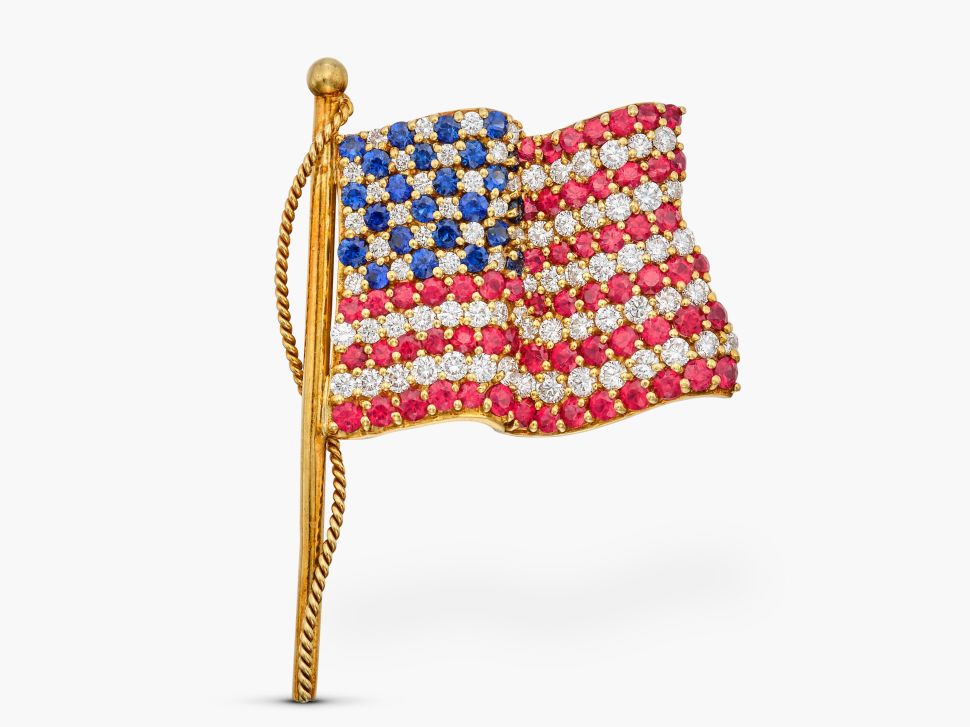
While European jewelry houses were shaped by royal courts, aristocratic patronage and centuries of tradition, American jewelers emerged from a culture of entrepreneurship, industrial innovation and self-made wealth. The result was a distinct American style—bold, technically innovative, gemstone-driven and often less constrained by convention. Beginning in the 19th Century, firms including Tiffany & Co., Marcus & Co., J.E. Caldwell, Bailey Banks & Biddle, Harry Winston, David Webb, Oscar Heyman, Verdura, Raymond Yard and Seaman Schepps helped redefine luxury jewelry, creating an American tradition that eventually influenced collectors and designers around the world.
Now, cultural institutions around the country are using America’s 250th anniversary to bring attention to American artists and designers in several creative fields, including jewelry. In New York, for instance, Sotheby’s “250 Years of American Art & Culture” selling exhibition includes a special display of archival and contemporary creations from David Webb. The display will include a never-before-shown aquamarine suite from the 1950s, a newly conceived iteration of David Webb’s iconic Totem Necklace, vintage coral pieces and emerald and sapphire one-of-a-kind brooches from the 1960s. “We didn’t think but two minutes that it would be David Webb. They’ve been great friends for years,” Frank Everett, Sotheby’s vice chairman of jewelry, told Observer. “He is the quintessential American jeweler. It was just the perfect fit.”
Maverick designs and salesmanship as defining qualities
According to Everett, two defining factors set American jewelers apart from their European peers. The first is their rebellious nature when it comes to design: “I think there’s just a real maverick spirit here. I don’t mean just innovating. I think it’s one thing to be an innovator, and it’s another to be a maverick. When you look at someone like Louis Comfort Tiffany, who focused so much attention on American materials and American stones, things like Montana sapphires that had never been used before, and then using materials in unusual combinations. I think that was quite ahead of his time, kind of groundbreaking. Then fast forward to David Webb in the 1960s and ’70s, it was the same kind of thing. He was famously known to go to the Metropolitan Museum of Art every Saturday, and he just combined all kinds of influences that he saw there in a kind of an unorthodox way. He just did what he wanted to do, and the boldness was beyond.”
The second defining factor was that many of the major jewelry houses were run by salesmen. “So many of the great companies were entrepreneurial,” Everett said. “Harry Winston was a salesman. Raymond Yard had a 20-year career as a salesman. Same with Paul Plato, and even Charles Lewis Tiffany (who founded Tiffany & Co.). He started out as a stationery salesman and then moved into jewelry. I think that entrepreneurial spirit is pure America.”
Meanwhile, New Orleans antiques dealer M.S. Rau is hosting a virtual exhibition, “American Icons: Artists who Defined a Nation 1776-2026.” Elle Spurr, a researcher, writer and specialist at M.S. Rau, told Observer that American jewelers helped define a luxury identity rooted in ingenuity, ambition and self-invention: “From the artistic vision of Louis Comfort Tiffany to the legendary diamonds of Harry Winston, the exceptional gemstones of Oscar Heyman and the daring designs of David Webb, American makers proved that this country could produce objects of extraordinary refinement and originality. Their work reflects the rise of American wealth, taste and confidence on the world stage.”
Asked about her picks for a museum exhibition that would best represent the American experience in jewelry, she said, “Tiffany would establish the foundation of American luxury, Marcus & Co. would represent turn-of-the-century artistic refinement. Oscar Heyman would stand for technical mastery and gemstone excellence. Harry Winston would anchor the story of the important diamond. And David Webb would bring in the bold, sculptural confidence of mid-century American design. Together, they tell the story of American jewelry from refinement to reinvention.”
American influence abroad
It is commonly believed that American high jewels were influenced by European master jewelers, but Ariel Saidian of Joseph Saidian & Sons, a New York-based antique and vintage jewelry dealer, argued that America’s success in high jewelry design also influenced the major European houses. “I think great American jewelry has influenced the great European maisons in that not every detail of a jewel needs to be extremely refined,” he told Observer. “An American-made jewel that may be a bit more clunky or heavy or bold compared to how the same item was manufactured in Paris, for example, does not mean anymore that is ‘worse.’ In fact, I think the more audacious and bold American style is much more popular worldwide now. Far East clients who did not even know brands such as Verdura and David Webb 15 years ago, cannot get enough of them today.”
David Webb is one of a few American jewelry houses that have remained faithful to its founding aesthetic. Although Webb died in 1975, the company continues to produce jewels based on his original designs—bold creations defined by sculptural hammered gold, oversized colored gemstones and striking enamel work. Today, the jeweler is majority owned by two investment firms.
Webb was born and raised in Asheville, N.C., and moved to New York in the 1940s to become a jeweler. “From the start, he was fulfilling a very American dream of upward mobility and chasing his heart’s wildest desire,” Levi Higgs, head of archives and brand heritage at David Webb, told Observer. “Aside from his origin story, perhaps the most distinctly American aesthetic qualities of David Webb’s jewels are their bold forms and proportions, and an overall design vocabulary developed through an amalgamation of varied cultural and historical influences.”
Higgs oversees the preservation of the company’s heritage while continuing to make the brand relevant to contemporary clients. “David Webb was one of the few visionaries who propelled women into a modern and contemporary age through jewelry,” he said. “His work embodies the peak of American luxury—a moment in the second half of the 20th Century when luxury became bold and uncompromising. He listened to his clients and let them be his muses in many ways. The zeitgeist of the 1960s and ’70s has always been a lightning rod for identifying the strength of the American sensibility, and David Webb was firmly of this moment, and continues to be relevant today.”
The immigrant stories behind American jewels
While David Webb represents a distinctly homegrown American success story, many of the nation’s greatest jewelry houses were founded by immigrants who adapted Old World craftsmanship to a rapidly changing American marketplace. The founder of Marcus & Co., Herman Marcus, was born and raised in Germany and moved to New York in 1850. Duke Fulco di Verdura, a Sicilian aristocrat, founded the Verdura jewelry salon in New York. Harry Winston was the son of Ukrainian immigrants.
The story of high jewelry brand Oscar Heyman is also very much an immigrant story. The company was founded by Oscar and Nathan Heyman, who immigrated to the United States from Latvia in the 1900s. The brothers were among the few American jewelers who could work with platinum; Oscar was the first non-French craftsman at Pierre Cartier’s Manhattan workshop.
When the rest of the Heyman family came to America in 1912, Oscar and his brothers founded Oscar Heyman & Bros., which quickly became a preferred workshop for many of America’s leading jewelry houses, particularly for platinum jewelry, at a time when few American craftsmen possessed that expertise. Between the company’s founding in 1912 and 1942, Oscar Heyman secured seven patents related to jewelry making, and the firm soon earned a reputation for its superb craftsmanship and creative use of exceptional colored gems.
The firm remains family owned, led currently by third-generation president Tom Heyman and second-generation CEO Adam Heyman. It’s one of the few important American high jewelry companies still owned by the original family and also one of the few to still have a full-service workshop on Madison Avenue.
“Like many of their time, they worked seven days a week for decades to serve their customers,” Tom Heyman told Observer. “When the company was originally founded, the brothers and many of their family members all worked together to build the business and establish the esteemed reputation that we now enjoy. My cousin Adam and I feel grateful to be able to carry on the family and company legacy.”
Following World War II, Oscar Heyman was the first American jeweler to source gemstones directly from miners and cutters in Asia. “Our stone sourcing team continues to travel internationally to view the largest assortment of gems so that they may sort through thousands to arrive at what they believe are the very best,” Tom Heyman explained. “Oscar Heyman stands out particularly in our use of rare and esoteric gemstones, such as alexandrites, black opals and Paraíba tourmalines.” It is also one of the few high jewelry firms that does nearly all its business within the jewelry trade, preferring to sell through retailers, rather than directly to consumers.
250 years after the nation’s founding, America’s greatest jewelers gave rise to an aesthetic rooted not in inherited aristocracy but in exceptional craftsmanship driven by innovation. In the hands of immigrants, salesmen and self-taught mavericks, jewelry ceased to be a record of bloodlines and became something more democratic and daring, not to mention unmistakably American: a record of ambition.
