
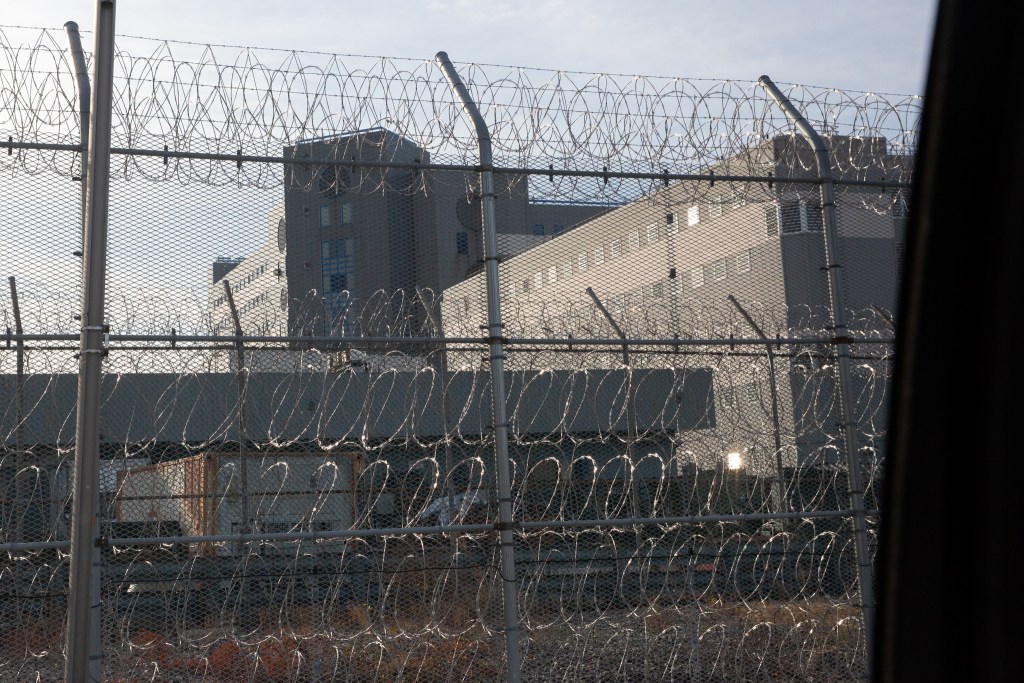
The court-appointed remediation manager overseeing Rikers Island has ordered the city to overhaul key parts of the troubled jail system, calling for hiring new investigators to police officer misconduct, a $50 million expansion of educational and other programs for detainees and a pilot revamp of solitary confinement.
In a 33-page action plan filed Wednesday — six months after his appointment — Nicholas Deml ordered the Department of Correction to improve everything from internal investigations and staffing to fixing broken cell doors and quickly reporting serious security breaches.
U.S. District Judge Laura Swain appointed Deml, a former CIA officer who most recently led Vermont’s prison system, after concluding years of court oversight had failed to bring the jail system into constitutional compliance.
Deml cautioned that meaningful change will take time.
“The failures that define these jails developed over many decades and will not be resolved overnight,” his report said. “Yet these conditions can be reversed.”
His report opens with two vivid examples of why he believes dramatic intervention is necessary.
Fire and Brawls
During one of his team’s first walk-throughs of the Rose M. Singer Center for women detainees on Rikers, they entered a housing unit filled with smoke from fires set by people in custody. The air carried what the report described as a chemical odor, likely from burning synthetic materials. Fire alarms echoed through the housing area, as detainees pounded on their cell doors, while others sat shackled to restraint desks.
A correction officer simply shrugged, according to the report, as though it were “another day on Rikers.”
In another incident at the George R. Vierno Center on Rikers, nearly 30 detainees became involved in a violent fight after officers failed to secure doors connecting two housing units.
Detainees armed themselves with broomsticks and mop buckets taken from unsecured janitorial closets. A single officer eventually dispersed the melee with chemical spray.
Criminal justice reform advocates protest against detainee deaths at Rikers Island, Feb. 28, 2022. Credit: Ben Fractenberg/THE CITY
Rather than prompting sweeping operational changes, Deml wrote, both incidents were treated as routine. Between January and May, people in custody set 130 fires and were involved in 2,978 fights, according to his report filed in federal court.
Among the most significant directives, Deml ordered the corrections department to dramatically expand the number of investigators examining allegations of staff misconduct, spend an additional $50 million on educational, vocational and therapeutic programming and establish a pilot housing unit that would offer an alternative to solitary confinement for people who commit serious acts of violence.
He also directed the department to develop plans to improve staffing, repair broken infrastructure, strengthen emergency reporting procedures and better manage day-to-day jail operations.
Deml wrote that the city has a rare opportunity to remake its jail system, pointing to new leadership under Commissioner Stanley Richards, the court’s appointment of a remediation manager and the planned transition to borough-based jails.
The Legal Aid Society, the city’s largest public defender organization, praised the plan’s emphasis on expanding programming.
“We applaud the Plan’s focus on increasing both the volume and variety of programming, as well as engaging community-based service providers,” the organization said in a statement.
The Hard Parts
But the action plan is also notable for what it leaves untouched: how to address the growing number of detainees with serious mental illness or overhaul the disciplinary system for officers accused of brutality.
Deml does not propose a strategy for reducing the jail population, which remains well above the roughly 4,400 people envisioned under the city’s plan to close Rikers Island. As of Wednesday, 6,576 people were being held in city custody.
For years, the Department of Correction and Correctional Health Services have struggled to provide adequate treatment for mentally ill detainees despite creating specialized therapeutic housing units known as CAPS and PACE. Those units have consistently fallen short of demand.
Earlier this year, Mayor Zohran Mamdani announced the opening of a long-delayed 104-bed therapeutic unit at Bellevue Hospital intended to house detainees with acute mental health needs. The project, however, nearly doubled in cost, climbing from $130 million to $241 million.
The report also stops short of recommending specific changes to the department’s long-criticized disciplinary system for correction officers accused of using excessive force, despite years of findings by the federal monitor documenting staff brutality and weak accountability.
The action plan also calls for a comprehensive analysis of how correction officers are deployed throughout the department, a politically fraught issue that has stymied previous reform efforts.
Several years ago, Steve Martin, the court-appointed federal monitor, hired corrections expert James Austin to conduct a similar staffing review. The report was never made public, and DOC never implemented any sweeping changes.
Today, officers with the most seniority — or the strongest political connections, according to current and former DOC officials — are often assigned away from housing units and into coveted posts at department headquarters in the Bulova building in East Elmhurst, perimeter security or courthouse assignments. That has left many jail housing areas staffed by less experienced officers.
Our nonprofit newsroom relies on donations from readers to sustain our local reporting and keep it free for all New Yorkers. Donate to THE CITY today.
The post Rikers Remediation Manager Unveils Blueprint for Overhauling City Jails appeared first on The City Reporter.
