
Power in artificial intelligence has stopped moving through the channels everyone was trained to watch. There was a time (not long ago, though it already feels quaint) when you could rank the field by compute and capital raised, and the ranking would roughly match reality. That scoreboard no longer explains who wins.
There are other A.I. Power Lists—Observer is not naive about that—but ours asks one question and holds to it: Who, over the last twelve months, has controlled the flow of capital in artificial intelligence? The money, where it moves, who moves it and who is waiting.
The honorees below make decisions that everyone (downstream and up) follows, but the mechanisms of power in A.I. shift faster than in any other sector that history has ever chronicled, so whether their leverage compounds is a question we look forward to asking next year.
The Most Powerful People in A.I.
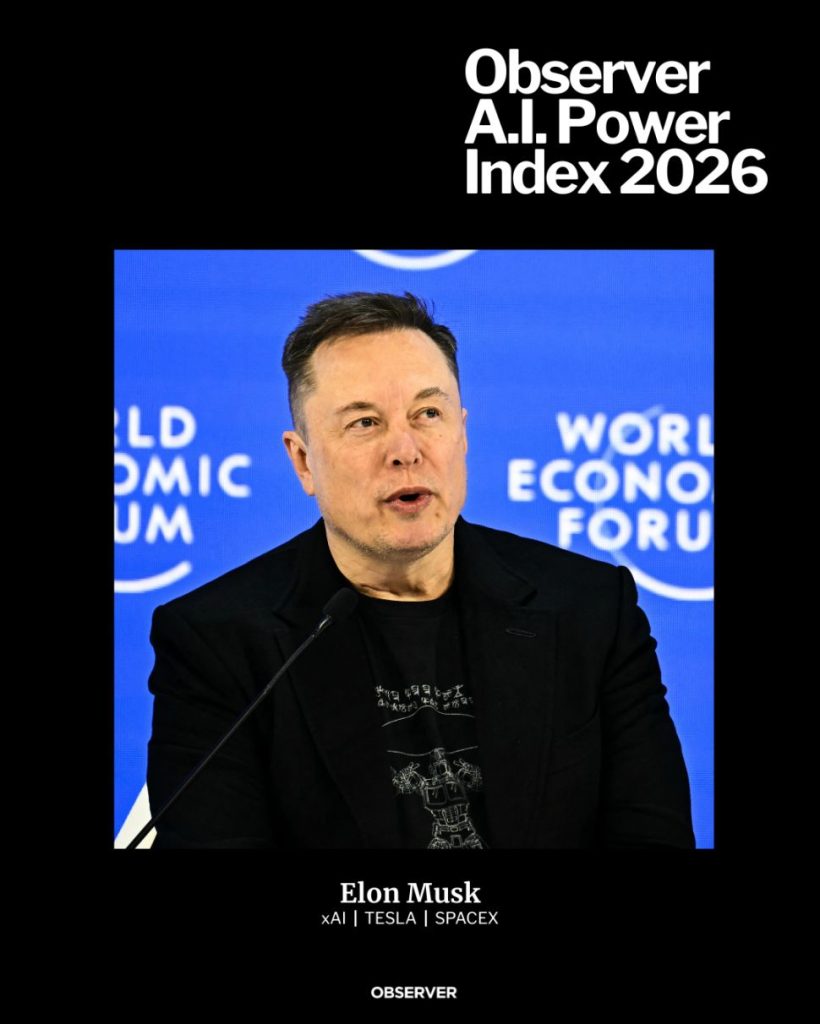
Elon Musk
Founder of xAI; CEO of Tesla & SpaceX
Elon Musk became the A.I. industry’s largest disruptor and financier this year after rolling his LLM, social media and space businesses into a $1.75 trillion juggernaut debuting on Nasdaq. In February, Musk’s SpaceX acquired xAI, which had absorbed the social media platform X the previous year, in a deal that valued SpaceX at about $1 trillion and xAI at $250 billion. The series of deals fused rocket and satellite production, internet services, A.I. research, data centers and social media into one vertically integrated tech giant. It also formalized Musk’s lifelong ambition to build an all-encompassing business empire under the “X” brand.
Musk’s long-term goal is to move the energy-intensive process of running A.I. systems off-planet. In SpaceX’s IPO filings, he pitched the idea of space-based data centers using satellites and solar power, which would be vastly cheaper than land-based infrastructure. SpaceX has filed for permission to put as many as one million satellites in Earth’s orbit. Musk estimates the technology could be cost-competitive in two to three years.
In March, Musk unveiled Terafab, a massive semiconductor initiative designed to give Tesla, SpaceX and xAI direct control over the chips powering their A.I. systems. The project’s ultimate goal is to generate one terawatt of annual compute capacity. The initial phase is estimated to cost $55 billion, with total investments projected to reach $119 billion. Musk’s team has already begun reaching out to supply partners with the goal of beginning silicon production by 2029.
Terafab plans to use Intel’s next-generation 14A process for eventual mass production in Grimes County, Texas. In April, Tesla broke ground on an initial $3 billion R&D pilot facility at Tesla’s Giga Texas in Austin. This research fab will test and prototype chips for Tesla’s cars and Optimus robots at a limited scale.
Elon Musk.
Getty Images
Sundar Pichai
Sundar Pichai spent the past year proving that Google can keep pace in A.I. without compromising the business it already has. Alphabet’s share price doubled over the past 12 months, while most of its Big Tech peers moved far less, and the company has backed that confidence with heavy spending. After investing about $91 billion in 2025, it lifted its projected 2026 capital expenditure to between $180 billion and $190 billion.
Alphabet has already crossed the $100 billion quarterly revenue mark, and Google Cloud has continued to post strong growth. Gemini has also reached a wide audience, surpassing more than 900 million monthly active users, and “AI Mode” in Search has passed 1 billion monthly users, Pichai said at Google I/O in May.
Pichai has argued that A.I. is becoming central to how Google works and how people search, write and code. At Cloud Next in April, he highlighted Google’s internal use of A.I., saying 75 percent of new code at the company is now A.I.-generated and then reviewed by engineers, up from 50 percent the previous fall. He also unveiled Google’s eighth-generation Tensor Processing Units, built for heavy training workloads.
That same month, Google introduced Gemini Enterprise Agent Platform, aimed at helping companies manage fleets of A.I. agents rather than just experiment with them. Pichai’s broader message is that Google wants to control the full stack, from A.I. chips to Search and Android, while keeping users inside its own ecosystem. That makes this a much bigger bet than a simple Gemini-versus-ChatGPT contest.
Sundar Pichai.
Getty Images
Dario Amodei
Co-Founder & CEO, Anthropic
Anthropic, currently the world’s most valuable private A.I. startup valued at $965 billion, is poised for a trillion-dollar public market debut. It’s a remarkable ascent for a company that was seen as a cautious alternative to OpenAI just a few years ago. In May, Amodei said Anthropic had posted an 80-fold annual increase in revenue and usage in the first quarter of 2026, pushing projected annualized revenue past $47 billion.
That growth has come alongside sharper political and regulatory scrutiny. After Anthropic temporarily suspended access to Claude Fable 5 in June, Amodei argued in an essay that governments should be able to block or delay deployment of models judged, on the basis of third-party assessment, to pose unacceptable risks. He followed that by announcing $200 million for research into public policy on A.I. and another $150 million for a national fellowship aimed at spreading the benefits of A.I. more broadly across the U.S.
Meanwhile, the company’s appetite for compute continues to grow. In April, Amodei secured 5 gigawatts of next-generation compute capacity with Google and Broadcom, beginning in 2027, to support future frontier models. Anthropic has also committed more than $100 billion over ten years to Amazon cloud infrastructure in exchange for up to 5 gigawatts of additional capacity, while Amazon has said it will invest as much as $25 billion in the company.
In addition, Anthropic has announced a $50 billion data center buildout in Texas and New York. It has also pledged $30 billion toward Microsoft Azure compute and agreed to buy up to 1 gigawatt of Nvidia hardware.
Dario Amodei.
Getty Images
Mark Zuckerberg
Founder, Chairman & CEO of Meta
Mark Zuckerberg overhauled Meta’s A.I. team last year after deciding that simply playing catch-up was no longer enough. In June 2025, Zuckerberg launched Meta Superintelligence Labs to pursue advanced machine intelligence and tapped Alexandr Wang, the Scale AI co-founder and former chief executive, to lead the effort after Meta took a $14.3 billion 49 percent stake in his company. Since then, MSL has absorbed Meta’s FAIR (Fundamental AI Research) team in an effort to unify frontier-model development with product deployment.
Zuckerberg has said he would rather risk “misspending a couple of hundred billion” than fall behind in A.I. That urgency has carried into 2026, with Meta raising its capital spending forecast to as much as $145 billion, after spending $72.2 billion in 2025. This week, the company announced plans to begin producing its custom Iris A.I. chip in September in an effort to double computing capacity.
For now, Meta’s ad business is still strong enough to bankroll the ambition. The company generated $201 billion in revenue last year and is on pace to reach roughly $250 billion this year, according to Wall Street estimates. In the first quarter of 2026, Meta generated $56.3 billion in revenue—a 33 percent year-over-year increase—and $26.8 billion in net income.
Over the past year, Meta’s major A.I. releases have included April’s Muse Spark, the first major model out of MSL, the new Meta Glasses in June and Muse Image in July. Zuckerberg has cast the effort as a bid to build “personal superintelligence,” and he has said Meta will keep shipping products throughout the year rather than wait for a single breakthrough. With apps that already reach billions of users, Meta has a distribution advantage that rivals still have to buy.
He has also been candid about the growing pains. In May, Meta notified roughly 8,000 employees of layoffs and reassigned about 7,000 others to A.I.-focused roles as part of a broader reorganization. Zuckerberg has acknowledged how hard the transition has been, telling employees in July that A.I. agent development had not accelerated as quickly as expected. In July, Meta also expanded its Hyperion data center in Louisiana to five gigawatts of planned computing capacity, increasing the project’s expected investment to more than $50 billion.
Mark Zuckerberg.
Courtesy of Meta
Sam Altman
Founder & CEO of OpenAI
On February 27, Sam Altman closed a $110 billion funding round for OpenAI at a $730 million pre-money valuation. On March 31, OpenAI closed the expanded round with $122 billion in committed capital at an $852 billion post-money valuation, in what was likely the largest private technology financing to date. The funding included $50 billion from Amazon, $30 billion from Nvidia, and $30 billion from SoftBank, with Microsoft and additional financial investors contributing to the expanded round. The financing reshaped OpenAI’s partnerships. Amazon Web Services became the exclusive third-party cloud provider for the company’s enterprise platform, Frontier. This prompted Microsoft and OpenAI to renegotiate their longstanding partnership. In April, the two companies amended their agreement, easing exclusivity terms to allow OpenAI to operate across multiple clouds while keeping Azure as the primary platform. Meanwhile, OpenAI’s chatbot, ChatGPT, surpassed 900 million weekly users and 50 million paying subscribers as of February of this year.
Growth came at a price. OpenAI burned $3.7 billion in Q1 2026 alone against $5.7 billion in revenue. At the company’s “Intelligence at Work” event on June 2, Altman acknowledged that enterprise customers have become increasingly weary of costs after spending much of the year chasing model capability.
Days after the Capitol Hill appearance came a rupture with OpenAI’s most important distribution partner. On July 10, Apple sued OpenAI in federal court in Northern California, alleging trade secret misappropriation and breach of contract in the development of OpenAI’s unreleased consumer hardware. The complaint names hardware chief Tang Tan, a former Apple vice president, and engineer Chang Liu as defendants alongside io, the Jony Ive venture OpenAI acquired for $6.5 billion, and claims the misconduct ran “at every level” of the company.
Apple, which says more than 400 of its former employees now work at OpenAI, is seeking damages and an injunction barring OpenAI from using its trade secrets. “We have no interest in other companies’ trade secrets,” an OpenAI spokesperson said. The suit further strains, but has not formally ended, the 2024 partnership that put ChatGPT inside the iPhone, and lands squarely on the two bets Altman has staked the next phase on: the hardware device expected this year and the IPO the company continues to weigh.
Sam Altman.
Getty Images
Jensen Huang
Founder & CEO of Nvidia
Last year, Nvidia’s data center revenue grew more than 140 percent from the previous year to $115 billion, accounting for the vast majority of its total revenue. The company’s Blackwell platform alone generated $11 billion in its first quarter of production, the fastest product ramp in Nvidia’s history. These numbers speak more than a runaway demand for GPUs; they illustrate Nvidia’s absolute grip on the physical infrastructure powering A.I. globally.
That reach is increasingly global. In June, Jensen Huang used a trip to South Korea to line up a web of partnerships with SK Group, Naver, LG Group, Hyundai and Doosan. The most important deal was a multi-year agreement with SK Hynix, which helps secure Nvidia’s supply of advanced memory for its Vera Rubin supercomputing platform. SK Telecom also committed to building a gigawatt-scale A.I. cloud environment around Nvidia’s architecture, while Hyundai outlined plans for an A.I. Valley testing hub for autonomous systems.
Huang has also used Nvidia’s giant balance sheet as a weapon. Through NVentures, the company’s venture arm, Nvidia has backed a growing list of startups across enterprise software, infrastructure and robotics, giving Huang outsize influence over which young companies get capital, compute and customers. At the same time, he has become one of the loudest public voices on U.S.-China export controls and the politics of semiconductor power, a role that now reaches far beyond Silicon Valley.
In May, Huang delivered Carnegie Mellon’s commencement address and made his familiar case that A.I. is less a threat than a tool to be mastered. “A.I. is not likely to replace you,” he told graduates. “But someone using A.I. better than you might. Do not fear the future—guide it.” In July, Nvidia also shipped a limited number of H200 chips to China, a reminder that even amid tighter restrictions, the company still sits at the center of the global contest for compute.
Jensen Huang.
Courtesy of NVIDIA
Prince Mohammed bin Salman
Chairman of Public Investment Fund
Crown Prince Mohammed bin Salman chairs Saudi Arabia’s Public Investment Fund (PIF), a $900 billion sovereign wealth fund that backed HUMAIN, a PIF-owned A.I. company that will build data centers, cloud infrastructure, frontier models and A.I. applications.
Launched in May of 2025, HUMAIN quickly became the Kingdom’s A.I. dealmaking vehicle. Amazon Web Services committed to invest more than $5 billion in an A.I. Zone in Saudi Arabia for AI infrastructure, services and talent development. In May 2025, they expanded their partnership with Nvidia, which agreed to supply hundreds of thousands of GPUs over five years, beginning with 18,000 Blackwell GPUs. AMD announced a $10 billion collaboration to build 500 megawatts of A.I. computing infrastructure over that same time frame.
Under Salman’s leadership, in February 2026, HUMAIN invested $3 billion in xAI, becoming a significant minority shareholder before the stake converted into SpaceX equity following Elon Musk’s merger of the two companies. HUMAIN’s Chat feature, powered by the Arabic-first large language model, ALLaM, targets government and enterprise applications for more than 400 million Arabic speakers. The Saudi Data and Artificial Intelligence Authority (SDAIA) says its programs have trained more than one million Saudis in A.I. skills within a year.
Prince Mohammed bin Salman.
Getty Images
Stephen A. Schwarzman
Chairman, CEO & Co-Founder of Blackstone
Stephen A. Schwarzman has long believed that artificial intelligence will be one of the most significant technological shifts of our lifetime and has positioned Blackstone, the world’s largest alternative asset manager, as a leading investor across the A.I. value chain.
In 2018—long before A.I. was front of mind for most—Schwarzman made a $350 million donation to MIT to establish the Schwarzman College of Computing, a landmark initiative aimed at advancing A.I. research and integrating computing across disciplines. The gift helped reorient MIT to address the opportunities and challenges presented by the rise of A.I., including critical ethical and policy considerations. The following year, he contributed $250 million to Oxford University to establish the Schwarzman Centre for the Humanities, which opened in 2025 and includes the Institute for Ethics in A.I. This giving catalyzed further investment in A.I. by universities around the world.
Schwarzman’s early conviction has made Blackstone one of the largest investors in A.I.-related infrastructure in the world—and the largest and most active investor in data centers globally. The firm currently has $150 billion+ of data center assets, including those under construction, and another $160 billion in the development pipeline.
In the first half of 2026, Blackstone announced a new A.I.-native enterprise services company with Anthropic, launched a strategic partnership with Google that includes an initial $5 billion equity commitment to build a U.S.-based TPU-powered cloud platform, took a data center company public (BXDC), and established BXN1, a dedicated platform for investing across the rapidly expanding A.I. ecosystem.
In April, Schwarzman joined President Donald Trump in Beijing for a two-day summit with Chinese President Xi Jinping, alongside other leading CEOs, to advance U.S.-China dialogue on trade, semiconductor exports, artificial intelligence and more.
Stephen A. Schwarzman.
Courtesy of Blackstone
Satya Nadella
CEO of Microsoft
Microsoft’s $13.8 billion investment in OpenAI translated into a 27 percent stake valued at roughly $135 billion after the company restructured into a public benefit corporation in October 2025. Satya Nadella preserved Microsoft’s rights to OpenAI’s intellectual property through 2032, including future frontier models under the revised agreement.
Nadella spent the following months protecting that position. In February, after Amazon announced a $50 billion investment in OpenAI and became the exclusive third-party cloud provider for its Frontier enterprise platform, Microsoft publicly asserted its contractual rights before renegotiating the partnership in April. The revised agreement preserved Microsoft’s nonexclusive IP license through 2032 while keeping Azure as OpenAI’s primary cloud platform.
Microsoft’s own A.I. business keeps growing. Azure revenue grew 40 percent year over year in the fiscal third quarter of 2026. Microsoft 365 Copilot crossed 20 million paid seats in April, up from 15 million three months earlier. Microsoft also landed its largest Copilot deployment to date, rolling the software out to roughly 743,000 Accenture employees in April. Rather than owning every frontier model, Nadella is making its product offerings the infrastructure through which enterprises buy, deploy and manage them.
As Nadella put it in a long essay on X posted on June 14, “The real opportunity is not in picking the best model but instead in building a learning loop on top of models where human capital and token capital compound.”
Satya Nadella.
Courtesy of Microsoft
Liang Wenfeng
Founder & CEO of DeepSeek
In June 2026, DeepSeek CEO Liang Wenfeng raised more than $7.4 billion in the company’s first external financing round, valuing DeepSeek at more than $50 billion and making it China’s most valuable A.I. startup. The round came just 18 months after DeepSeek’s R1 model challenged industry assumptions about the cost of training frontier A.I. models, with the chatbot trained for a mere $6 million. Following the June funding round, Liang’s net worth has more than doubled to roughly $36 billion, making him the world’s richest creator of A.I. models.
Only a month after completing its first outside financing, DeepSeek entered preliminary talks for another round that could value the company at roughly $71 billion before the new investment. The company has also reportedly begun preparing for a possible IPO, potentially giving Liang access to public-market capital as DeepSeek builds its own data center and acquires more chips for autonomous A.I. agents.
Liang structured the financing to preserve his control. Most investors, including Tencent, CATL, JD.com, NetEase and IDG Capital, invested through a limited partnership that Liang manages, accepted a five-year lock-up and received no voting rights. China’s National Artificial Intelligence Industry Investment Fund invested directly, making it the only major investor to receive voting rights.
The financing marks a shift for a company that long rejected outside capital. DeepSeek plans to use the proceeds to expand its compute infrastructure, retain researchers and commercialize its next-generation models, including DeepSeek V4. It will continue its open-weight approach despite U.S. sanctions and export restrictions on advanced chips, seeking innovative ways to achieve more for less.
Liang Wenfeng.
Getty Images
Sheikh Tahnoon bin Zayed Al Nahyan
UAE National Security Advisor; Chairman of G42 & MGX
Nobody moves A.I. capital at the scale UAE National Security Advisor Sheikh Tahnoon bin Zayed Al Nahyan does. Through MGX, he has backed OpenAI, Anthropic, xAI and Databricks and joined the $500 billion Stargate project as a partner. His G42 holds a $1.5 billion investment from Microsoft. In July, the U.S. Commerce Department reclassified the UAE’s export status, granting G42 license-free access to buy cutting-edge A.I. chips and servers from firms like Nvidia and AMD. Tahnoon also chairs the $790 billion Abu Dhabi Investment Authority and controls a separate $1.3 trillion business portfolio.
President Trump flew to Abu Dhabi in May 2025 and the two countries unveiled Stargate UAE, a 5GW A.I. campus spanning 10 square miles and the largest data center deployment outside the U.S. In March, Tahnoon visited the White House, pledged $1.4 trillion in U.S. investment over a decade, and helped secure 500,000 advanced Nvidia chips annually for the UAE, with one-fifth going to G42.
But a $500 million stake in President Trump’s family’s World Liberty Financial, taken by Tahnoon-backed Aryam Investment in January 2025 and months before the chip deal closed, drew Congressional corruption accusations. Tahnoon has not publicly commented.
“Today’s agreement is a testament to the ongoing collaboration between our countries in artificial intelligence,” Tahnoon said at the May 17 unveiling of Phase 1 of a 5-gigawatt A.I. campus in Abu Dhabi. The polished language belies what he built: the largest A.I. infrastructure deal in the Middle East, funded by oil money and sealed with a presidential handshake.
Sheikh Tahnoon bin Zayed Al Nahyan.
Getty Images
Patrick Collison
Co-Founder & CEO of Stripe
With 86 percent of the Forbes A.I. 50, 90 percent of the companies in the Dow Jones Index and 80 percent of the NASDAQ 100 using Stripe—including OpenAI, Anthropic, Midjourney and Cohere—co-founder and CEO Patrick Collison has positioned the payments platform as a core piece of economic infrastructure behind A.I. companies. At Stripe Sessions 2026 in April, the company said businesses on its platform processed $1.9 trillion in total volume in 2025, up 34 percent year over year, a growth rate roughly 17 times that of the global economy.
In July, Collison expanded a partnership with fintech company Cross River as part of a broader strategy to build out agentic commerce, which allows A.I. agents to make purchases on a user’s behalf with a restricted, single-use virtual card via their Link wallet. The technology is designed to meet strict know-your-customer (KYC) and anti-money laundering regulatory requirements. Agentic commerce is poised to reach $1.5 trillion in spending by 2030, according to Juniper Research, and the firm projects $8 billion in transaction value for 2026. Collison’s advancement in the space, spearheaded in part by its early 2025 acquisition of token infrastructure company Bridge for $1.1 billion, is poised to bring agentic commerce to the mainstream.
In 2025, Collison announced features allowing businesses to sell their products inside A.I. apps, with retailers like Kate Spade, Best Buy and Coach using the tools. In April, he built on that by announcing a partnership with Google that, once live, will allow businesses to sell to consumers inside A.I. Mode and the Gemini app. This is in addition to limited instant checkout via ChatGPT, Microsoft Copilot and Meta’s buy now button.
Stripe and the private equity firm Advent International reportedly submitted a joint $53 billion offer to acquire PayPal. If completed, the deal would dramatically expand Stripe’s consumer payments reach.
Patrick Collison.
Courtesy of Stripe
Masayoshi Son
Chairman & CEO of SoftBank Group
Masayoshi Son committed roughly $65 billion to OpenAI, putting SoftBank on track to own about 13 percent of the company after its latest financing closes. In June, SoftBank overtook Toyota as Japan’s most valuable company for the first time in 22 years, driven by gains in its OpenAI investment, a nearly 20 percent rally in Arm Holdings following Nvidia’s May earnings and renewed expectations of an OpenAI IPO.
Son, SoftBank Group chairman and CEO, also chairs Stargate, the $500 billion A.I. infrastructure venture backed by SoftBank, OpenAI, Oracle and MGX. In January, SoftBank and OpenAI each invested $500 million in SB Energy to build Stargate’s first 1.2-gigawatt data center campus in Texas. The venture’s first international deployment, Stargate UAE, will provide frontier A.I. infrastructure and model access across government and commercial institutions in the United Arab Emirates.
Son has continued recycling capital into A.I. To help finance OpenAI and Stargate, SoftBank exited its Nvidia position while retaining its stake in Arm, valued at roughly $180 billion, its largest strategic asset, as of June. In July, SoftBank reopened negotiations on a $10 billion margin loan backed by its OpenAI stake to finance additional A.I. investments, extending Son’s strategy of using existing A.I. assets to fund the next wave of infrastructure.
Masayoshi Son
Getty Images
Vinod Khosla
Founder of Khosla Ventures
In 2019, Vinod Khosla wrote a $50 million check to OpenAI at a $1 billion valuation, becoming the company’s first institutional investor. Seven years later, on March 31, OpenAI closed a $122 billion round at an $852 billion valuation.
Khosla, whose eponymous VC is raising $3.5 billion across new flagship, growth and seed funds, continues to deploy capital across the full A.I. stack. He doubled down on OpenAI through a $405 million special-purpose vehicle in October 2024. In January 2026, he co-led Emergent’s $70 million Series B alongside SoftBank after the coding-agent startup reached 5 million users and $50 million in annual recurring revenue within seven months. Two months later, he backed Rhoda AI, a robotics company, in a $450 million Series A. He also continued investing in fusion companies, including Commonwealth Fusion Systems’ $863 million financing and Realta Fusion to generate the energy needed to power A.I. infrastructure.
Vinod Khosla.
Erin Beach, Courtesy of Khosla Ventures
Lisa Su
CEO of AMD
In 2023, Lisa Su bet AMD’s data center roadmap on a precise technical judgment: large model inference would be memory-constrained, not compute-constrained. The resulting MI300X launched with 192GB of HBM3—more than twice the capacity of Nvidia’s dominant H100. Microsoft, Meta and Oracle rushed to qualify it, and AMD’s data center revenue soared to $5.8 billion in Q1 2026, officially eclipsing Intel’s data center business for the first time in an opening quarter.
That bet has now solidified 12 gigawatts of committed infrastructure. OpenAI signed a landmark 6-gigawatt agreement to anchor its long-term data center buildout with AMD’s next-generation Instinct MI450 platform, and Meta quickly followed with an identical 6-gigawatt, $60 billion commitment. To lock in these multi-year buildouts, AMD issued both OpenAI and Meta performance-based warrants for 160 million shares apiece—representing a potential 10 percent equity stake for each company. When a customer demands ownership of its supplier’s upside, they stop looking for alternatives.
Beyond commercial hyperscalers, Su is aggressively redirecting state-level infrastructure and academic spend. In June 2026, Su took the stage at London Tech Week to announce a massive £2 billion ($2.5 billion) five-year investment funding the U.K.’s flagship national A.I. supercomputers—”Zenith” at Cambridge and the fusion-focused “Sunrise”—while establishing a strategic collaboration with Imperial College London to optimize A.I. algorithms across health care, climate modeling and data-intensive computational sciences.
Just days after President Trump’s visit to China in May, Su traveled to Beijing to meet with Chinese officials and pledge deeper operations and investments in China—despite aggressive U.S. export restrictions. Yet, even as she coordinates multibillion-dollar hardware pipelines across corporate and national borders, Su remains fiercely vocal about the human element behind the machines. Delivering the MIT Commencement Address to the Class of 2026, she urged the graduates to remember that technology itself does not choose the future. “The world does not just need people who know how to use powerful tools,” Su said. “It needs people who know what to use them for. People with a sense of purpose. Judgment. Courage.”
The TSMC 2nm-based MI450 launches in late 2026. With Intel’s Diamond Rapids architecture slipping out to mid-2027, Su commands the only alternative to Nvidia at hyperscale.
Lisa Su.
Getty Images
Marc Andreessen
Co-Founder & General Partner of Andreessen Horowitz
On July 9, Fed Chair Kevin Warsh named Marc Andreessen co-lead of a Federal Reserve task force on A.I., productivity and jobs. In 2026, Andreessen’s firm reached over $100 billion in assets under management, cementing its status as the world’s largest venture capital firm. This includes the $15 billion in new capital the company raised in 2025, over $3 billion of which will flow into a16z’s A.I.-driven applications and infrastructure funds. With new investments in A.I. apps like Town and Lassie, the firm is set to continue riding the A.I. boom.
A16z provided $115.5 million in political funding during the 2026 election cycle, including $50 million to the pro-A.I. Super PAC Leading the Future, which funds ad campaigns against candidates who promise to regulate A.I. This spring, Andreessen was one of 13 leaders appointed to a position on President Trump’s Council of Advisors on Science and Technology.
Andreessen remains a staple within mainstream technology discourse. The a16z Substack reaches 250,000 subscribers, and the firm’s podcast regularly ranks in the top 10 of technology shows. Andreessen has 3.5 million followers on X, where he promotes ideas and voices that push back against growing A.I. skepticism. Recent appearances on Joe Rogan and Lenny Rachitsky’s podcasts have kept him in front of general audiences, opportunities he has used to advance both his investment portfolio and his broader pro-technology worldview.
Marc Andreessen.
Getty Images
Andy Jassy
Krishna Rao
CFO of Anthropic
Behind Anthropic’s unprecedented valuation surge—from $61.5 billion in March 2025 to $965 billion in May of this year—is chief financial officer Krishna Rao, who disclosed in May that existing customers spent 5x more on Claude than they did a year prior. Under Rao’s financing guidance, Anthropic has added about $96 million in annualized revenue per day, going from $9 billion at the end of 2025 to $47 billion by mid-2026. By April, more than 1,000 enterprise accounts crossed the $1 million annual spend threshold with Anthropic.
Rao shifted the company toward a multi-platform compute strategy with chips from Nvidia, Google and Amazon. This included a $30 billion agreement for Microsoft servers powered by Nvidia chips, securing up to one million Google Cloud tensor processing units for as much as $50 billion and a multi-gigawatt, $36 billion compute acquisition through Broadcom and Google extending into 2027. Propelled by an API business boasting more than 80 percent gross margins, Anthropic filed confidentially for an IPO, with secondary markets already valuing the company around $1.2 trillion.
Rao participated in a court declaration in March warning that the Pentagon’s supply-chain risk designation against Anthropic “could reduce [the company’s] revenue by multiple billions of dollars.” Anthropic formally challenged the designation with two federal lawsuits that incurred mixed results.
Getty Images
Andrew Feldman
Co-Founder & CEO of Cerebras Systems
In May, Andrew Feldman’s Cerebras Systems went public in an IPO that valued the company at more than $55 billion. After withdrawing its initial attempt to go public in 2025—following regulatory scrutiny over the UAE-based A.I. firm G42, which accounted for 87 percent of Cerebras’ revenue in early 2024—Feldman, co-founder and CEO of the semiconductor, supercomputer and software development company, expanded Cerebras’ U.S. client base and received regulatory clearance. In January, Feldman signed a $20 billion deal with OpenAI, in part to provide the A.I. giant with 750 megawatts of computing capacity through 2028. By March, he entered into a multi-year partnership of undisclosed value with Amazon Web Services.
“I don’t think there are many examples in history where monopoly was good for an ecosystem,” Feldman tells Observer. Most chips before Cerebras, he explains, “were the size of a postage stamp. We built a chip the size of a dinner plate—fifty-eight times larger.” That scale, he says, is what lets Cerebras (a loud competitor of Nvidia) deliver inference speeds Feldman put at 15 times faster than its closest competitor.
At last week’s RAISE Summit in Paris, Feldman announced a major expansion of Cerebras’ European infrastructure footprint, with plans to bring its first European data center capacity online by the end of this year and to expand total capacity to 200 megawatts by the end of 2027.
“Some of the first movers and some of the early actions of data center builders were misguided. They sought to push off some cost on local power utilities… and they were wasteful in their use of resources, none of which is necessary,” Feldman tells Observer. Cerebras uses closed-loop water cooling to minimize its footprint. “We think it’s reasonable to pay our own way,” Feldman says. “Data centers should be profitable without pushing off costs on the local community.”
Despite a 94-percent increase in first-quarter revenue year over year, Cerebras announced a plan to mitigate short-term supply bottlenecks: Temporarily renting back its own systems from an existing client while it builds out more data center capacity in places like the UAE, Australia, Singapore, India and Indonesia.
Andrew Feldman
Courtesy of Cerebras Systems
Cristiano Amon
CEO & President of Qualcomm
As the cornerstone of Qualcomm CEO Cristiano Amon’s diversification bet, Snapdragon Cockpit and Ride Platforms now power more than 75 million vehicles worldwide. Automotive revenue crossed $1 billion in a single quarter for the first time in late fiscal 2025, charting a 36 percent year-over-year surge to $3.96 billion. In January, Volkswagen Group signed a letter of intent making Qualcomm the primary chip supplier for its software-defined vehicle architecture, built through its joint venture with Rivian. Stellantis followed in May, expanding Snapdragon across ADAS, cockpit and connectivity for its next-generation lineup.
In June, Qualcomm announced its entry into the data center market, with an A.I. infrastructure strategy and fiscal 2029 revenue target of more than $15 billion. At the same event (Qualcomm’s Investor Day), the company announced that it has nearly doubled non-smartphone revenue targets to $40 billion, increased its automotive revenue target to $10 billion by fiscal 2029 and expanded its automotive design-win pipeline to $65 billion. At Investor Day, the company stated it is on track to become the largest pure-play automotive semiconductor supplier globally.
At Davos in January, Amon said, “Whoever has presence on the edge is going to win. The edge is where the humans are.” The edge-first strategy found its clearest enterprise proof point at Build 2026, where Microsoft unveiled Project Solara with Qualcomm silicon powering the wearable badge concept. CVS Health, Best Buy, Target and Levi’s are already in pilots. Over the past year, Amon has spoken about Qualcomm’s role in enabling the next wave of A.I. devices, noting that the company is working on more than 40 A.I. devices and partnering with virtually all of the major players developing this new category.
That OpenAI reportedly bypassed Qualcomm in May, pivoting to a customized MediaTek Dimensity 9600 for its A.I.-agent smartphone, appears to have little impact on the future company.
Cristiano Amon.
Courtesy of Qualcomm
Larry Ellison
Co-Founder & CTO of Oracle
Larry Ellison continues Oracle’s shift in focus from legacy on-premise software to A.I.-focused cloud hosting, with the company’s cloud revenue jumping 39 percent in fiscal year 2026 to $34 billion, just over half of its $67.4 billion total revenue for the year. Ellison directed the majority of Oracle’s $55.6 billion capital expenditures for the year to building out advanced data centers. Critics argue Ellison’s efforts to win the A.I. race are unsustainable, but Oracle rests on a $638 billion backlog in A.I. infrastructure contracts (a 363-percent increase from 2025). To support Ellison’s A.I. infrastructure expansion, the company plans to raise $40 billion in debt and equity for fiscal year 2027.
Ellison is a key backer in the Trump administration’s Stargate project, a $500 billion privately funded initiative to build massive data centers across the United States using Oracle’s cloud infrastructure. The initiative has so far resulted in projects like the Stargate data center in Texas, which is built with 450,000 Nvidia GPUs (worth $40 billion) and leased to OpenAI and Microsoft. Ellison’s network extends further, including a $300 billion, five-year contract with OpenAI in which Oracle Cloud Infrastructure supplies computing power beginning in 2027. On the human front, Ellison participated in an Oracle layoff that shed roughly 13 percent of the company’s workforce, or 21,000 heads, over 12 months in favor of A.I.
Larry Ellison
Getty Images
Ali Ghodsi
Co-Founder & CEO, Databricks
At the Databricks annual Data + AI Summit in June, CEO Ali Ghodsi announced that the data and A.I. organization expects to achieve an 80-percent increase in annualized revenue run rate from the year prior, to $6.9 billion, with a quarter of that ($1.7 billion) coming from dedicated A.I. products.
In February, Ghodsi and Databricks finalized a $7 billion investment, including ~$5 billion in equity financing at a $134 billion valuation and $2 billion in additional debt capacity. Ghodsi shared that existing enterprise customers continue to expand their spending by more than 40 percent year over year.
Under Ghodsi’s leadership, Databricks recently introduced A.I. innovations, including Genie One, an agentic coworker that automates work across teams using business data, LTAP, a data processing architecture that unifies analytical and operational data on the lakehouse, and Unity AI Gateway, which helps teams manage A.I. costs and governance across agents, tools, models and MCPs. Databricks also recently entered the marketing space with CustomerLake, an agentic customer data platform, following its move into security with Lakewatch, a Security Lakehouse built to help organizations defend against sophisticated A.I.-driven attacks.
Databricks is multi-A.I., combining partnerships with OpenAI, Anthropic and Google alongside support for open source models. The company serves more than 20,000 customers, including 70 percent of the Fortune 500.
Ali Ghodsi.
Courtesy of Databricks
Sarah Friar
CFO of OpenAI
Sarah Friar is financing one of the largest infrastructure projects in the history of artificial intelligence: OpenAI’s planned $600 billion, five-year buildout of data centers and compute capacity. In March, the CFO engineered the largest-ever private fundraising, raising $122 billion for OpenAI, including $80 billion in the first quarter, and secured a $40 billion bridge loan through major Wall Street banks to help accelerate the company’s expansion. Friar has described the financing strategy as creating “maximum optionality,” allowing OpenAI to continue expanding while preserving access to both private and public capital markets.
That capital underpins an A.I. platform whose demand continues to accelerate. ChatGPT now serves more than 800 million weekly active users, while OpenAI has surpassed 3 million paying business users. The company projects annual recurring revenue will reach approximately $20 billion by the end of 2026, up from roughly $13 billion earlier this year. That growth has intensified demand for chips, power and data center capacity, making access to financing as critical as advances in model performance. Every financing round Friar closes helps determine how quickly OpenAI can secure the compute infrastructure supporting hundreds of millions of ChatGPT users and millions of enterprise customers.
Despite OpenAI’s scale, spending has only begun. The company generates roughly $2 billion in monthly revenue but expects to invest more than $200 billion before reaching profitability, making continued access to private capital central to its long-term strategy. Friar has pushed back against speculation about a 2026 IPO, arguing that OpenAI still has organizational and financial milestones to reach before entering public markets. Instead, she has pointed to 2027 as a more realistic timeline, emphasizing that private financing remains sufficient to support the company’s expansion.
Sarah Friar.
Getty Images
Tareq Amin
CEO of HUMAIN
Tareq Amin is CEO of HUMAIN, the full-stack artificial intelligence company headquartered in Saudi Arabia, launched by the Public Investment Fund (PIF) in May 2025 and chaired by His Royal Highness Crown Prince Mohammed bin Salman bin Abdulaziz Al Saud. Widely reported as a planned $100 billion A.I. company, HUMAIN is building A.I. capabilities across data centers, cloud infrastructure, frontier models, platforms and applications. Prior to becoming CEO of HUMAIN, Amin served as Chief Executive Officer of Aramco Digital and has held senior global leadership positions across telecommunications and digital infrastructure.
Since HUMAIN’s launch, Amin has led the company’s rapid expansion through strategic collaborations with leading global technology companies to accelerate A.I. infrastructure and innovation. Publicly announced collaborations include a more than $5 billion A.I. Zone with AWS, a collaboration with AMD to invest up to $10 billion in A.I. infrastructure, and an agreement with Nvidia to deploy hundreds of thousands of GPUs in Saudi Arabia, beginning with an initial deployment of 18,000 Nvidia Blackwell GPUs. HUMAIN has also announced collaborations with global A.I. leaders, including xAI, Qualcomm, Groq, Cohere and others, as it builds A.I. capabilities across infrastructure, models and enterprise solutions.
In previous speaking engagements, Amin emphasized that the success of A.I. depends not only on technology but on execution, noting that many generative A.I. initiatives fail because organizations underestimate the operational transformation required. Under his leadership, HUMAIN has focused on building an integrated A.I. ecosystem by combining infrastructure, strategic partnerships and advanced A.I. technologies to support customers in Saudi Arabia and around the world.
Tareq Amin.
Courtesy of Humain
Jonathan Ross
Founder of Groq and Chief Software Architect of Nvidia
In December, Nvidia signed a non-exclusive licensing agreement for Groq’s technology, hiring Groq founder Jonathan Ross and about 90 percent of the company’s employees. The $20 billion “acqui-hire” is the largest deal in Nvidia’s history. Ross is reported to have taken home close to $950 million in cash after tax, based on an estimated 9 percent stake, with more in Nvidia stock still vesting.
In March, three months into Ross’ new role as chief software architect, Nvidia unveiled the Groq 3 LPX, an inference processor that’s up to 35 times faster with 10x more revenue opportunity than prior designs. “This is not a pilot,” Ross said in July about Nvidia’s large-scale manufacturing of Groq’s licensed tech.
Although Ross has been outspoken about his perceived leadership mistakes, it is a testament to the foundation he built that Groq continues to thrive without him. Under CEO Adam Winter, the company raised a fresh $650 million in June, led by Disruptive and Infinitum, brought in new executive leadership, and kept GroqCloud running for its more than 2 million registered developers and customers—including Saudi Arabia’s HUMAIN, which committed $1.5 billion.
Jonathan Ross.
Courtesy of Groq
Alexandr Wang
Chief A.I. Officer of Meta
This summer marks the one-year anniversary of Alexandr Wang’s arrival at Meta as its first chief A.I. officer, where he now leads Meta Superintelligence Labs. This spring, the lab released Muse Spark, Meta’s first proprietary foundation model, to mixed reviews. Muse Spark performed competitively on some benchmarks, but it still lagged OpenAI’s GPT-5.4 Pro and Google’s Gemini 3.1 Pro, raising questions about whether Meta has fallen behind in the frontier-model race. At a Bloomberg event in June, Wang called Muse Spark “an appetizer” and acknowledged that it was not yet on par with the leading models. He said Meta’s next releases would close that gap. In July, the company followed with Muse Image, its first image-generation model from Meta Superintelligence Labs, rolling it out through Meta AI and into creative features on Instagram and WhatsApp.
Wang is steering Meta’s shift away from open-source toward a more closed, frontier strategy. Unlike Meta’s Llama models, Muse Spark was initially deployed only within Meta’s own products, but Meta later opened an upgraded version, Muse Spark 1.1, to U.S. developers through a paid public-preview API in July. Its core strength lies in multimodal performance across text, images, video and audio, along with support for complex tasks in health applications and creative coding, Wang said. Those capabilities are underpinning Meta’s broader effort to build A.I. agents.
Wang said his team is now focused on scaling data, computing power and research to drive better models. That ambition is backed by Meta’s $125 billion to $145 billion capital spending plan for 2026 and by the company’s continued reassignment of engineers toward A.I. tooling and core model work. In July, Meta expanded its Hyperion data center in Louisiana to five gigawatts of planned computing capacity, increasing its investment in the project to more than $50 billion.
Alexandr Wang.
Courtesy of Meta
Brad Gerstner
Founder & CEO of Altimeter Capital
In May 2026, the tectonic plates of Silicon Valley shifted. Anthropic surpassed OpenAI to briefly become the world’s most valuable private company, securing a staggering $965 billion post-money valuation following a monumental $65 billion Series H round, led by Brad Gerstner and his team at Altimeter Capital. Gerstner’s leading role in the Series H isn’t an isolated tech bet, but rather a calculated piece of a multi-layered hedge to corner the market on frontier A.I. infrastructure. Long before backing Anthropic, Altimeter participated in OpenAI’s pivotal $6.6 billion round in October 2024 at a $157 billion valuation, and doubled down by joining OpenAI’s $122 billion mega-round in March 2026 ($852 billion valuation). By anchoring Anthropic’s Series H just months later, Gerstner effectively built a fortress position across both market leaders.
Altimeter has held core positions in data cloud giants Snowflake (since its 2015 Series C) and Databricks, and in late 2022, while the broader market retreated, Gerstner aggressively piled capital into Nvidia, catching the absolute genesis of the A.I. hardware supercycle. By anchoring Anthropic’s $65B round—which notably unlocked a massive $25 billion multi-year AWS infrastructure commitment from Amazon, Gerstner helped provide the computing runway necessary for Anthropic’s June 2026 IPO filing.
Through his widely streamed BG2 Podcast (co-hosted with tech veteran Bill Gurley) and regular market-moving appearances on CNBC and Bloomberg, Gerstner has positioned himself as a leading public evangelist translating complex private capital formation cycles for everyday investors. More importantly, he is actively trying to turn A.I.-driven market gains into a public safety net. As the driving force and co-architect behind the Invest America Act, Gerstner successfully socialized federal legislation establishing a $1,000 tax-advantaged investment seed fund for every American child born between 2025 and 2028.
Gerstner is actively directing where A.I. capital lands, dominating both the private funding tables of frontier A.I. and pushing for systemic economic policy in Washington.
Courtesy of Altimeter Capital
Robert F. Smith
Founder, Chairman & CEO of Vista Equity Partners
Robert F. Smith oversees more than $100 billion in assets at Vista Equity Partners, one of the world’s largest software-focused private equity firms, as enterprise software companies race to embed A.I. across their products. Vista’s portfolio spans more than 90 software companies, serving over 450 million users. Rather than backing frontier model developers, Smith has poured capital into the enterprise software layer, where businesses deploy A.I. across finance, healthcare, cybersecurity, human resources and customer operations.
In June, Vista and Cambium Capital launched Vector Core Compute, an enterprise A.I. inference cloud backed by a $3.5 billion compute commitment to SambaNova. Vista secured early access to the infrastructure for its portfolio companies, giving them additional computing capacity to deploy A.I. agents at scale. Across its portfolio, Vista has pushed software companies to incorporate generative A.I., including A.I. agents, into products, internal workflows and customer-facing tools.
Smith argues that the next wave of A.I. value will come from enterprise software companies that embed intelligence into existing workflows. In July, Vista Credit Partners backed a $100 million financing for Cover Genius at a $1.9 billion valuation, supporting the company’s development of agentic insurance distribution and automated claims tools.
Robert F. Smith.
Getty Images
Shawn Edwards
CTO of Bloomberg
Within two months of launching ASKB in February, Bloomberg CTO Shawn Edwards and team had put the system in front of roughly 125,000 investors, analysts and bankers, about one-third of the Bloomberg Terminal’s 375,000 users. Bloomberg does not separately report A.I. revenue, but the tools sit within the product that accounts for most of the private company’s estimated $14.9 billion in annual revenue.
ASKB capped a year of releases under Edwards. Bloomberg launched A.I.-Powered News Summaries in January 2025, followed in April by Document Insights, initially covering more than 200 million company documents. Its June expansion doubled the searchable library to more than 400 million documents. In September, Bloomberg added A.I. Portfolio Commentary to PORT Enterprise, a risk-and-return platform used by more than 750 institutional clients.
ASKB now searches hundreds of millions of filings and transcripts, approximately 5,000 original Bloomberg News stories and 1.1 million curated news items each day, plus research from more than 1,200 providers. On average, Bloomberg’s underlying infrastructure processes around 450 billion pieces of financial information daily. Edwards’ 2026 roadmap connects those agents directly to portfolio positions, active bets, proprietary financial models and internal research through PORT and RMS Enterprise. Clients can also add GLG and Third Bridge’s library of more than 100,000 expert interviews, as well as near-real-time credit card, web traffic and foot traffic data.
Edwards says agents reduced the time required to ingest a new dataset from 4.5 months to 2 days, allowing teams previously assigned to data entry and cleaning to move into model evaluation.
Shawn Edwards.
Courtesy of Bloomberg
Brett Adcock
Founder & CEO, Figure AI
Last year, Figure AI CEO Brett Adcock launched a new hardware and software startup called Hark. In May, poised to deliver “personal intelligence” solutions with A.I.-native hardware, multimodal models and agentic systems, the company raised $700 million in a Series A funding round that valued it at $6 billion. Adcock himself put $100 million into the round alongside major chipmakers Nvidia, AMD and Intel.
Adcock has not yet publicized a product or consumer pricing for Hark, but said it’ll begin releasing the first models this summer, with purpose-built hardware to follow. He recruited from major tech competitors Apple, Tesla, Google, Meta and Amazon to build his engineering team.
Meanwhile, Adcock’s Figure AI has continued deploying humanoid robots in factory settings, most recently at a BMW plant in South Carolina. Its Figure 02 robots worked 10-hour shifts and helped assemble more than 30,000 vehicles. A $1 billion funding round in September brought Figure to a valuation of $39 billion, a 15-times valuation increase over roughly 18 months with just $1.9 billion in total funding.
Brett Adcock.
Courtesy of Figure AI
Hemant Taneja
CEO & Managing Director of General Catalyst
Venture capital firm General Catalyst CEO Hemant Taneja announced in May that the firm had quadrupled its investment in Anthropic, marking the firm’s largest single investment in history. GC’s cumulative investments into Anthropic have not been publicly disclosed, but the A.I. giant has gone from a $61.5 billion valuation in March 2025 (when Taneja’s firm first invested) to a $965 billion valuation in May 2026, with GC involved in every round during that time.
Taneja has also spearheaded what he calls an “AI-enabled roll-up,” or a $1.5 billion overall investment in acquiring legacy service businesses, incubating applied A.I. and combining them for growth. Under Taneja’s roll-up strategy, GC has expanded its presence in Europe. In early 2026, it led a $43 million equity investment in UK-based lettings & property management platform Dwelly, with a $200 million equity and debt financing round on the horizon.
Outside of GC’s roll-up strategy, Taneja has invested in Gusto, Polymarket, Ro, Stripe and more. In January, Parloa, a Berlin-based A.I. agent firm for enterprises, secured a $350 million Series D round led by GC; Taneja joined Parloa’s supervisory board as part of the deal. In July, General Catalyst participated in Helsing’s $1.8 billion financing at an $18 billion valuation, extending a defense A.I. investment the firm has backed since 2023. It also joined Chai Discovery’s $400 million Series C, expanding Taneja’s A.I. portfolio into computational drug design. Taneja also serves as chairman of nonprofit Responsible Innovation Labs, which helps startups build on a foundation of responsible innovation.
Hemant Taneja.
Courtesy of General Catalyst Partners
Thomas Kurian
CEO of Google Cloud
Under the leadership of Thomas Kurian, Google Cloud has aggressively positioned itself as a full-stack provider for A.I. cloud and computing services, earning the organization a 63-percent year-over-year revenue surge to $20 billion in the first quarter of 2026. Kurian set in motion a $$460 billion backlog, nearly doubled quarter over quarter, with half of that poised to convert to revenue within two years, the chief executive said. Kurian is at the forefront of an organization responsible for the majority of Google parent company Alphabet’s $190 billion in projected 2026 expenses, with most of that going towards building out data center capacity, A.I. servers and high-speed networking. Corroborating this point is Alphabet’s June announcement that it plans to raise $80 billion in stock sales to fund the A.I. buildout.
At Google Cloud’s annual conference in April, Kurian announced the organization’s $750 million agentic A.I. investment across the business. At the same time, Merck partnered with Google Cloud to accelerate agentic A.I. transformation in a deal worth up to $1 billion. In early 2026, Kurian and the team at Google finalized a $32 billion acquisition of cloud security giant Wiz, with the Wiz team joining Google Cloud as part of the transaction.
Kurian announced in October a $15 billion investment over five years to build an A.I. data center hub in India—marking Google’s largest single investment outside of the U.S. Google Cloud is “working alongside the Indian government and industry leaders to realize the vision of a truly AI-first nation,” Kurian said in a blog post. In August 2025, Kurian secured a $10 billion contract with Meta to provide cloud infrastructure over six years.
Thomas Kurian.
Courtesy of Google
Matthew Prince
Co-Founder & CEO of Cloudflare
Cloudflare’s Q1 2026 revenue reached $639.8 million, up 34 percent year-over-year—the fastest growth rate in six quarters. The acceleration is concentrated in enterprise spend; Cloudflare added as many customers spending over $5 million annually in one quarter as it added in all of 2025. Customers paying more than $100,000 a year grew 25 percent year over year and now account for 72 percent of revenue, up from 69 percent a year prior. Deals over $1 million grew 73 percent year-over-year, the fastest pace since 2024.
Traffic data explains the spend. Hundreds of billions of agentic requests now pass through Cloudflare’s network monthly, marking a more than 1,700 percent increase in daily agentic requests on its network in a single year. By June of this year, Cloudflare’s own data showed bot-driven traffic had officially surpassed human traffic, reportedly generating 57 percent of all web requests
Cloudflare is converting that position into building the foundation for the agentic Internet: Workers AI for edge inference, AI Gateway for governing enterprise A.I. API spend, MCP hosting for agent-to-tool authentication. It holds $4.2 billion in cash to fund the buildout. More than 5.5 million developers build on Workers, a million added in Q1 alone. In July, Cloudflare made Precursor generally available, extending its A.I. strategy to continuous behavioral detection that distinguishes human users from sophisticated automated agents across an entire website session. The company has not disclosed revenue or customer figures for Precursor.
“If agents are the new users of the web,” Prince told analysts in February, “Cloudflare is the platform they run on and the network they pass through.”
Matthew Prince.
Courtesy of Cloudflare
Marco Argenti
CIO of Goldman Sachs
As Chief Information Officer at Goldman Sachs, Marco Argenti leads broad technology strategy at a firm that, on yesterday’s earnings call, announced it has surpassed $4 trillion in assets. Argenti is an early A.I. adopter: In February, he announced an integration with Anthropic to launch what he called “digital coworkers,” automating tasks like trade and transaction accounting and client vetting and onboarding.
In mid-2025, Argenti made Goldman the first major bank to deploy Devin, Cognition Labs’ autonomous coding agent. At the same time, he launched an A.I. assistant across the organization of nearly 50,000 people. In May, Argenti shared his strategy for assessing A.I. productivity among employees—not tokenmaxxing, but how quickly they move from idea to execution. As a result, Goldman Sachs has seen up to 20 percent efficiency gains across its 12,000-plus developer population and has been introducing additional business-specific A.I.-powered tools across its leading Global Banking & Markets and Asset & Wealth Management franchises.
Argenti is responsible for bringing high-value talent to Goldman, including recent partner hires like Daniel Marcu, Archana Vemulapalli and Evan Kotsovinos.
Marco Argenti.
Courtesy of Goldman Sachs
Harry Sideris
CEO of Duke Energy
Harry Sideris expanded Duke Energy’s five-year capital plan to $103 billion, claiming it’s the largest investment program of any regulated U.S. utility as A.I. data centers boosted electricity demand across the South.
Announced in February 2026, the plan increased Duke’s capital spending by $16 billion. It includes investments to add roughly 14 gigawatts of new power generation and storage capacity while expanding transmission, modernizing the grid and advancing plans for nuclear power, including small modular reactors. At the time, Duke had executed data center agreements totaling 4.5 gigawatts, with another 9 gigawatts in its late-stage pipeline.
By May 2026, Duke disclosed it had signed approximately 7.6 gigawatts of executed Electric Service Agreements with data center customers. That includes 2.7 gigawatts added since the previous quarter, with another approximately 7.8 gigawatts remaining in its high-confidence, late-stage pipeline. The growth has also intensified scrutiny over who pays for the infrastructure required to serve hyperscale computing.
During Duke’s Q4 2025 earnings call, Sideris said affordability was “definitely on everybody’s mind,” pointing to customized data center contracts, federal tax credits and other cost-control mechanisms to protect existing customers from subsidizing A.I. demand.
Getty Images
John Furner
CEO of Walmart
John Furner is overseeing A.I. deployment across the world’s largest retailer, a business with $713 billion in annual revenue, 280 million weekly customers and 10,900 stores across 19 countries. Within months of his appointment as CEO in February, Furner reorganized the company’s product, design and A.I. organizations—previously split across Walmart U.S., Walmart International and Sam’s Club—into a single global structure designed to build A.I. products once and roll them out across the company’s global operations. At Walmart’s scale, changes to a single A.I. system can influence how millions of customers shop and how thousands of stores, fulfillment centers and employees operate.
Furner has backed that strategy with new infrastructure investments. In January, Walmart committed $520 million to Symbotic—$230 million paid upfront, with the remainder contingent on performance milestones—to build 400 Accelerated Pickup and Delivery centers powered by autonomous robotics. Fewer than half of Walmart’s U.S. stores currently receive inventory from automated distribution centers. The expansion moves Walmart toward 65 percent automation coverage under a 12-year exclusive agreement, building on earlier Symbotic deployments that reduced U.S. delivery costs by 40 percent.
Those investments are already transforming the customer experience. On Walmart’s fiscal 2027 first-quarter earnings call, Furner reported results that put Sparky—the A.I. shopping agent developed through Walmart’s OpenAI partnership—at the center of the company’s growth story. By the end of fiscal 2026, half of Walmart app users had already tried Sparky. In the following quarter, purchases completed directly through Sparky increased more than fourfold, while weekly active users more than doubled. Customers using Sparky spend 35 percent more per order than those who do not, and Furner credited Sparky and related A.I. investments with helping drive 26 percent U.S. e-commerce growth during the quarter.
“Our investments in A.I. have increased Sparky intelligence and response quality by 40 percent this year,” Furner told analysts, signaling that Walmart now views A.I. as a driver of customer engagement, logistics performance and revenue growth.
John Furner.
Getty Images
Peter Thiel
Co-Founder & General Partner of Founders Fund, Chairman of Palantir Technologies
Peter Thiel’s Founders Fund raised a $6 billion growth fund after deploying its previous $4.6 billion fund into a robust portfolio of frontier A.I. and defense companies. The new fund came after June 2025, when the Founders Fund made its largest investment to date, committing $1 billion to Anduril’s $2.5 billion financing at a $30.5 billion valuation. In May 2026, the defense tech company raised another $5 billion at a $61 billion valuation, more than doubling its valuation in less than a year.
In February 2026, Founders Fund made its first direct investment in Anthropic, co-leading the company’s $30 billion Series G funding round alongside D. E. Shaw Ventures, Dragoneer, ICONIQ and MGX at a $380 billion post-money valuation. The investment gave Founders Fund significant positions in both Anthropic and OpenAI while expanding its portfolio, which already includes SpaceX, Stripe and Palantir.
As chairman and co-founder of Palantir, Thiel helped build one of the first software companies to commercialize A.I. for government and defense. In May 2026, Palantir reported $1.63 billion in quarterly revenue, up 85 percent year over year.
Peter Thiel.
Getty Images
Larry Fink
CEO of BlackRock
When the CEO of the world’s largest asset manager decides A.I. infrastructure is not a speculative bubble, the implication is that the capital sitting in millions of pension funds, 401ks and sovereign wealth mandates has a direction. At Davos in January 2026, BlackRock chief Larry Fink, who manages $13.9 trillion in assets, made his argument explicit. “I sincerely believe there is no bubble in the A.I. space,” he said. “Hundreds of billions of dollars is needed to build this out. The CapEx is going to drive more global growth.”
BlackRock agreed in 2024 to acquire Global Infrastructure Partners for $12.5 billion, a deal that closed October 1, 2024 and gave it a dedicated vehicle for hard assets: data centers, power grids and transmission infrastructure. Two weeks before that close, BlackRock, GIP, Microsoft and MGX launched what is now called the AI Infrastructure Partnership, targeting $30 billion in equity capital and up to $100 billion including debt financing. Nvidia and xAI joined in March 2025, positioning the firm not just as a capital allocator but as a co-developer of the physical infrastructure A.I. runs on.
“Savings accounts and pension accounts will be used to fund the construction of new data centers and power infrastructure,” he told an audience in Texas in May 2026.
Fink’s investment thesis also contains a labor component he has been unusually public about. In March 2026, he launched Future Builders, a $100 million initiative to train 50,000 skilled tradespeople: electricians, HVAC technicians, construction workers to build the facilities the computing boom requires. He has argued that underinvestment in A.I. infrastructure is a geopolitical vulnerability, warning that Western nations risk falling behind China if capital deployment remains concentrated among a few dominant players.
Larry Fink.
Getty Images
Amy Hood
CFO of Microsoft
Since stepping in as Microsoft’s first female CFO in 2013, Amy Hood has rewritten the tech giant’s financial strategy. She systematically shifted capital away from legacy desktop software toward cloud computing, orchestrated blockbuster acquisitions like GitHub, LinkedIn and Activision Blizzard, and negotiated critical A.I. alliances including 2023’s $10 billion deal with OpenAI. Now, she is running the same high-stakes playbook in the A.I. infrastructure race,
This year, Microsoft projects a massive $190 billion in capital expenditures—on par with Google—to scale its global data center network. It’s a 61 percent jump from Microsoft’s CapEx last year. To calm Wall Street nerves, the 54-year-old former Goldman Sachs banker has noted that two-thirds of the budget will be directed toward short-lived assets like GPUs and memory chips that generate immediate revenue.
A few months into 2026, those bets are already yielding massive returns. Driven by robust demand for Azure cloud and Copilot suite, Microsoft’s A.I. business reached a $37 billion annualized revenue run rate in early 2026, a 123 percent year-over-year surge. Revenue from Azure cloud alone grew by 40 percent.
Yet, funding this infrastructure race has required cutbacks elsewhere. To protect Microsoft’s industry-leading margins during a period of massive A.I. investment, Hood has executed rolling layoffs that keep total headcount flat and slashed operational budgets. In April, Hood flagged that Microsoft expects its global headcount to shrink further through the next fiscal year to accommodate rising A.I. investments.
Amy Hood.
Courtesy of Microsoft
Chris Cox
Chief Product Officer of Meta
As longtime product chief and one of Facebook’s earliest engineers, Chris Cox is tasked with making Meta’s A.I. spending pay off in the apps used by billions of people every day. In the first three months of 2026, Meta’s “Family of Apps” segment, which Cox oversees, generated $55.9 billion in revenue while incurring $29 billion in expenses. For the full year, Meta plans to spend up to $169 billion in total operational expenses and up to $145 billion in capital expenditures.
Working closely with Zuckerberg and Chief A.I. Officer Alexandr Wang, Cox sits at the intersection of Meta’s frontier A.I. work and its consumer products, which span Facebook, Instagram, Threads, WhatsApp, Messenger and smart glasses. As Meta pours hundreds of billions into its superintelligence push, Cox’s job is to ensure the company’s engagement-driven products continue generating enough revenue to bankroll that ambition.
In June, Cox helped recruit Indian fintech entrepreneur Kunal Shah, the founder of CRED, to be the new global head of WhatsApp. Similar to how Meta recruited Alexandr Wang, Cox and Zuckerberg invested $900 million in CRED. Shah retained his own roughly 20 percent stake in the startup while stepping back from its executive leadership. Shah is tasked with turning the messaging app into a larger revenue driver through business messaging, transactional tools and A.I.-powered services.
As part of Meta’s company-wide restructuring, Cox also oversaw a major re-wiring of the product team. He helped transition traditional software engineering roles into dedicated A.I.-focused developer squads. General engineers were reallocated into new operational structures, taking on internal roles like “A.I. builder,” “A.I. pod lead,” and “A.I. org lead.”
Cox’s long-term future at Meta is also closely tied to performance. In March, SEC disclosures revealed a performance-based stock option plan modeled after Elon Musk’s Tesla package. If Meta reaches a $9 trillion market capitalization by 2031, Cox could receive a payout worth as much as $921 million. Meta is currently worth about $1.67 trillion.
Chris Cox.
Courtesy of Meta
William J. Fehrman
Chairman of the Board, President & CEO of American Electric Power
William J. Fehrman raised American Electric Power’s (AEP’s) five-year capital plan to $78 billion in May, adding $6 billion in planned investment in three months as A.I. data center demand surges. He also signed agreements for 7 gigawatts of new large-load capacity in the first quarter and identified more than $10 billion in additional investment opportunities beyond the utility’s current plan.
Fehrman’s prospective customers increasingly include the companies building A.I. itself. The company is in discussions with Google to open a multibillion-dollar data center in West Virginia and expects to provide transmission service for a data center campus in Piketon, Ohio. Amazon plans to invest $12 billion in data center campuses in Northwest Louisiana that will be served by Southwestern Electric Power Co., an AEP subsidiary.
AEP expects 63 gigawatts of incremental contracted load to come online by 2030, with nearly 90 percent tied to data centers. As of May, AEP has received requests for an additional 190 gigawatts of new load, up from 180 gigawatts in February. Fehrman has insisted that hyperscale customers pay for the transmission lines and grid upgrades they require rather than shifting those costs onto households.
In July, AEP Texas secured a federal loan of up to $3.26 billion to finance nearly 100 transmission projects across the state. The upgrades, which include approximately 2,800 miles of new or rebuilt infrastructure, will help serve AEP Texas’ 41-gigawatt large-load pipeline while reducing financing costs for existing customers.
Getty Images
Michael Dell
Founder & CEO of Dell Technologies
Over the past year, Michael Dell has propelled his eponymous company to a 757-percent surge in year-over-year quarterly revenue—just for A.I.-optimized servers. The Dell founder and CEO’s focus on A.I. data center infrastructure bumped quarterly revenue 88 percent year-over-year to $43.8 billion and drove broad-based demand growth across the portfolio, including $16.1 billion for A.I. servers. During its Q1 earnings report, Dell raised its full-year revenue forecast to $167 billion, driven by $60 billion in A.I. server revenue. While not specific to A.I., Dell pushed quarterly R&D investments up 22 percent year over year to $983 million.
In May, Dell negotiated an ongoing partnership of undisclosed value with OpenAI to bring Codex to the Dell A.I. Data Platform and Dell A.I. Factory, both of which operate in partnership with Nvidia. The on-premise and hybrid deployment of proprietary agents includes firewall enclosure for regulated sectors like healthcare and defense, which have historically been limited in A.I. use. He announced earlier this year that the Data Platform—which serves as the “data foundation” for the A.I. Factory—was getting an upgrade to accommodate the agentic era, a move made possible by Dell’s December acquisition of Israeli-based data infrastructure startup Dataloop for $120 million. While a small value compared to recent similar acquisitions by Google (which bought A.I. infrastructure firm Wiz for $32 billion in 2025), it’s a significant step toward full infrastructure offerings.
Dell signed a deal with Google in May to bring Distributed Cloud Gemini to enterprise data centers with Nvidia GPUs. The company booked $24.4 billion in A.I. orders in the latest quarter alone, including a sizable individual order: a $1.44 billion purchase agreement from enterprise A.I. cloud infrastructure provider Boost Run for hardware and software certainty in April. The company now sells more in A.I. servers than all its PCs combined.
Michael Dell.
Getty Images
Bernard Gavgani
Senior Advisor to BNP Paribas
Bernard Gavgani, senior advisor and former chief information officer of French multinational bank BNP Paribas, built A.I. strategy into the firm’s tech plan, including its rollout of secure A.I. tool Ask Sage to more than 3,000 developers. In May, Gavgani shepherded the continuation of a three-year deal between BNP and enterprise A.I. platform Mistral, with the partnership now including co‑development research projects for banking-specific A.I.
In March, Mistral raised $830 million in debt financing, with BNP a part of the consortium assembled to fund a 44-megawatt data center near Paris built with nearly 14,000 Nvidia chips. In 2025, Gavgani announced BNP was deploying Oracle’s on-premise databases in its own data centers. He shared at the Adopt AI Summit by Artefact in mid-2024 that he had hired more than 700 data scientists and deployed more than 1,000 A.I. use cases at BNP, which operates in 65 countries with varying regulatory requirements.
After moving to an advisory role at BNP, Gavgani joined the board of A.I. security firm for enterprise clients 1touch.io. Gavgani is an advocate for A.I. risk control and cybersecurity in financial services.
Getty Images
Eric Glyman & Karim Atiyeh
Co-Founders & Co-CEOs of Ramp
On June 25, Ramp announced that co-founder Karim Atiyeh, previously the company’s chief technology officer, is now its co-CEO, alongside co-founder Eric Glyman. The news came just weeks after Ramp raised $750 million in June at a $44 billion valuation, led by ICONIQ, GIC and Ontario Teachers’ Pension Plan—a roughly 38 percent step up from its $32 billion valuation seven months earlier and the company’s fourth markup in thirteen months. Ramp has now raised $3 billion total and in September 2025 crossed $1 billion in annualized revenue with positive free cash flow, serving more than 70,000 businesses.
In April, the company launched a product giving clients clearer visibility into their A.I. spend. According to Ramp’s internal data, average monthly token spend increased 13-fold from January 2025 to April of this year. In June, Ramp released Stack, an A.I. operating system to help accounting firms onboard clients and optimize bookkeeping—marking the company’s entry into the $150 billion accounting industry.
Glyman, who’s been in the CEO role since co-founding Ramp with Atiyeh in 2019, said they made the co-CEO announcement “now because of how we see the A.I. exponential reshaping what Ramp can be.” Glyman has said Ramp intends to go public rather than sell. At $44 billion and growing nearly 40 percent valuation step-ups every few months, the IPO would be one of the largest fintech listings on the calendar when it lands.
Eric Glyman and Karim Atiyeh.
Getty Images
Robert M. (Bob) Blue
President & CEO of Dominion Energy
Blue expanded Dominion Energy’s five-year capital plan to approximately $65 billion as surging A.I. data center demand reshaped the U.S.’s largest electricity market. Announced in February 2026, the plan increased Dominion’s infrastructure spending by nearly 30 percent as the utility reported 48.5 gigawatts of data center capacity in various stages of contracting, including projects for Alphabet, Amazon, Microsoft, Meta, Equinix, CoreWeave and CyrusOne. Dominion’s service territory in Northern Virginia hosts the world’s largest concentration of data centers.
In May 2026, Dominion reported data center capacity in various stages of contracting had grown to nearly 51 gigawatts, adding roughly 2.5 gigawatts in one quarter. On the company’s Q1 2026 earnings call, Blue said Dominion continued to see “incredibly strong demand” and “no detectable change” in new data centers despite broader concerns about power constraints. Later that month, NextEra Energy agreed to acquireh Dominion in a $66.8 billion all-stock transaction, citing the rapid growth of electricity demand from A.I. data centers. If the transaction closes, Blue would become president and CEO of the combined company’s regulated utilities and join its board. He would retain oversight of the utility operations serving the companies’ large-load pipeline.
The deal was met with opposition from a Maine senator urging the Federal Energy Regulatory Commission to reject the merger. If the acquisition is approved, the combined company will inherit Dominion’s nearly 51-gigawatt contracted data-center pipeline and its relationships with many of the world’s largest technology companies.
Beyond transmission lines, Dominion is completing the 2.6-gigawatt Coastal Virginia Offshore Wind project while expanding its transmission network and generation fleet to meet long-term demand from hyperscale computing.
Robert M. Blue.
Getty Images
Tekedra Mawakana
Co-CEO of Waymo
Tekedra Mawakana, co-CEO of Alphabet-owned autonomous vehicle company Waymo, is at the helm of a company raking in more than 80 percent of the industry’s $19 billion in venture capital funding during the first half of 2026. Valued at $126 billion, Waymo has increased in value by more than 400 percent since Mawakana first took over operations in 2019.
At TechCrunch Disrupt in October, Mawakana announced plans to increase Waymo’s weekly autonomous rides from the “hundreds of thousands” to one million by the end of 2026. Already operating in five U.S. cities, she added the company plans to more than double its geographic footprint by expanding to new locations: Miami, Dallas, Denver, Seattle, Nashville and Washington, D.C.
Since Mawakana’s ascension, the company has secured a partnership with Uber, allowing users to book Waymo rides through the app. Still, its reported $350 million in annual revenue is offset by losses. Alphabet accounts for the firm’s finances in its “Other Bets” segment, which reported $7.5 billion in operating losses in 2025, including $2.1 billion in employee compensation for Waymo’s fourth quarter alone. Mawakana continues to proselytize about Waymo’s safety—the tech shows a 13-times reduction in serious injury-causing crashes compared to human drivers, she told Stanford Graduate School of Business in May.
Tekedra Mawakana.
Getty Images
Mustafa Suleyman
CEO of Microsoft AI
Mustafa Suleyman’s team at Microsoft AI now leads the development of the company’s proprietary models after Microsoft renegotiated its OpenAI partnership to give itself greater freedom to build independently. That strategy came into focus at Microsoft Build, where Suleyman introduced seven in-house MAI models spanning reasoning, coding, voice, transcription and image generation. MAI-Thinking-1 features 35 billion active parameters and a 256,000-token context window, while MAI-Code-1was built for GitHub.
Microsoft says MAI-Transcribe-1 delivers enterprise-grade transcription at roughly half the GPU cost of leading alternatives while processing batch transcription 2.5 times faster than Azure Fast. The models are already being deployed across Bing, PowerPoint, Teams and Azure AI Foundry, with customers including Shutterstock and WPP, extending Suleyman’s work to products used by hundreds of millions of consumers and enterprises. Suleyman has argued that Microsoft is pursuing “true self-sufficiency,” reducing its dependence on OpenAI by developing proprietary models. Microsoft AI is also taking those models into healthcare. In June, the company partnered with Mayo Clinic to develop a frontier foundation model trained on de-identified clinical data, longitudinal patient records and clinical expertise, with deployment planned by Mayo and through Azure AI Foundry.
Meanwhile, Microsoft is planning a $190 billion capital spending program, which includes $25 billion tied to higher chip and memory costs, as the company builds the infrastructure needed for its AI ambitions. Microsoft added one gigawatt of data center capacity in its most recent quarter, expects to double its infrastructure footprint within two years and says demand for compute will continue to outpace supply at least through the end of 2026.
Mustafa Suleyman.
Getty Images
Michael Truell
Co-Founder & CEO of Cursor/Anysphere
Michael Truell co-founded Anysphere, the parent company of A.I. coding agent Cursor, in 2022 alongside three MIT classmates. Last November, Truell, 25, became a billionaire following a funding round that valued the company at $29.3 billion. This June, Elon Musk’s SpaceX agreed to acquire the company for $60 billion, a move that doubled Truell’s net worth to $2.7 billion.
An opponent of true vibe coding, Truell describes Cursor as an assistant that builds on existing developer workflows. His leadership enabled the company to double its annualized recurring revenue to $2 billion in three months, with roughly 60 percent of that revenue coming from corporate customers (including 64 percent of all Fortune 500 companies). Nvidia’s Jensen Huang said in October that Truell’s Cursor is his “favorite enterprise A.I. service.”
“There was going to be an opportunity for all of coding to change in the next five years and for all of software development to flow through models,” Truell said in an interview for Y Combinator’s AI Startup School in San Francisco last year. “It felt like no one working on the space at the time was really taking that seriously.”
Michael Truell.
Photo by Andria Lo, Courtesy of Cursor
Scott Wu
Co-Founder & CEO of Cognition
In September 2025, Cognition raised $400 million at a $10.2 billion valuation; eight months later, it raised more than $1 billion at a $26 billion valuation, led by Lux Capital, General Catalyst and 8VA, with Founders Fund, Khosla, Bain Capital Ventures and Elad Gil among the backers. Run-rate revenue had climbed from $37 million a year earlier to $492 million, a multiple of nearly 53 times. Goldman Sachs, Mercedes-Benz and the U.S. Navy are paying customers; Mercedes says a legacy overhaul that took eight months took Devin eight days.
Wu calls Cognition the “Switzerland” of A.I., meaning it’s model-agnostic, routing each task through OpenAI, Anthropic and its own model on price-performance. The bet is that durable value lives in the agent layer, not the model layer. The labs that are incinerating hundreds of billions of dollars on compute are building the commodity, and the orchestrator on top is building the franchise. The Windsurf acquisition extended the same logic downward—when Google poached Windsurf’s founders in mid-2025, Wu bought what remained, taking the workspace developers sit in all day so he’d own both the agent and the surface it runs on.
Wu insists Devin augments rather than replaces. “We’ve never thought about [A.I.] as replacing humans,” Wu told TechCrunch in May. But the thing he sells is the instrument that lets a company convert a payroll line into an A.I. bill, and the 89-percent figure is his own proof that it works. The capital flowing toward him is, finally, a wager on how much of the world’s coding labor it can flow away from
Scott Wu.
Getty Images
Robin Vince
CEO of BNY
With over 300 A.I.-enabled solutions in production and over $60 trillion in assets under custody and administration, BNY CEO Robin Vince is embedding A.I. into the core infrastructure of the world’s largest custody bank. In May, Vince said BNY has increased the number of analysts and interns over the past two years, hiring graduates who arrive with A.I. skills already in hand to unlock greater productivity across its workforce. As of March, Vince had deployed more than 100 digital employees, who “all report to a human manager,” he said in an interview.
BNY reportedly spends more than any of its peers—about 19 percent of its revenue—on technology investments, totaling nearly $4 billion annually. Vince led BNY to become the first major bank to deploy an A.I. supercomputer (powered by Nvidia) to accelerate processing capacity and A.I. capabilities. Last fall, when BNY announced an update to its enterprise A.I. platform, Eliza, Vince said that the majority of employees are trained in generative A.I. and use Eliza daily. So far this year, BNY has coortindated partnerships with both OpenAI and Anthropic to use their advanced cyber models to scan for vulnerabilities.
Last year, BNY announced a $10 million partnership with Carnegie Mellon University to establish a dedicated A.I. research lab in Pittsburgh.
Robin Vince.
Courtesy of BNY
Kevin Ooley
Incoming CEO of DataBank
Kevin Ooley has been DataBank’s CFO since 2011, and the credit lines, bond sales and bank loans behind nearly all of that buildout carry his signature. In January 2026, he detailed DataBank’s strategy of using flexible credit facilities and asset-backed financing to fund new A.I. data centers after the company expanded its development facility from $725 million to $1.6 billion.
DataBank closed a $1.1 billion securitization in September 2025, the first dual-rated data center ABS in the market (S&P and Moody’s both signed off) and the first hyperscale securitization of its kind. It was subscribed to by 38 investors, pushing DataBank’s total securitized debt past $3.2 billion. A $1.6 billion credit facility expansion followed, then a $2 billion construction loan led by MUFG in April 2026 for the company’s new Red Oak campus outside Dallas, where Oracle has signed on as the anchor tenant. DataBank added an $800 million revolver and a $650 million Red Oak upsize in June. While DataBank operates 76 facilities compared to over 260 for Equinix and more than 300 for Digital Realty, its recent financing pace has put it among the fastest-scaling private operators in the market, raising nearly $6 billion in 12 months.
What Ooley sells investors is the idea that data center debt is the safer way into the A.I. trade. One need not bet on a specific A.I. model or chipmaker. Instead, the bonds financing the data centers that house the GPUs can be bought directly. Data center ABS issuance industry-wide has grown from $2.6 billion in 2020 to more than $14 billion a year.
The A.I. buildout is also creating demand for the skilled labor needed to construct and operate these facilities. “We have seen a tremendous amount of demand for highly paid trade jobs,” Ooley tells Observer. “We employ several hundred to several thousand construction workers for multiple years. These include general contract labor but also mechanical and electrical subs. Once commissioned, we staff highly paid critical infrastructure (facilities) staff alongside data center technicians.” He added that “the demand for these trade jobs is outpacing the supply of available candidates.”
Kevin Ooley.
Courtesy of DataBank
Misha Laskin & Ioannis Antonoglou
Co-Founders of Reflection
In May, Reflection was named A.I. model provider for all 17 U.S. Department of Energy national laboratories—the institutions that built the atomic bomb, mapped the human genome and run the country’s supercomputing infrastructure. Co-founded by Misha Laskin and Ioannis Antonoglou in late 2024, Reflection is now the “foundational intelligence layer” for the DOE’s Genesis Mission.
In March 2025, the duo raised $130 million at a valuation of $545 million. In October 2025, Nvidia led Reflection’s $2 billion Series B with an $800 million check, valuing the company at $8 billion. Nvidia uses strategic investments to secure future chip customers; an $800 million lead check—40 percent of the entire round—signals Reflection is expected to become one of its largest. Lightspeed, Sequoia, GIC and DST Global also participated. By March 2026, Reflection was seeking $2.5 billion at a $25 billion valuation, a 46-fold increase from its Series A twelve months earlier.
In June 2026, Reflection signed a $6.3 billion compute agreement with SpaceX Colossus 2 in Memphis—$150 million per month starting July 1, 2026, through 2029, for access to Nvidia GB300 chips that provide instant, massive computational scale required to eliminate capacity bottlenecks, double user rate limits, and train frontier models without being throttled by standard cloud shortages. This month, Reflection finalized a deal with European A.I. infrastructure company Nebius, spending up to $1 billion to access Nvidia’s latest chips.
“DeepSeek and Qwen are our wake-up call,” Laskin told TechCrunch at the Series B close. “If we don’t do anything about it, the global standard of intelligence will be built by someone else. It won’t be built by America.”
Misha Laskin & Ioannis Antonoglou
Courtesy of Reflection
Mira Murati
Founder & CEO of Thinking Machines Lab
Mira Murati led OpenAI’s core product development as head of applied A.I. and then CTO for six and a half years, through ChatGPT, DALL-E and GPT-4. When Sam Altman was briefly ousted during a boardroom crisis in November 2023, Murati was the board’s first choice as interim CEO. When she founded Thinking Machines Lab in February 2025 with a team drawn from OpenAI, Meta AI and Mistral, she brought with her a crucial diagnosis of where frontier A.I. development goes wrong.
“Knowledge of how these systems are trained is concentrated within the top research labs,” Murati wrote at the founding, “limiting both the public discourse on A.I. and people’s abilities to use it effectively.” The company she built around that diagnosis focuses not on scaling the next pre-training run but on post-training: making existing models more useful, customizable and auditable.
In July 2025, Andreessen Horowitz led a $2 billion seed round at a $12 billion valuation—the largest seed round in A.I. history. Nvidia, Google, Jane Street, Accel and ServiceNow participated. John Schulman, co-founder of OpenAI who co-led its post-training team before a six-month stint on Anthropic’s Alignment Science team, joined as chief scientist. In March 2026, Nvidia signed a multiyear supply agreement to provide Thinking Machines with its next-generation Vera Rubin accelerators—Nvidia committing unreleased chips to a lab with no disclosed revenue is an unusually strong institutional signal.
Thinking Machines’ first product, Tinker, launched in October 2025, giving developers fine-grained control over model fine-tuning without managing distributed compute. Interaction models, launched in research preview May 2026, are multimodal voice systems that interrupt and add context mid-conversation—a direct architectural challenge to the turn-based model every major competitor has standardized on.
At Bloomberg Tech on June 4—her first major public appearance in 18 months—she described frontier A.I. development as a tandem bike, not an autopilot: human and machine engaged continuously, rather than signed off at a checkpoint and left alone.
Mira Murati.
Courtesy of Thinking Machines Lab
Reid Hoffman
Co-Founder & Board Chair of Manas AI
LinkedIn co-founder and Greylock partner Reid Hoffman just gave up a nine-year seat on Microsoft’s board to go back to founder mode. Given what he has been building, that is worth taking seriously.
Hoffman spent the past year making the cultural case for A.I. at a scale few investors bother with. Superagency: What Could Possibly Go Right with Our AI Future, published in January 2025, became a New York Times bestseller and landed in the curriculum at Wharton and Stanford, with endorsements from Bill Gates, Satya Nadella and Fei-Fei Li. His “Possible” podcast with former UK Deputy Prime Minister Nick Clegg carries that argument into global policy circles. But Hoffman isn’t entirely sunny about it. “I worry that we fumble it in bad ways,” he told Fortune in January 2025. “The transition is going to be painful.”
As a Greylock partner with more than 37 A.I. companies in the portfolio, Hoffman co-founded Manas AI with oncologist Dr. Siddhartha Mukherjee in January 2025. The firm has since raised $50.6 million across two seed rounds for A.I.-driven drug discovery targeting prostate cancer, lymphoma and triple-negative breast cancer. Competitors like Xaira launched at $1 billion, and Manas is not yet in that class, but a Microsoft Azure partnership and Hoffman’s network give it reach.
Reid Hoffman.
Courtesy of Reid Hoffman
Shishir Mehrotra
CEO of Superhuman
Shishir Mehrotra led Grammarly’s company rebrand to Superhuman in 2025 after acquiring the A.I.-powered email app of the same name. While the deal value remains undisclosed, Superhuman Mail was valued at $825 million at the time. Just over a month before the July 2025 deal, Mehrotra’s company secured $1 billion in growth financing from General Catalyst to fund its acquisitions and fuel its broader expansion. Mehrotra himself became CEO of Superhuman after the company acquired Coda, his productivity startup, for an undisclosed amount in late 2024. Prior to the acquisition, Coda’s latest valuation was $1.4 billion.
Superhuman now has a suite of four main products: Grammarly, Superhuman Mail, Superhuman Docs (formerly Coda), and Superhuman Go, its new A.I. assistant product launched in October alongside the company rebrand. After a February acquisition of spreadsheet technology Rows, which had raised at least $40 million at the time, Mehrotra is using Rows’ expertise to build a new experience inside Superhuman Docs (formerly Coda)—for example, releasing Superhuman Databases, a new data management product. Most recently, in June, Superhuman acquired GPTZero, the A.I. content detector and authenticity suite, to build out Superhuman’s authenticity layer. He told Observer in October that the company-wide rebranding was crucial because “we wanted to be able to expand our offerings over time and still have it fit.”
Mehrotra, a board member at Walmart and Spotify, views A.I. not as a job taker but as a “job expander.” The scale behind that claim is easy to miss: “Grammarly processes over a hundred billion LLM queries per week,” Mehrotra tells Observer—making it, by his account, most users’ number-one A.I. tool without them ever registering it as one. That’s the design philosophy behind Superhuman Go, which he describes as bringing “proactive A.I.” directly into a user’s workflow rather than requiring them to seek it out. He also credits Superhuman Mail with saving him personally “10 to 20 hours a week” of email triage through its auto-sorting and auto-drafting features.
Earlier this year, Mehrotra came under fire for a Grammarly feature release called Expert Review, which offered users writing suggestions in the style of well-known authors without their consent. Mehrotra moved to permanently disable the feature in March. He frames the company’s broader philosophy on A.I. use as a firm line between augmentation and replacement. A.I. should be “an extension of yourself and not a replacement of yourself,” he tells Observer.
Shishir Mehrotra.
Courtesy of Superhuman
Ivan Zhang, Aidan Gomez & Nick Frosst
Co-Founders of Cohere
In April, Canadian large language model company Cohere, co-founded by Nick Frosst, Aidan Gomez and Ivan Zhang, announced its intent to acquire German A.I. startup Aleph Alpha, giving the combined company a valuation estimated at around $20 billion. The deal aims to pit Cohere as a strong alternative to both American and Chinese A.I. giants. In February, Cohere reported that 2025 revenue more than doubled, from $100 million to $240 million, a KPI that has already helped the merged brand secure $600 million in Series E funding.
Cohere’s 2026 releases—Command A+, Cohere Transcribe and North Mini Code—all open-sourced by design, letting governments and enterprises run models on their own infrastructure rather than ceding control to a foreign cloud. The strategy extends to North, Cohere’s secure A.I. agentic platform, and Model Vault, its private inference layer for scalable, closed-network deployment. The product logic maps directly onto Cohere’s customer list: SAP and TKMS in Germany, Fujitsu in Japan, LG CNS in Korea, Dell and RBC in North America, stc in the Middle East, RWS and the UK government and Indra Group in Spain—enterprises and states buying autonomy, not just accuracy. The May acquisition of Reliant AI added a biopharma research team and proprietary datasets to that platform, while an expanded Nvidia partnership secured hardware-optimized models for workloads frontier labs still can’t serve; vertical deals with Aston Martin, Aramco and Ensemble Health show the same sovereignty pitch working at the brand and industry level. Nearly 700 employees now span North America, EMEA, APAC and MENA.
Domestically, Frosst, Gomez and Zhang have partnered with groups like Thales Canada and Bell Canada, the latter of which led, in June, to a three-year, $220 million contract with HIVE Digital Technologies—funding Cohere’s security-first LLMs and building sovereign A.I. infrastructure for Canadian enterprise and government customers specifically. In July, the co-founders extended that value proposition internationally with Transcribe Arabic, a speech-to-text model for Arabic speakers.
“When I think of sovereignty, I think of autonomy and agency and control,” Frosst tells Observer. “I think it can apply to a country, an organization, an enterprise, a smaller company, and I think it can apply to a person.” Of Cohere’s focus on enterprise and government clients rather than consumers, Zhang told Observer earlier this year that, “while other people were racing to build the flashiest demo, we built the infrastructure that actually works when you need to deploy at scale with real stakes.”
Ivan Zhang, Aidan Gomez & Nick Frosst.
Courtesy of Cohere
Ogi Redzic
Chief Digital Officer of Caterpillar
Caterpillar’s chief digital officer and head of Cat Digital, Ogi Redzic, is the champion behind the construction equipment company’s plans to increase tech investment by 2.5 times through 2030. Part of this is a global innovation challenge with a $25 million prize pool over five years to encourage ideas that create jobs and train skilled workers in an automated, A.I. world.
Since joining Caterpillar in 2018, Redzic created cloud-based enterprise data platform Helios and helped grow its technology and parts services revenue from $14 billion in 2019 to $24 billion in 2025, with the goal of reaching $30 billion in 2030. He has overseen Cat Digital’s workforce boom, spearheading a 500-percent boost in engineers, data scientists and product developers.
In January, Redzic and his team introduced the Cat A.I. Assistant, which streamlines the purchasing, maintenance, management and operation of equipment. He said his integration of predictive A.I. alerts into equipment resolves up to 80 percent of problems before an actual breakdown happens on a construction site. At the same time, Redzic launched an expanded partnership with Nvidia to improve in-cab A.I. features, build digital twins of factories and improve physical A.I.
Ogi Redzic
Courtesy of Caterpillar
Raquel Urtasun
Founder & CEO of Waabi
As founder and CEO, Raquel Urtasun raised $1 billion to expand Waabi from autonomous trucking into robotaxis. The financing included a $750 million Series C co-led by Khosla Ventures and G2 Venture Partners, plus a $250 million milestone-based investment from Uber tied to a partnership to deploy at least 25,000 Waabi-powered robotaxis on Uber’s platform. Founded in 2021, Waabi has become one of the best-funded autonomous driving companies under Urtasun’s leadership.
Urtasun built Waabi around what she calls AV 2.0, an end-to-end A.I. system designed to reason through unfamiliar road conditions rather than relying on hand-coded rules. In June, Waabi announced that the same A.I. model could drive a new Volvo truck platform without retraining or additional data, a breakthrough the company says makes autonomous trucking more scalable. The company validates its technology through mixed-reality testing. It has also partnered with Volvo to deploy autonomous trucks as well as Nvidia on the computing infrastructure behind its self-driving platform.
Urtasun continues to teach at the University of Toronto while leading Waabi’s expansion beyond freight. Her scholarly work has been cited close to 107,000 times.
Raquel Urtasun
Courtesy of Waabi
Brian Armstrong
Co-Founder & CEO of Coinbase
Brian Armstrong, CEO and co-founder of cryptocurrency exchange Coinbase, in June announced Coinbase Advisor, an SEC-registered A.I. investment advisor that gives users investment guidance. Internally, he said Coinbase operates roughly 1,200 active A.I. agents across the organization. In June, Armstrong said Coinbase had cut its A.I. spending nearly in half, even as token usage continued to rise. Coinbase is experimenting with defaulting to open-weight models from China’s Z.ai and Moonshot while allowing employees to select more expensive models when the work requires them. In July, Coinbase said nearly all code merged into its base was A.I. generated and reviewed by humans, up from 5.7 percent in early 2025.
In May, Armstrong announced on X that he was laying off 14 percent of the company’s workforce, responding to weaker crypto markets and reorganizing around A.I.-native teams, specifically “rebuilding Coinbase as an intelligence, with humans around the edge aligning it.” Coinbase has also established an independent advisory board to prepare blockchain networks for the long-term risks posed by quantum computing.
Armstrong has been vocal about the U.S. Senate’s Clarity Act, a bill aimed at regulating digital securities. In January, he pulled support for the act, but compromised after rewrites, leading the bill to pass the Senate Banking Committee in June.
Armstrong also co-founded anti-aging startup NewLimit, which raised $435 million in June in a Series C led by Peter Thiel’s Founders Fund. NewLimit uses A.I. to design therapeutic payloads and genomics experiments to improve its models, with plans to begin A.I.-developed human drug trials for liver disease in 2027.
Brian Armstrong.
Courtesy of Coinbase
Yann LeCun
Executive Chairman of Advanced Machine Intelligence (AMI) Labs
Former Meta chief A.I. scientist Yann LeCun left Zuckerberg’s tech giant in November 2025 to launch Advanced Machine Intelligence (AMI) Labs, an A.I. research lab focused on world models. AMI Labs surfaced publicly in January and formally launched in March with a $1.03 billion seed round co-led by Cathay Innovation, Greycroft, Hiro Capital, HV Capital and Bezos Expeditions at a $3.5 billion pre-money valuation. LeCun recruited top researchers from Meta and Google DeepMind to build out the lab. “We have good hopes that this will really be a complete change of the blueprints of intelligent systems,” LeCun said about world models overtaking large language models (LLMs) in June at the VivaTech conference.
In mid-July, LeCun withdrew previously publicized involvement with a new venture capital fund, Extelligence Invest, after the firm said it learned he had unspecified “existing exclusive relationships with other funds” that created legal and contractual complications. Extelligence abandoned the fund’s launch shortly after his withdrawal. The conflicting relationship has not been publicly identified and should not be attributed specifically to AMI Labs.
LeCun is an advocate for sovereign A.I. and distributed foundational repositories—not closed corporate ecosystems. He is vocal about the limitations of LLMs, saying at VivaTech, “They’re not particularly smart [and] don’t have an underlying understanding.” He received the 2025 Queen Elizabeth Prize for Engineering for his foundational global contributions to neural networks and the A.I. boom, with the total prize worth £500,000 ($640k).
Yann LeCun.
Getty Images
Demis Hassabis
CEO of Google DeepMind
Demis Hassabis unveiled Isomorphic Labs’ Drug Design Engine in February 2026, then raised $2.1 billion three months later in a Series B led by Thrive Capital with participation from Alphabet, GV, MGX, Temasek, CapitalG and the UK Sovereign AI Fund. The funds will be used to scale the company’s A.I. drug design platform, advance its drug candidate pipeline toward the clinic and invest in hiring world-class talent. The raise followed Isomorphic’s $600 million external financing in March 2025 to turbocharge its drug discovery programs. Isomorphic has already signed multi-billion-dollar drug discovery partnerships with Eli Lilly and Novartis, with a potential combined value of $3 billion, including $82.5 million in upfront payments.
As CEO of Google DeepMind, Hassabis oversees the Gemini family of models while leading breakthroughs that extend beyond chatbots into biology, robotics and scientific discovery. At Google I/O 2026, he introduced Gemini for Science, a suite of A.I. tools designed to help researchers accelerate scientific discovery, calling A.I. a “force multiplier for human ingenuity.”
On July 14, Hassabis wrote that artificial general intelligence is “probably only a few short years away” and proposed a U.S.-led, public-private standards body to evaluate frontier models before release. Modeled on the Financial Industry Regulatory Authority, the industry-funded body would initially conduct voluntary reviews and could eventually establish mandatory standards for models deployed in the U.S.
The year also brought setbacks. In January 2026, Hassabis delayed the expected start date of Isomorphic’s first human clinical trials of its first A.I.-designed drugs from the end of 2025 to the end of 2026, reflecting the complexity of translating computational breakthroughs into approved medicines.
Demis Hassabis.
Getty Images
Walid Mehanna
Chief Data and A.I. Officer, Merck KGaA, Darmstadt, Germany
German life sciences giant Merck Group’s A.I. transformation—an effort led largely by chief data and A.I. officer Walid Mehanna—has driven a 47.2-percent boost in operating cash flow year over year to €818 million ($934 million). A.I. measures include expanding Merck Group’s myGPT Suite (a customized, secure version of ChatGPT tailored for employees) to more than 32,000 active monthly users, or more than half of its workforce.
Roughly 300 data and A.I. specialists at Merck Group report to Mehanna, with more than 20,000 of the company’s 62,000 global employees receiving A.I. education through Mehanna’s programs. “A.I. at scale isn’t a tech challenge. It’s a leadership challenge,” Mehanna said in March.
The organization in February signed a deal with the U.S. government that runs until January 2029, with part of the agreement requiring Merck Group to invest $300 million by the end of 2028 to build new manufacturing plants or expand existing ones in the U.S. Mehanna will spearhead data and A.I. integrations as part of the expansion.
In September 2025, Mehanna and Merck Group signed a landmark agreement with industrial automation leader Siemens to deepen its strategic partnership for an undisclosed value, integrating technology from the Siemens Xcelerator platform with Merck Group’s life science portfolio to deploy A.I.-driven tools and digital workflows in drug discovery, manufacturing and beyond.
Walid Mehanna.
Courtesy of Merck KGaA, Darmstadt, Germany
Ilya Sutskever
Co-Founder & Chief Scientist of Safe Superintelligence
Ilya Sutskever’s Safe Superintelligence (SSI) raised a total of $3 billion at a $32 billion valuation, without a commercial product, as of April 2025. The round was led by Greenoaks with participation from Andreessen Horowitz and Lightspeed Venture Partners. It followed SSI’s $1 billion financing in September 2024 at a $5 billion valuation.
Sutskever founded SSI in June 2024 after leaving OpenAI, where he served as co-founder and chief scientist. The company says it has “one goal and one product: a safe superintelligence.” Without defining the concept, Sutskever has structured its business around pursuing that objective rather than near-term commercialization. In April 2025, Google Cloud announced that SSI would use its TPU infrastructure to power the company’s research. In July 2025, Sutskever became SSI’s CEO after co-founder Daniel Gross departed for Meta. Meta had reportedly attempted to acquire SSI and recruit Sutskever before hiring Gross.
Less than a year later, the National Academy of Sciences honored Sutskever with its Award for the Scientific Discovery of Artificial Intelligence, recognizing his contributions to deep learning and generative A.I.
Ilya Sutskever.
Getty Images
Arvind Krishna
President & CEO of IBM
In mid-July, IBM experienced its worst trading day in 58 years, with the stock tanking by about a quarter of its value—a shock that came on the heels of president and CEO Arvind Krishna’s letter citing shifted client priorities towards “servers, storage and memory purchases to secure supply-constrained infrastructure ahead of expected price increases.” Despite stale revenue numbers, Krishna finalized several deals over the last year, including an $11 billion buyout of Confluent in March to incorporate real-time data streaming into its hybrid cloud and generative A.I. systems.
IBM’s Z platforms—a family of enterprise computers designed for reliable, massive transaction processing and extreme security—saw a shortfall in sales in the company’s second fiscal quarter of 2026. Still, Krishna announced that IBM’s latest mainframe, the z17, has so far tracked 30 percent more sales than the z16 predecessor and most customers are either keeping their current systems or buying more capacity. The z17 can process 450 billion A.I. inferences daily, optimizing real-time transactions for major banking, airline and retail networks.
Leveraging IBM’s own internal A.I. and automated workflows, Krishna slashed $4.5 billion from the company’s operational expenditures across a three-year period ending in 2026. In May, IBM and open-source security company Red Hat committed $5 billion to Lightwell, a joint venture “focused on securing the open source software supply chain.” Since its launch in early July, clients like Bank of America, Visa and Goldman Sachs have signed on for open-source vulnerability remediation. Krishna in December outlined a 5 year, $10 billion investment in quantum computing including R&D, manufacturing and M&A.
Arvind Krishna.
Courtesy of IBM
Vikram Bajaj
Co-Founder & Co-CEO of Project Prometheus
Prometheus, a physical A.I. startup, emerged from stealth after raising a $12 billion Series B that valued it at $41 billion. Vik Bajaj co-founded the company with Jeff Bezos seven months earlier. JPMorgan Chase, Goldman Sachs, BlackRock, DST Global, ARCH Venture Partners and Bezos participated in the Series B. Bezos said a significant portion of the funding would be spent on compute to train Prometheus’ models.
Prometheus is building what it calls an “artificial general engineer,” software designed to automate the path from design to manufacturing for products including jet engines, medical devices and consumer electronics. Prometheus estimates that manufacturing, aerospace, industrial engineering and pharmaceutical development account for roughly 60 percent of global GDP, or about $70 trillion, yet remain largely inaccessible to A.I. systems trained primarily on internet data. The company has about 150 employees across San Francisco, London and Zurich.
Bajaj’s ambitions extend beyond software. By March, Bezos was in talks to raise as much as $100 billion for a separate investment arm that would acquire manufacturing companies and deploy Prometheus’ technology across their operations. The plan pairs one of the largest A.I. financings on record with one of its most ambitious industrial investment strategies.
Jim Burke
CEO of Vistra Corp.
As part of the A.I. infrastructure buildout, Vistra Corp. CEO Jim Burke has positioned the utilities company as a key provider of A.I. energy. In June, Burke participated in a $10 billion investment in the KKR-launched Helix Digital Infrastructure alongside Nvidia, with Vistra listed as the preferred power provider for the venture.
Burke in January finalized a 20-year power purchase agreement of undisclosed value with Meta, locking in 2,600 megawatts of zero-carbon nuclear energy to power Meta’s Prometheus supercluster computing system that’s under construction in Ohio. The project includes plant upgrades that represent the largest capacity increase at existing U.S. nuclear plants ever backed by a private corporation, according to Vistra.
At the start of the year, Vistra acquired Cogentrix Energy for $4 billion, helping Burke and his team secure 5,500 megawatts of natural gas capacity across grid-constrained data center hubs in the U.S. Late last year, Burke also finalized the acquisition of seven natural gas generation facilities from Lotus Infrastructure Partners, securing 2,600 megawatts of capacity for $1.9 billion. As a result of strategic A.I. positioning, Burke reported $5.64 billion in revenue for Q1 2026, up 43 percent year over year.
Getty Images
Bret Taylor & Clay Bavor
Co-Founders of Sierra
Bret Taylor is best known as the chairman of OpenAI. But his startup, Sierra, co-founded with former Google Labs chief Clay Bavor, is growing into a serious player in enterprise A.I. The company, which builds A.I. agents for customer service, is used by more than 40 percent of Fortune 50 companies and has surpassed $150 million in annual recurring revenue. In May, Sierra raised a $950 million Series E that pushed its valuation past $15 billion, up from $10 billion last fall.
Taylor and Bavor have positioned Sierra as a way to replace traditional customer service software with agents that can handle inquiries more autonomously. In the crowded agentic A.I. space, Sierra differentiates itself from competitors with a model built around outcome-based pricing. It charges customers per resolved interaction rather than per seat or per license, which ensures ROI for clients.
Sierra’s customer list includes ADT, SiriusXM, The North Face and Rivian. More than half of its clients generate over $1 billion in revenue, and 20 percent top $10 billion. That customer base helps explain why Sierra has attracted so much capital so quickly. The latest funding will power Sierra’s global expansion, especially in Europe and Asia, while strengthening its foothold in the U.S.
Bret Taylor & Clay Bavor.
Getty Images
Aravind Srinivas
Co-Founder & CEO of Perplexity
Aravind Srinivas co-founded Perplexity in 2022 with Denis Yarats, Johnny Ho and Andy Konwinski. What they built has evolved into an agentic A.I. platform that offers more than 20 models, hundreds of connectors and a suite of built-in tools to complete multi-step tasks autonomously.
In February, Srinivas launched Perplexity Computer, which combines a built-in browser, developer sandbox and Perplexity search. In April, he introduced Personal Computer, a local version that orchestrates across a user’s own files and native Mac applications. In June, Perplexity unveiled Hybrid Compute, the first agentic tool that autonomously routes tasks between local models running on a user’s device and frontier models hosted on a server. The company has since integrated Perplexity Computer into Slack, Microsoft Teams and Microsoft 365 apps, and announced a Windows version in June. More than 50,000 organizations now use Perplexity Enterprise.
Investors have contributed more than $1.5 billion in funding, driving Perplexity’s valuation to $20 billion in September 2025—a 165-fold increase from $121 million in April 2023. The company generated approximately $200 million in annual recurring revenue by late 2025 and aims to reach $656 million by the end of 2026. Perplexity executes a multi-cloud compute strategy across every major provider, including AWS and Nvidia. In January, it signed a three-year agreement with Microsoft Azure to run OpenAI, Anthropic and xAI models through Microsoft Foundry. In March, it expanded that strategy by signing a multi-year partnership with CoreWeave for Nvidia GB200 NVL72 clusters.
Aravind Srinivas.
Courtesy of Perplexity
Will Marshall
Co-Founder & CEO of Planet Labs
Former NASA scientist Will Marshall has positioned his satellite imagery and earth data analytics company as a key ingredient in A.I. expansion. The Planet Labs co-founder and CEO grew the company’s order backlog by 72 percent to $906 million in the first fiscal quarter of 2027 and raised its projected yearly revenue to $425 million, up more than 40 percent from last year. In April, the company successfully launched Nvidia chips into orbit.
In March, Marshall announced a partnership with Anthropic’s Claude for an undisclosed amount to pursue what he calls large Earth models, which train on sensor data (such as satellite imagery, weather networks and IoT devices) to understand the physical world. Planet Labs achieved its first adjusted profit of $15.5 million in fiscal year 2026 due to defense data contracts with the likes of NATO and the U.S. Defense Innovation Unit, which continue to account for at least 60 percent of revenue for the company. Marshall anticipates more commercial partners to flip this weighting within a couple of years.
In September, Marshall raised $460 million in convertible debt to meet increasing demand. Google’s Project Suncatcher plans to launch two test satellites in 2027 in partnership with Marshall and his team. He projects that space-based data centers could undercut terrestrial computing facilities by 2029, despite currently costing at least three times as much and having no full-scale operations yet.
Will Marshall.
Getty Images
Ravi Kumar
CEO, Cognizant
Ravi Kumar expanded IT consulting firm Cognizant’s partnership with Google Cloud in July, deploying Gemini Enterprise and Google Workspace to 100,000 internal associates immediately and 200,000 employees over time. The CEO’s A.I.-led growth strategy positions the firm to bring in more than $22 billion in revenue this year, up roughly 5 percent from last year. In July, Kumar announced plans to scale human capital, hiring 5,000 Frontier Certified Engineers and 10,000 Frontier Business Engineers by the fourth quarter of 2026.
Cognizant’s context engineering ensures A.I. agents function autonomously at large client organizations. This effort has already brought $200 million in sales to the organization, a number poised to reach $1 billion by the end of 2026, Kumar said at Cognizant’s corporate summit in June.
Kumar said at Fortune’s COO Summit in June that he anticipates A.I. will create more jobs. Cognizant has hired around 27,000 graduates since 2025. As of July 15, Cognizant is on track to hire 1,500 more by the end of this year.
Ravi Kumar.
Courtesy of Cognizant
Jaakko Kokko
Founder & CEO of AlphaSense
AlphaSense CEO Jack Kokko convinced investors this year that the company transforming how Wall Street and enterprise teams conduct research should be worth $7.5 billion, not $4 billion, and he proved it with revenue. Kokko closed a $350 million round on June 3, led by Vitruvian Partners, Accenture Ventures and J.P. Morgan Asset Management, after annual recurring revenue crossed $600 million in the first quarter, up from $500 million in October. He also turned Accenture into AlphaSense’s first strategic channel partner, meaning his platform is now represented inside Accenture’s consulting engagements, not just its own sales pipeline.
“We’re building a continuously learning intelligence platform that combines proprietary content, deep expert insights from Tegus and purpose-built A.I.,” Kokko said in a company statement. The goal, as he explains it, is “to help organizations move from insight to action in real time, and make faster, higher-conviction decisions in complex environments.”
More than 7,000 enterprises run research on AlphaSense—Amazon, J.P. Morgan Chase, and Nvidia, among them. A Third Point analyst captured what that looks like from inside a fund, writing on LinkedIn that he watched “every analyst get a login.” Kokko’s harder fight is reputational. He’s pushed back publicly on the idea that tools like his gut entry-level finance jobs, telling CNBC it’s “a popular narrative,” a direct break from Anthropic’s Dario Amodei, who has warned A.I. could erase half of entry-level office work.
At the same time, AlphaSense launched SuperAnalyst, an agent built to run research projects from start to finish. Rather than simply responding to questions, SuperAnalyst agentically codes and executes multi-step research and monitoring work on the user’s behalf.
“Organizations don’t just need better answers. They want systems that continuously monitor, analyze, synthesize, and act on information as it changes. As AI accelerates product development, competition, and market change, decision-making itself becomes the bottleneck,” Kokko wrote on LinkedIn. “That’s why we’re seeing unprecedented demand for trusted proprietary data, domain-specific A.I., and workflows embedded directly into how enterprises operate.”
Jaakko Kokko.
Courtesy of AlphaSense
Matt Anderson
Partner & Chief Digital Officer of Carlyle
Matt Anderson has led numerous A.I.-driven strategic initiatives at Carlyle, bringing A.I. to the forefront of the business across several areas, including investment strategy, due diligence and A.I. transformation both internally at the firm and across Carlyle’s portfolio.
Anderson has advised senior dealmakers on deals ranging from A.I. infrastructure (data centers, power) to A.I.-led applications. Anderson has also mobilized Carlyle’s data analytics team to leverage A.I. in delivering advanced diligence on healthcare, industrial, financial services and tech investments, providing differentiated insights for major transactions—notably Carlyle’s late 2025 €7.7B carve-out of BASF’s coatings and surface treatments businesses. Beyond the transactional side, Anderson has driven several strategic partnerships, putting the firm at the forefront of technological change across the A.I. ecosystem.
Matt Anderson.
Courtesy of Carlyle
Rene Haas
CEO of Arm
Rene Haas serves as CEO of compute platform and chip designer Arm Holdings, and was recently appointed CEO of A.I. and semiconductor investment firm SoftBank Group International.
Under Haas’ leadership, Arm in March launched its first in-house data center chip, the AGI CPU, which the company reports could save data centers up to $10 billion in capital expenditures per gigawatt of A.I. capacity. In June, Haas said he expects the firm to hit $15 billion in in-house chip sales ahead of schedule. Haas has spearheaded the licensing of Arm’s chip designs to giants like Nvidia, Apple, Amazon, Google and Microsoft, accounting for more than 350 billion chips worldwide. In 2026, Arm brought in $4.92 billion in revenue, up 23 percent year over year, including more than doubled data center royalties.
In early 2025, Haas led the company’s agreement with Malaysia for $250 million in chip design over 10 years. The deal has since been targeted by the nation’s anti-corruption unit for fraud and corruption allegations, with proceedings underway.
Rene Haas.
Courtesy of Arm
Clément Delangue, Julien Chaumond & Thom Wolf
Co-Founders of Hugging Face
In January, the founders of open-source A.I. platform Hugging Face—Clément Delangue, Julien Chaumond and Thom Wolf—turned down a $500 million investment from Nvidia. “We’ve taken a bit of an unconventional approach,” Delangue tells Observer, describing a company that has chosen to “self-fund our growth with our revenue” rather than raise. But the $4.5 billion company is still chasing momentum, with recent partnerships integrating Hugging Face into major tech solutions. In July, the team announced an integration of its open-source library for robotics, LeRobot, with A.I. robot development platform Nvidia Isaac. At the same time, they launched integrations with machine learning cloud platform Amazon SageMaker AI and Qualcomm Dragonfly data center solutions.
Delangue, Chaumond and Wolf advocate for democratized A.I. Unlike many other A.I. players, the trio runs a company that has been profitable since at least 2024. In June, Delangue announced that Hugging Face achieved $100 million in annual recurring revenue. About 50,000 corporate clients use the platform, including more than 30 percent of Fortune 500 firms like Microsoft, Amazon and Intel.
Delangue rejects the doom narrative around A.I. and jobs outright. “Software engineers… are more in demand than they were six months ago,” he tells Observer, arguing the technology is “replacing tasks, not jobs”—and the people it does replace are those who fail to adopt it. He predicts the labor shift ahead will run in the opposite direction most people expect: not mass unemployment, but the rise of “a hundred million A.I. builders by 2028,” as software engineers and non-engineers alike absorb A.I. tools into their work. It’s a bet that tracks with his approach to monetization; Delangue says he’s comfortable capturing a fraction of the value Hugging Face’s platform generates for the broader ecosystem rather than optimizing for short-term revenue, calling it a company built for “the next 10 years,” rather than the next funding round.
Clément Delangue, Julien Chaumond and Thom Wolf.
Courtesy of Hugging Face
Michael Kratsios
Science & Technology Advisor to the President of the United States
Since 2025, Michael Kratsios has been spearheading policy and investment decisions in the White House as the Science & Technology Advisor to the President of the United States. In May, Kratsios advocated for the creation of the National Science Foundation X-Labs, a startup-speed R&D initiative backed by $1.5 billion in government funding over the next decade.
Formerly the director of the White House Office of Science and Technology Policy and chief of staff at Thiel Capital, Kratsios’ department spearheaded the June launch of the National Security Agency’s QuantumEAGLe initiative to advance the U.S. quantum computing ecosystem, as well as the Department of Commerce’s May commitment of $2 billion in federal incentives to quantum companies. He orchestrated Federal agencies’ transition of critical systems to post-quantum cryptography, which the National Institute of Standards and Technology says will be complete by the end of 2027.
In an April memo, Kratsios shared that Chinese entities were accessing proprietary information about U.S. A.I. models, adding that the Trump administration would “partner with private industry” to establish best practices combatting this trend. This is already in the works, with the Genesis Mission, a public-private initiative aimed at strengthening national A.I. leadership, launched in November. In a July keynote, Kratsios advocated for technology workforce development policy, but has so far not made any funding commitments.
Michael Kratsios.
Getty Images
Cristóbal Valenzuela
Co-Founder & Co-CEO of Runway
Cristóbal Valenzuela, co-founder and co-CEO of A.I. video generation platform Runway, is the developer behind a company now valued at $5.3 billion. Used for ads from Louis Vuitton, Disney and Nike, plus film studios like Lionsgate, Runway in February raised $315 million from the likes of General Atlantic, Nvidia and Adobe Ventures. This Series E funding supports Valenzuela’s goal of developing world models to simulate real-world environments for industries such as gaming and robotics.
In late 2024, Valenzuela spearheaded the launch of Runway’s Hundred Film Fund, which began with $5 million in funding and the potential to grow to $10 million, plus an additional $2 million in Runway credits, for filmmakers with A.I.-augmented film projects. That same year, his company signed a deal of undisclosed value with Lionsgate to train a custom model on the studio’s full library of 20,000 titles. Lionsgate expanded the partnership in June 2026, extending Runway’s tools across previsualization, storyboarding and final-frame production for more of the studio’s filmmakers.
In July, Runway committed an initial $30 million to a new Paris research hub focused on world models and physical A.I. and launched Runway Dev, an enterprise platform already used by teams at Adobe, ElevenLabs and Shutterstock.
Valenzuela foresees filmmakers being able to use A.I. to make 50 films for the cost of one blockbuster today. “It’s a quantity problem,” he said at Semafor World Economy in April.
Cristóbal Valenzuela
Courtesy of Runway
Eric Schmidt
Co-Founder of Bolt
Former Google CEO Eric Schmidt committed $150 million to Bolt, a data center development firm, after concluding that “energy is the main constraint in scaling A.I.” In December 2025, Texas Pacific Land Corporation invested $50 million in Bolt, receiving an equity stake, warrants and long-term water rights as the companies partnered to build large-scale A.I. infrastructure across West Texas. Schmidt, who serves as Bolt’s chairman, said the company aims to combine power generation, land, water and data centers into “the largest and most efficient data center company in the world.”
In February 2026, Bolt was reportedly negotiating a deal with Google to build its first West Texas campus with an initial commitment of approximately 250 megawatts, with plans to expand the site into a 5-gigawatt campus. The project reflects the growing competition among technology companies to secure dedicated power and land for frontier A.I. infrastructure.
Schmidt also expanded his footprint into defense technology. In April 2026, Romania reportedly prepared to deploy Merops drone interceptors developed by Project Eagle, the defense company founded by Schmidt. Two days prior, U.S. forces had reportedly used the same interceptors at Prince Sultan Air Base in Saudi Arabia as part of new counter-drone defenses.
On July 13, Schmidt was among the tech leaders who signed a letter warning of A.I. threats to the economy and urging policymakers to do more.
Eric Schmidt.
Getty Images
Ravi Mhatre
Lightspeed Venture Partners
First entering A.I. back in 2012, Lightspeed Venture Partners has since invested more than $5.5 billion across 165 A.I.-native startups. As co-founder and partner, Ravi Mhatre has helped raise $9 billion across six funds. This past year, he has extended Lightspeed’s reach deeper into the tech, leaning on a record of fundraising and exits that have made the venture firm one of Silicon Valley’s most durable tech backers.
Lightspeed is behind several of the tech IPOs that defined the last two years, including Rubrik, Netskope and Navan, three of the most significant public offerings in 2024 and 2025. One of Lightspeed’s most notable bets is France’s Mistral AI. The venture firm led the startup’s $114 million seed round in June 2023 at a $260 million valuation. The company’s private-market valuation has since soared to over $23 billion, potentially giving Lightspeed an enormous windfall in the event of an exit.
The son of an Indian immigrant, Mhatre also sees India as an increasingly important market. Nearly 60 percent of Lightspeed’s India investments now go to A.I.-native startups, including Sarvam AI, a Bengaluru-based “sovereign AI” company building conversational tools for Indian languages and local use cases.
Ravi Mhatre.
Getty Images
Tuhin Srivastava
Co-Founder & CEO of Baseten
In 2026, inference economics supplanted foundational model training as the defining capital battleground of the A.I. race. With a fresh $150 million from Nvidia that valued the company at $5 billion, Tuhin Srivastava’s Baseten broke through as a platform-class juggernaut and Silicon Valley’s foremost enterprise in the contested inference vertical. As a crucial intermediary between the major labs and the estimated $467 billion A.I. application market, Baseten’s annualized revenue surged past $600 million (up from $200 million just months prior), and is expected to exceed $1 billion before the end of the year.
Running the mission-critical production workloads for hyper-scale AI-native products like Cursor, Notion, Abridge, and Clay, Baseten entered blockbuster talks to raise a fresh $1 billion mega-round targeting an $11 billion valuation, adding to the $585 million in investments the firm has already closed. Inference is on track to represent two-thirds of all global AI compute demand by the end of the year. Founded in 2019, Srivastava’s Baseten is now positioned to become the “AWS of inference” and deliver critical efficiencies for the thousands of A.I. applications that are expected to enter the market in the coming years.
Tuhin Srivastava.
Getty Images
Fei-Fei Li
Co-Founder & CEO of World Labs
Fei-Fei Li, Stanford’s Sequoia Professor and former Chief Scientist of A.I. at Google Cloud, built ImageNet, the dataset that sparked the deep learning era. World Labs, her spatial intelligence startup, is betting the next era belongs to world models — A.I. systems that generate persistent, navigable 3D environments rather than flat text and images.
Andreessen Horowitz backed the $230 million seed in 2024; Autodesk’s $200 million commitment anchored the $1 billion Series B in February 2026, with AMD, Nvidia, Fidelity and Emerson Collective joining — $1.23 billion total at a reported $5 billion valuation and one of the largest financings behind the world-model thesis.
World Labs shipped Marble, its world model, in November 2025. Magnific, a creative platform with millions of daily users, built 3D Scenes on it, allowing non-specialists to generate production-ready 3D environments in minutes. Marble also runs in Nvidia Isaac Sim and MuJoCo for robot training, cutting environment curation time by more than 90 percent.
On June 3, Li published “A Functional Taxonomy of World Models,” sorting the field into renderers, simulators and planners. Few people influence a category’s capital, technical direction and vocabulary simultaneously. Li now does.
Fei-Fei Li.
Getty Images
Lin Qiao
Founder & CEO of Fireworks
While much of the A.I. industry is focused on training larger models, Lin Qiao is focused on the infrastructure that serves them. In October 2025, Fireworks AI raised $250 million in Series C funding at a $4 billion valuation, led by Lightspeed Venture Partners, Index Ventures and EVANTIC, with backing from Sequoia Capital, Benchmark, Nvidia and AMD. Less than a year later, the company was reportedly in talks to raise another round at a $15 billion post-money valuation, with Index Ventures expected to co-lead.
Fireworks’ customer base grew from roughly 1,000 companies to more than 10,000 between its Series B and Series C rounds. Customers include Cursor, Perplexity, Notion, Sourcegraph, Uber, DoorDash, Shopify and Upwork, supporting applications ranging from coding assistants and enterprise search to conversational A.I. and agentic workflows. Companies use the platform to customize and optimize open-source models—Cursor runs Composer 2 on Fireworks, Vercel built a custom model for its v0 web development assistant and Harvey customized GLM 5.1 to match GPT-5.5’s benchmark score at one-fifth the cost.
Fireworks reached $800 million in annualized revenue by May 2026, up from roughly $305 million at the end of 2025. The platform processes 30 trillion tokens per day, with 286,000 requests per second. In June 2026, Microsoft named Fireworks a preferred inference and optimization partner for its MAI reasoning models and made the platform generally available through Microsoft Foundry.
Lin Qiao.
Courtesy of Fireworks
Palmer Luckey
Founder of Anduril Industries
Palmer Luckey sold Oculus to Facebook for $2.3 billion in 2014, at age 21, was fired in 2017 and channeled the capital and the grievance into Anduril, a defense technology company built on one thesis: that Pentagon procurement was too slow and too captured by legacy contractors to compete in the A.I. era.
Luckey’s diagnosis of the problem is specific. “A Tesla has better A.I. than any U.S. aircraft,” he told CBS in 2025, “and a Roomba vacuum has better autonomy than most of the Pentagon’s weapons systems.” That indictment is the business case. Anduril is building what the military is missing: A.I.-governed autonomous weapons at commercial development speed. At the center is Lattice, Anduril’s sovereign command platform, which integrates sensor data from drones, submarines and fighter jets into a unified picture for human operators. The U.K. Ministry of Defence, Australian Defence Force and U.S. Special Operations Command are all customers.
A.I.-governed autonomous weapons are now a standard procurement category in U.S. and allied military planning. Luckey made them that way. In March 2026, the U.S. Army awarded Anduril a 10-year enterprise contract worth up to $20 billion, consolidating more than 120 separate procurement actions into one framework—the largest defense tech contract in history. On May 13, 2026, Thrive Capital and Andreessen Horowitz led a $5 billion funding round that doubled its previous valuation to $61 billion. The company has raised $6.26 billion in total funding since 2017. Revenue more than doubled to $2.2 billion in 2025, up 110 percent year-on-year. Anduril projects revenue to double again in 2026 to $4.3 billion, driven by Arsenal-1, a weapons manufacturing campus scaling in Ohio. Vice President JD Vance disclosed a stake worth between $1,000 and $15,000, dating to his time as a venture investor before he entered politics.
Palmer Luckey.
Getty Images
Joe Lonsdale
Co-Founder of Palantir
Palantir co-founder Joe Lonsdale closed 8VC’s seventh flagship fund at $1.5 billion in July 2026, the firm’s largest to date, following $998 million for Fund VI and $880 million for Fund V. The new fund is built around what Lonsdale calls the “American A.I. Industrial Revolution,” targeting productivity software, manufacturing, defense and healthcare. Roughly 25 to 30 percent of the fund is reserved for 8VC’s Build Program, the firm’s internal venture studio that develops companies before they formally launch.
The Build Program has launched companies including Saronic, Epirus and Resilience, with Lonsdale personally involved in shaping each company’s thesis and strategy. Resilience raised $800 million after being created through the venture studio, while defense startup Saronic, another Build company, raised $1.75 billion in March at a $9.25 billion valuation, one of the largest defense technology financings on record. In February, 8VC also led a $100 million round for Overland AI, an autonomous ground vehicle company developing software for military applications.
8VC now manages more than $6 billion in assets, writing checks from $500,000 seed investments to $50 million growth rounds, with those dollars flowing toward A.I. companies building autonomous systems, industrial software and defense infrastructure. “The summer of 2026 is shaping up to be one of the great American wealth-creation moments: SpaceX, AI, and a generation of companies built in genuinely twenty-first-century ways are minting great fortunes for individuals, and for our country,” Lonsdale recently wrote on his Substack. “A lot of people are about to become very rich because they bet on new models, new institutions, new ways of organizing talent and risk.”
Getty Images
Guillaume Lample, Timothée Lacroix & Arthur Mensch
Co-Founders of Mistral
Arthur Mensch spent three years at Google DeepMind Paris, contributing to Flamingo and Gemini, the lab’s frontier multimodal models. He left in 2023 to co-found Mistral with Guillaume Lample and Timothée Lacroix, both veterans of Meta’s LLaMA team. Semiconductor equipment giant ASML anchored Mistral’s €1.7 billion Series C in September 2025, taking an 11 percent stake and driving Mistral’s valuation to €11.7 billion (~$14 billion USD)—establishing it as Europe’s highest A.I. valuation. Mistral secured a historic $830 million debt financing round in March from a consortium of European banks. The capital funds a sovereign data center near Paris running 13,800 Nvidia GB300 chips. The facility goes live in mid-2026 at 44 megawatts, anchoring a broader roadmap to command 200 MW of independent European compute capacity by 2027.
By early 2026, Mistral’s annualized recurring revenue hit $400 million—a staggering twentyfold increase year-over-year—with a clear path toward surpassing $1 billion. Sixty percent of that revenue originates in Europe, driven by enterprise clients like HSBC, Tesco, CMA CGM and BMW. In January, France’s Ministry of the Armed Forces awarded Mistral a sweeping framework agreement to deploy A.I. across its defense and energy sectors. A joint public-private partnership between France, Germany, Mistral and SAP immediately followed to digitize public administration, with Singapore’s military, Greece and Luxembourg rapidly joining the procurement pipeline.
At a parliamentary hearing in May, Mensch issued a stark warning: “Europe must build its own A.I. infrastructure within the next two years, or face becoming a vassal state to American compute.” Through open weights and sovereign data centers, Mensch has officially turned Sovereign A.I. into a permanent global procurement category.
Getty Images
Piotr Dąbkowski & Mati Staniszewski
Co-Founders of ElevenLabs
As Europe’s third-largest A.I. unicorn, Piotr Dąbkowski and Mati Staniszewski’s ElevenLabs helps dispel claims that the continent is lagging in the A.I. industrial footrace. In early 2025, the London-based venture tripled its valuation to $3.3 billion. In early 2026, it once again tripled its valuation to over $11 billion with its series D. That same quarter, Staniszewski became a verified billionaire at age 30.
By July, ElevenLabs was reportedly exploring an employee share sale at a valuation of approximately $22 billion, potentially doubling its implied value within five months. The proposed secondary transaction would provide liquidity to employees rather than raise additional operating capital.
Dąbkowski and Staniszewski co-founded their A.I. voice-generation company when leading labs like OpenAI and Anthropic did not have a presence in the space. Now the big labs are investing tens of millions to catch up to ElevenLab’s benchmarks. Today, ElevenLabs offers programs in over 70 languages, with services including film dubbing and customer support, supported by industry-leading features that enabled the company to reach $500 million in Annual Recurring Revenue (ARR) in May.
ElevenLab’s enterprise clients include not only Nvidia, Salesforce and Meta, but also the governments of Ukraine, Greece and the Czech Republic, to support their federal services. Recent contracts with Matthew McConaughey and toy-maker Hasbro highlight Dąbkowski and Staniszewski’s ability to navigate their company around murky legal and ethical territory, and remain a precedent-setter in one of the fastest-growing nodes of the A.I. economy.
Piotr Dąbkowski and Mati Staniszewski.
Courtesy of ElevenLabs
Laurel Taylor
Founder & CEO of Candidly
In March, Candidly offloaded its private student loan marketplace subsidiary to Nerdwallet for $18.8 million. Doing so afforded Laurel Taylor, the company’s founder and CEO, the opportunity to hone Candidly’s focus on agentic A.I. technology. “The sale was also a straightforward capital arbitrage,” Taylor tells Observer. “Redeploying the proceeds into the part of our business with the strongest revenue multiple.”
Three years ago, Candidly was valued at $150 million. Last year, the student debt and savings optimization platform reported $2.3 billion in student debt impact and $66 million in additional retirement savings to date.
In early July, Candidly—a World Economic Forum 2025 Technology Pioneer—rolled out a suite of A.I. agents, which provide guidance for Trump accounts, retirement plans, real-time budgeting and employer equity plans, among others. This release is in addition to last year’s launch of Cait, Candidly’s A.I. chat assistant for financial planning. Taylor in February announced the company facilitated $73.2 million in student loan employer contributions in 2025 for partners like Vanguard, Charles Schwab, Bank of America, Empower, Lincoln Financial Group and TIAA Financial Services.
“A foundation model can answer a 401(k) question for free, but it can’t answer it against the end user data held by the provider,” Taylor tells Observer, warning that legacy platforms risk losing customers if they don’t swiftly adopt smart agents. “The same model that produces a confident, fluent answer to a general question produces a confident, fluent answer when it’s wrong, too—and there’s usually no reliable way for the person asking to tell the difference.”
Laurel Taylor.
Courtesy of Candidly
Minna Song & Stoyan (Tony) Stoyanov
Co-Founders of EliseAI
Minna Song and Tony Stoyanov spent two years bootstrapping EliseAI before anyone handed them a check. Now EliseAI is a $2.2 billion company that just doubled its annual recurring revenue to more than $200 million by June 2026—five consecutive years of triple-digit growth—on the strength of an August 2025 Series E that brought in $250 million, led by Andreessen Horowitz with Bessemer Venture Partners, Sapphire Ventures and Navitas along for the ride. The company had already cleared $100 million in ARR before that round closed.
The company now powers one in six apartments across the U.S. and serves 75 percent of the NMHC Top 50 operators. In July, EliseAI reported that customers implementing centralized operating models had generated a $380 annual NOI lift per unit, alongside a 1.2 percent increase in occupancy and collection gains of 200 to 300 basis points. Song and Stoyanov have spent 2026 pushing hard into healthcare, where its platform automates scheduling, prior authorizations and billing—and claims to reduce overhead costs by as much as 25 percent for providers.
“If EliseAI succeeds at everything we’re setting out to do, renting an apartment or navigating healthcare in this country will feel dramatically simpler five years from now,” Song tells Observer. “The goal isn’t that people notice A.I. more, it’s that they notice friction less.”
Minna Song & Stoyan (Tony) Stoyanov.
Courtesy of EliseAI
Malte Kosub
CEO & Co-Founder of Parloa
“In the end, it is one of the biggest opportunities that has ever existed in software,” Malte Kosub told TechCrunch on January 15, 2026, the day he closed Parloa’s $350 million Series D at a $3 billion valuation. This market employs approximately 17 million human agents worldwide—people whose jobs consist entirely of answering customer calls, resolving queries and handling complaints. At Davos in January 2026, Kosub told the forum he intended to build a $100 billion company in Germany.
Kosub co-founded Parloa in Berlin in 2018 with Stefan Ostwald. The company’s Agent Management Platform gives enterprises the tools to build, train and deploy A.I. agents that handle customer service calls, chats and messages—voice first, because enterprise contact center volume still runs predominantly on phone calls. Allianz, Booking.com, HealthEquity, SAP and Swiss Life have been answering customer calls through Parloa agents. Parloa has reached $50 million in annual recurring revenue by late 2025.
General Catalyst led the $120 million Series C in May 2025 at a $1 billion valuation, then led the $350 million Series D in January 2026 at $3 billion—triple the Series C price in seven months. Total raised in less than four years: more than $560 million. Sierra, co-founded by OpenAI chairman Bret Taylor, raised $350 million at a $10 billion valuation in September 2025 targeting the same market. General Catalyst, which has visibility into that competitive landscape, led the Parloa Series D regardless.
Malte Kosub.
Sam Forthofer, Courtesy of Parloa
