
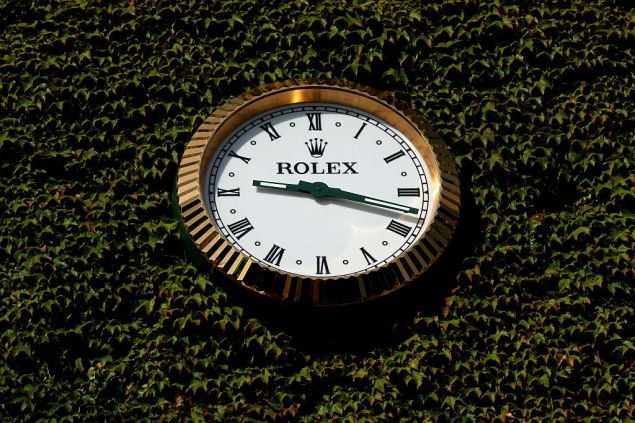
For a few weeks each summer, Rolex is hard to miss. At Wimbledon, its name is woven into the tournament’s image of precision, tradition and control, the same language the brand carries across its broader presence in tennis. But the Rolexes most viewers notice on television and the timepieces serious collectors fight over are not really the same watch.
The public version of Rolex is a luxury object: the Submariners, GMT-Masters and Daytonas that signal you’ve done well for yourself. The vintage market runs on different logic. At the very top, value comes less from general recognition than from the specific reasons one example matters more than another. A famous owner, a tiny production run, an unusual dial or a case that survived untouched can push a watch beyond expensive and into the category of something collectors may never see again.
Rolex doesn’t publish production numbers for its references, so the figures below come from auction records and collector scholarship, not the company itself. These six watches explain how the highest end of the vintage Rolex market works—and what a collector chasing the same feeling can still buy.
The most coveted Rolex references
Rolex Daytona Reference 6239 “Paul Newman”
Sold at Phillips, New York, October 2017. Result: $17,752,500
No watch on this list better shows how provenance can overtake the object itself. The Rolex Daytona is now one of the most recognizable watches in the world, but it was hardly an obvious future icon when it launched. Early examples sold slowly, and the unusual dial style collectors now call “Paul Newman” was, at the time, an odd and not especially popular variant.
That changed because of Newman himself. His personal Daytona was a gift from his second wife, Joanne Woodward, and was engraved “DRIVE CAREFULLY ME” on the caseback. He wore it for years before it disappeared from public view, helping turn the exotic-dial Daytona from a slow-selling chronograph into one of the defining collector watches of the modern market. When it resurfaced in 2017, it was not just another Paul Newman Daytona. It was the Paul Newman Daytona.
Phillips sold the watch in New York after a 12-minute bidding war that opened with a $10 million phone bid. The final price, $17,752,500, set a world record for any wristwatch and remains the highest price ever paid for a Rolex. That example is, of course, unavailable unless its current owner decides to sell. The broader category is less impossible to enter. Manual-wind steel Daytonas without exotic dials remain obtainable in the low six figures, while genuine Paul Newman-dial examples can climb far higher depending on reference, metal and condition. But none carries the same origin-story weight as the watch that gave the entire category its name.
Rolex Daytona Reference 6239 “Paul Newman.”
Photo: Abbrescia Santinell
Rolex Reference 4113 Split-Seconds Chronograph
Sold at Monaco Legend Group, April 2024. Result: €3,170,000
The Rolex Reference 4113 is rare for a more straightforward reason: almost none were made. Rolex built its reputation on durable, dependable watches rather than high complications, which is exactly why this reference sits so far outside the brand’s usual story. Made in 1942, the 44mm steel chronograph is the only split-seconds, or rattrapante, chronograph Rolex is known to have produced, with a second stopwatch hand that can be stopped independently to time laps or split intervals.
As few as 12 examples are believed to have been produced, making this one of the “holy grails” of Rolex collecting. The full history of the model is still murky, but the presence of both a telemetric scale and a tachymeter on the dial suggests the watches found their way into the Italian automotive world rather than staying with the aviation pilots they may have originally been intended for. Fewer than 10 examples are known to the public today, and the small group is tracked closely enough that collectors know the individual watches almost by name.
The example sold by Monaco Legend Group in 2024 came from the collection of the watch scholar Auro Montanari. It also arrived with the cheese knife he had used for years to open the caseback, a small and very specific detail that says something about how personal, and occasionally eccentric, the top of this market can become.
Buying one is almost never realistic. A Ref. 4113 only resurfaces when one of the known examples leaves a major collection, and each appearance to market is nothing short of an event. There is no real direct modern equivalent, either; Rolex has not made another split-seconds chronograph, and even its closest contemporary dress-watch relative, the 1908 collection, has nothing close to this complication, though that’s not to say that may change in the future. Ultimately, the Ref. 4113 isn’t really a watch a collector works toward, it’s one they wait for.
Rolex Reference 4113 Split-Seconds Chronograph.
Courtesy Monaco Legend Group
Rolex Reference 6062 with black dial and diamond markers
Sold at Monaco Legend Group, Monte Carlo, October 2025. Result: €5,150,000
With the Rolex Reference 6062, its scarcity comes from a side of Rolex many people forget existed. The brand is now defined largely by sports watches and professional models, but the Ref. 6062 belongs to a brief period in the early 1950s when Rolex was still making complicated wristwatches. It paired a triple calendar and moon-phase display with a waterproof Oyster case—an unusual combination even before the dial is considered.
Within that already rare reference, black-dial examples with diamond hour markers are the ones collectors chase hardest. Only a handful are known, and the most famous comparison is the so-called “Bao Dai,” a black-dial, diamond-marker Ref. 6062 made for the last emperor of Vietnam, which Phillips sold in 2017 for more than CHF 5,000,000.
The Monaco Legend Group example here pushed the reference higher still, and its multiple sales offered a useful measure of how far the market has moved: the same watch sold at an Antiquorum auction in 2006 for roughly $380,000 before returning in 2025 at more than $5 million.
Owning one is extremely unlikely. Other Ref. 6062s exist, but a black-dial, diamond-marker example is a trophy-market event whenever one appears. If the appeal is the moonphase rather than the exact reference, Rolex’s Cellini Moonphase offers a much more accessible modern alternative on the secondary market. But for most collectors, the appeal isn’t the idea of a Rolex moonphase in and of itself, but rather the exact configuration of the historical reference and what it represents as a brief and unusual chapter of the watchmaker’s lineage.
Rolex Reference 6062 with black dial and diamond markers.
Courtesy Monaco Legend Group
Rolex Daytona Reference 6265 “The Unicorn”
Sold at Phillips, Geneva, May 2018. Result: CHF 5,937,500 ($5.9 million)
The Rolex Reference 6265 “Unicorn” is the Daytona that seemed to break the rules collectors thought they understood. For decades, the manual-wind Daytona was known in stainless steel and yellow gold, and this watch broke that pattern, being produced in white gold on special order for a German retailer. Besides that, it features a black “sigma” dial, marked with the small Greek sigma symbols used to indicate gold hour markers. As far as the industry has been able to establish, no second example is known.
For years, the watch was closer to rumor than public object. The collector John Goldberger owned it privately for decades, and when it appeared on Hodinkee’s Talking Watches in 2013, it introduced many collectors to a watch they had never seen before. Goldberger later consigned it to a Phillips charity sale, where it sold for CHF 5,937,500, up from its estimate of CHF 3,000,000-5,000,000. When it sold at the time, it was second only to Paul Newman’s own Daytona among Rolex auction results.
There is no real path to buying one unless this exact watch returns to market. No other white-gold vintage Daytona is known, which means there is no true substitute. However, the look is more reachable. Steel Daytonas with black sigma dials do appear at auction, and they sell for a fraction of what the Unicorn brought. But the appeal of this watch is not only its looks. It is the fact that—within one of Rolex’s most collected families—it is a true piece unique.
Rolex Daytona Reference 6265 “The Unicorn.”
Courtesy Phillips
Rolex Daytona Reference 6241 “John Player Special”
Sold at Sotheby’s, Geneva, May 2023. Result: CHF 2,238,000 ($2.49 million)
The Reference 6241 “John Player Special” shows how granular the vintage Daytona market can get. Like Paul Newman’s own watch discussed earlier, its dial belongs to the exotic-dial Daytona family, built around squared sub-registers and contrasting color blocks that early buyers mostly ignored.
Notably, at the top of the Daytona market, the gap between expensive and extraordinary can come down to something as small as the color of a subdial. According to Sotheby’s, Rolex made roughly 3,000 examples of the 6241 between 1966 and 1969, but only about 300 in yellow gold, and the “John Player Special” narrows the field even further with its black dial and gold accents, a look nicknamed for the black-and-gold paint scheme of the John Player Special-sponsored race cars of the era. It is, today, one of the most desired looks in the entire vintage Daytona world.
This particular watch, sold at Sotheby’s, also came equipped with a matching yellow gold riveted bracelet. Most of these bracelets were replaced or lost over time, so it was particularly rare to find an example with its original. Estimated at CHF 600,000-1.2 million, it sold for CHF 2,238,000.
This watch is difficult territory, but not mythical, to obtain. Gold Paul Newman Daytonas appear at auction, and John Player Special examples are known to trade, but the best ones—fresh to market and correct down to the last detail—remain grail-level lots. A plain gold Daytona without this dial is a far easier and far cheaper way into the same metal and era, just without the specific look collectors are paying for here.
Rolex Daytona Reference 6241 “John Player Special.”
Courtesy Sotheby’s
Rolex Submariner Reference 6538 “Big Crown”
Sold at Sotheby’s, December 2025. Result: $431,800
This last one breaks the pattern of the rest of the list. Whereas every other watch here is rare because so few were made or because one specific example carries an unrepeatable story, the Reference 6538 is rare because of what has happened to it since. It is the early Submariner grail, instantly recognizable by its oversized 8mm crown and the absence of crown guards, and it is the exact reference most associated with the Submariner Sean Connery wore as James Bond in Dr. No.
Unlike every other watch on this list, the challenge is less so in finding one, but rather in finding one that has not been ruined by decades of actual use. These were dive watches, and people dove with them, and so bezels got swapped, cases got polished thin, dials aged unevenly and service parts crept in over the years. A collector can find a 6538 without much trouble, but finding one with the right dial, an honest case and real provenance is another matter entirely.
Christie’s set the reference record in 2018, when a rare Explorer-dial example sold for $1,068,500, despite missing its bezel. More recently, Sotheby’s sold a family-owned “Big Crown James Bond” example in December 2025 for $431,800 against a $100,000-$200,000 estimate, proof that even below the record-setting configurations, a fresh and honest early Submariner can still command serious money.
Buying a 6538 itself is realistic, and patience plus good advice goes a long way. But finding an untouched, well-preserved one is the real challenge, and the key distinction that separates this watch from everything else on this list. For collectors priced out even of an honest 6538, Tudor Big Crown Submariners from the same era carry a similar oversized-crown look at a fraction of the cost, with the added appeal of coming from Rolex’s own sibling brand and using similar cases at the time.
Rolex Submariner Reference 6538 “Big Crown.”
Courtesy Sotheby’s
