
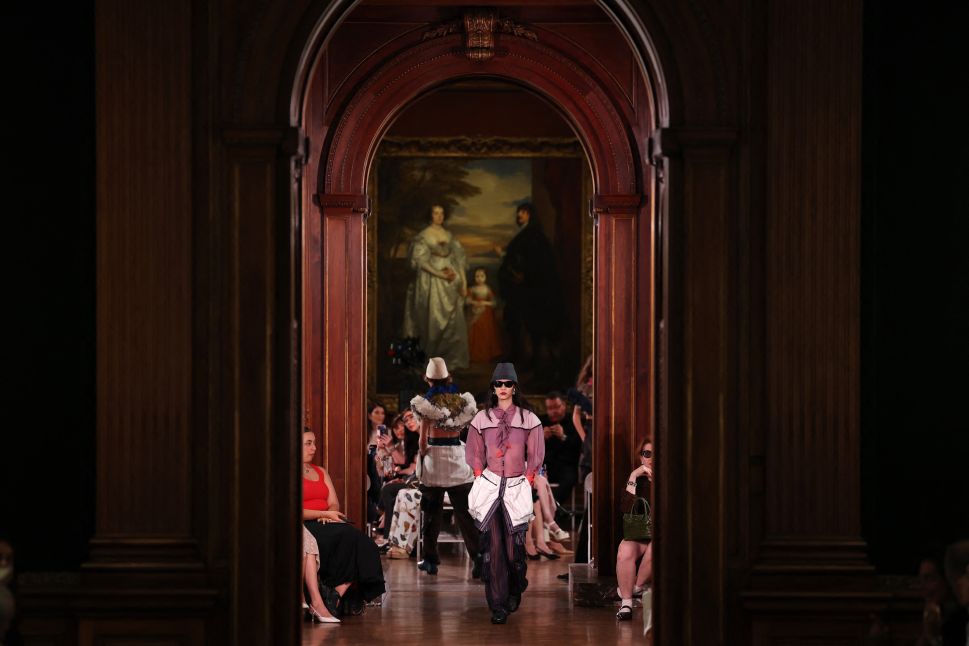
Following the cross-industry collaborations that dominated recent fashion weeks, it is clear that art has become one of luxury’s strongest competitive tools: a way to strengthen brand identity, increase perceived value and create experiences that extend beyond the product and the shop. Partnerships represent an enticing proposition for art museums looking to diversify funding: they get a boost of economic capital, while brands get a boost of cultural capital that, while largely symbolic, helps them maintain their position in a market less flush with cash but more crowded and more value-sensitive. Consider the Frick Collection, which reopened after a $220 million renovation and hasn’t shied away from getting in bed with the fashion and luxury industry. In May, it closed its doors to the public to host the debut of Louis Vuitton’s 2027 Cruise Collection designed by Nicolas Ghesquière in what marked the first time a fashion presentation was held inside the museum’s treasure trove of Gilded Age first-floor galleries. Previously, such events had taken place only in its courtyard.
With fashion’s usual omnivorous appetite, Ghesquière’s creations wove together art historical references from the Belle Époque to Pop Art and 1980s nostalgia. In a statement to the press, the designer described it as an opportunity for “unique dialogue between contemporary creation and such a remarkable artistic setting, where, surrounded by masterpieces spanning from the Renaissance onward, we enter into conversation with a place where art, history, and beauty have long been preserved and celebrated.” The show, he added, also marked the beginning of a meaningful relationship with an institution devoted to excellence and cultural heritage, further affirming Louis Vuitton’s commitment to engaging with art spaces that inspire and elevate creative expression.
The terms of the deal were soon unveiled: Louis Vuitton is underwriting a three-year cultural sponsorship that includes support for the museum’s monthly free evenings from June 2026 through May 2027. Louis Vuitton First Fridays will feature free evening admission on the first Friday of each month, excluding January and September, from 5:30 to 9 p.m., when visitors can enjoy the galleries and special exhibitions after hours, with programming that includes live music, talks and art-making activities. In addition, the luxury brand will support the Frick’s exhibitions program for the next three years, serving as lead sponsor of the next three major special exhibitions at the museum, starting with “Siena: The Art of Bronze, 1450-1500,” from October 2026 to January 2027. The house will also sponsor the first exhibition dedicated to the French enameller Susanne de Court, opening in spring 2027, and will back an additional undisclosed monographic exhibition of 19th-century paintings scheduled to open in late 2027.
The Louis Vuitton-Frick Collection partnership is more than a glamorous runway footnote: it points to a larger luxury strategy, as brands turn to museums, cultural sponsorships and art commissions to build value and experience beyond the product. Despite the luxury industry’s continuing revenue declines—with the past quarter further affected by tensions that have weighed on consumption in the Gulf market—LVMH reported €19.1 billion in Q1 2026, down just 6 percent. Still, as a “House of Culture,” the group continues to use cultural initiatives, art exhibitions and heritage projects as fundamental tools for building and maintaining cultural capital. Perceived brand value has become increasingly important in a luxury market that is more skeptical, more price-sensitive and more crowded. As luxury brands have been forced to pivot from product-centric models to storytelling—particularly for Gen Z and younger consumers who are more sensitive to brand authenticity, values and history—building cultural capital has become central. At the same time, consumers increasingly value experiences over products, requiring luxury brands to create memorable and distinctive encounters around their identities. Art and culture offer precisely those aesthetic spaces, while linking brands to the universally resonant power of human creation, a force that transcends language and geography and can build more meaningful, resilient channels of consumer dialogue.
Museums offer the perfect reputational infrastructure, and the Frick’s Gilded Age splendor clearly aligns with LVMH’s identity, conveying signals of taste and old-world legitimacy to a brand that wants to show how it continues to explore the emotional value of craftsmanship while promoting precise brand myths. Louis Vuitton furthers its ongoing commitment to art through cultural programming in its Espaces Louis Vuitton—cultural spaces connected to its major flagship stores in Tokyo, Munich, Venice, Beijing, Seoul and Osaka—all anchored by its Frank Gehry-designed art foundation, inaugurated in 2014. Beyond institutional sponsorship, Louis Vuitton has also long collaborated directly with artists on its own collections, with iconic bags designed by contemporary blue-chip names including Takashi Murakami, Yayoi Kusama, Richard Prince, Stephen Sprouse and Jeff Koons, among others.
Similar dynamics are behind Chanel’s expansive commitment to the arts, including a five-year partnership with Centre Pompidou, announced this May, to support the museum during its major renovation and help preserve access to its modern and contemporary art resources. This follows a separate Chanel-Pompidou initiative announced in 2025: a three-year partnership to expand the museum’s holdings of contemporary Chinese art, with a particular focus on women artists. Through its Chanel Culture Fund, the fashion house is now supporting a global program focused on cultural innovators, long-term institutional partnerships, cross-disciplinary collaboration and “greater representation in culture and society.” Also in May, Chanel announced a new partnership with the Dia Art Foundation to support artists, cultural events and ambitious projects, and in fall 2026 it will launch a new annual one-year fellowship in collaboration with the Guggenheim aimed at fostering collection studies and curatorial research, with fellows working between the two museums in New York and Venice. All this comes in addition to the ongoing Chanel Next Prize, a global award that celebrates artists and accelerates their future success through access to resources and mentorship. Each year, winners receive €100,000 in unrestricted funding, plus entry into a two-year mentorship and networking program facilitated by the house’s cultural partners, including the Royal College of Art in London.
Miu Miu has adopted a different iteration of this strategy, in which luxury brand support for art shifts from patronage to cultural production. The brand launched “Women’s Tales” in 2011, commissioning short films by female directors from around the world. With more than 30 films released to date, it has since become the fashion industry’s longest-running female-led short-film platform, as well as a core part of Miu Miu’s cultural identity and a new global force for the brand. Starting in 2024, it has also served as official partner of the Art Basel Paris Public Program, presenting Tales & Tellers, conceived by Goshka Macuga and convened by Elvira Dyangani Ose, in 2024, followed by Turner Prize-winner Helen Marten’s immersive performance work 30 Blizzards in October 2025. A second edition of Tales & Tellers was then brought to New York in May 2025.
