
When the Formula 1 champion Lewis Hamilton arrived at the 2015 Wimbledon final in a floral shirt, gray trousers and a fedora, the All England Club refused him at the door of the Royal Box. The offense was a missing tie. So a man who has spent his career draped in sponsor logos and fireproof Nomex, who treats a paddock like a runway, was turned away from the most coveted 74 seats in tennis because nobody on his team had mentioned that the room runs on jacket and tie—and, unable to find one in time, he watched the match from a hospitality seat instead, applauding Djokovic and Federer a few places down from Anna Wintour. It is the most telling thing that has ever happened to a guest at Wimbledon, and it draws the line the rest of the tournament lives by: the club polices its players without mercy and its crowd hardly at all.
What it enforces is narrower than the postcards suggest. Ordinary spectators face no dress code whatsoever. Win a ticket in the ballot or earn one in the legendary Queue, and you may turn up in nearly anything, so long as you keep your shirt on and your hat low enough to spare the row behind you. The Panama hats, the linen blazers and the sundresses amount to a costume the crowd has agreed to wear with nobody demanding it—an English summer performed by the people who paid for a seat. The crowd’s true indulgences are edible: more than 300,000 cups of Pimm’s, the tournament’s official cup since the 1970s and a quarter-million bowls of strawberries and cream across the two weeks. The real codes surface only as the rooms shrink and the company grows grander. Hospitality asks for smart-casual. The Members’ Enclosure is strict. The Royal Box runs on full protocol, suits and afternoon dresses, its invitations issued at the chairman’s discretion to a guest list that has seated monarchs since 1922. Royal Ascot checks its top hats at the turnstile. Wimbledon will let you in dressed as anything at all, then sit you down in front of a hedge.
Its players are shown no equivalent mercy. Wimbledon’s dress code is the most exacting in professional sport, and it leaves no daylight for interpretation: competitors must wear attire that is “almost entirely white,” and white, the club takes care to specify, “does not include off-white or cream.” The rule is Victorian in both origin and instinct. In the polite tennis of the 1870s, a visible bloom of sweat registered as indecent, and white hid it more graciously than any color—a matter of etiquette that doubled neatly as a class filter, since a spotless wardrobe demanded both money and the staff to maintain it. Over the decades, decorum hardened into something nearer to scripture. A band of color is allowed at the collar and the cuff, provided it runs no wider than three-eighths of an inch. Shoe soles and laces must stay white down to the eyelet. Officials still inspect kit before play and return the improperly dressed to the locker room to change. The effect is undeniably elegant, a whole court reduced to one clean idea in green and white—enforced with a tape measure.
People have been testing it for the better part of a century, and that testing is most of the history worth telling. The first to truly rattle the club was Gertrude “Gorgeous Gussie” Moran, who in 1949 walked onto Centre Court in lace-trimmed knickers sewn by the tournament’s own couturier, Ted Tinling. They flashed into view when she reached for a ball—the entire scandal: the committee accused her of dragging vulgarity into the game; the outrage reached the floor of Parliament; and Tinling—a Wimbledon fixture for decades—was frozen out for the next 33 years. His punishment set a template that every generation since has gleefully revived. Andre Agassi, the American with the denim and the neon, boycotted the place from 1988 through 1990 rather than submit to its whites, then came back and won the title outright in 1992, dressed head to toe in the rule he had spurned. Anne White contested a 1985 match in a full-length ivory catsuit and was asked, with great delicacy, never to repeat it. Tatiana Golovin slipped red beneath her dress in 2007 and survived on a technicality of hemlines. Roger Federer’s orange soles were outlawed in 2013, and the club tightened its footwear rules the following year to ensure it. Venus Williams was sent to change a fuchsia bra strap during a 2017 rain delay. Nick Kyrgios, in 2022, swallowed a wardrobe fine he later put near $10,000 rather than surrender the red cap and red Jordans he wore off court.
The code has bent meaningfully only once, and the cause was long overdue. In 2023, after years of players describing the particular dread of competing in white while menstruating, the club rewrote the rule to permit dark undershorts beneath the whites. Billie Jean King had pressed for the change for years; Coco Gauff said flatly that it would lift a real source of stress; Heather Watson admitted she had once timed her birth control to the draw. It was a rare case of the club listening to the people who actually wear the uniform, and it changed nothing a spectator could see.
For all its severity—or perhaps because of it—the white rule has worked as an improbable incubator for the fashion industry. Suzanne Lenglen scandalized the lawns around 1920 in Jean Patou’s pleated skirt and bandeau, bare-armed and daringly short, the first time couture and competitive tennis ever shared a court. René Lacoste stitched a crocodile onto his shirt and built an entire house on the motif. Fred Perry took three consecutive Championships in the mid-1930s and spun the club’s own laurel into a logo that outlived his playing days by half a century. Since 2006, Ralph Lauren has dressed the umpires, line judges and ball boys (the first designer in the tournament’s history to hold the contract); Lauren reportedly wanted the officials in white and was overruled on the grounds that they would upstage the players. And the most cherished looks of the modern game all worked within the cage rather than against it—Roger Federer’s cream cable-knit cardigan in 2008, its buttons hand-turned to mark five straight titles, and the gold-embroidered blazer of 2009, the wardrobe of a man dressing for a coronation he fully intended to award himself.
This is the strange bargain the All England Club struck 150 years ago, very likely without meaning to. The hedges stay clipped, the linens stay white, and anyone who hopes to be remembered has to be sharper than the rule built to contain them. A narrow palette, it turns out, is the most demanding thing you can hand a designer. And the club that polices a fraction of an inch of trim still crowns its winners by hand—the Princess of Wales, its patron, comes down from the Royal Box each July to present the trophies, the last formal flourish in a fortnight built on them.
The Best Wimbledon On-Court Style Moments Over the Years
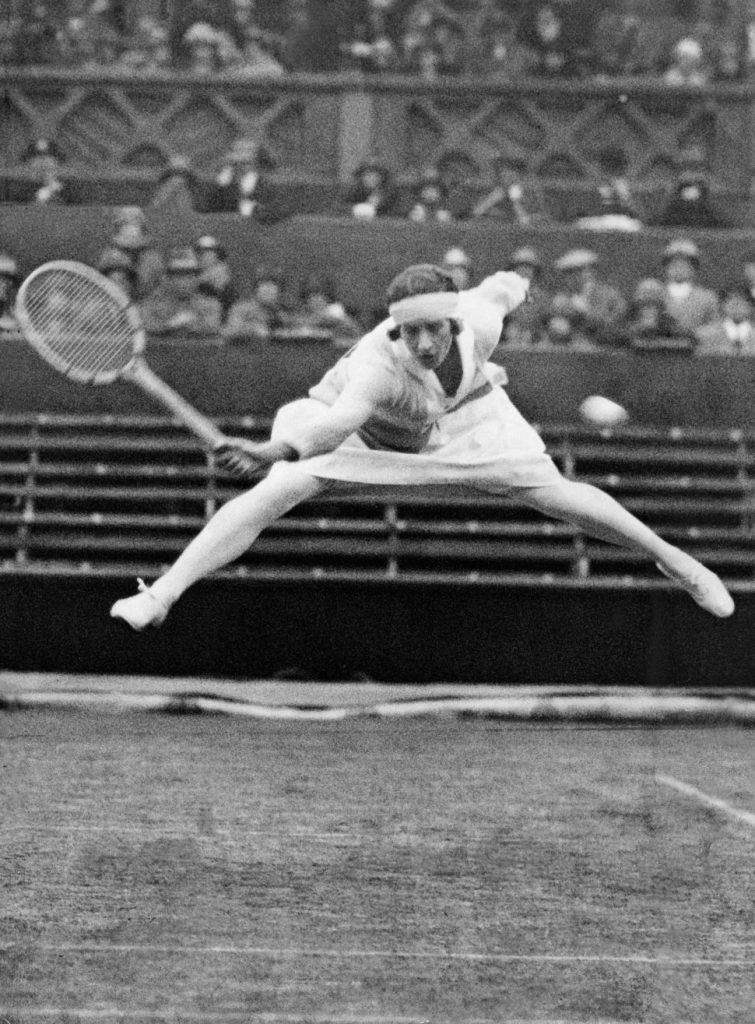
Suzanne Lenglen
The Championships, Wimbledon, 1925
The Frenchwoman in Jean Patou’s calf-length pleated silk and his signature bandeau, forearms bare and not a corset in sight, at a time when both were still considered a small indecency. She sipped brandy at the change of ends and dropped barely a game all fortnight, which tends to silence the people scandalized by your hemline.
Suzanne Lenglen in Wimbledon 1925.
ullstein bild via Getty Images
Gertrude “Gorgeous Gussie” Moran
The Championships, Wimbledon, 1949
Ted Tinling, the club’s own couturier, trimmed her shorts with an inch of lace that showed on every stretch and reach, and the sight of underwear on Centre Court sent photographers diving to the grass for an angle. The committee accused her of bringing vulgarity into tennis; the matter reached Parliament; Tinling was cast out for 33 years for the crime of a hemline.
Gertrude ‘Gussie’ Moran on court during the Wimbledon Tennis Championships.
Dennis Oulds
Bjorn Borg
The Championships, Wimbledon, 1979
The Swede in his pinstriped FILA polo and low terry headband, hair to the collar, at the peak of five straight titles. He made a tennis kit look like a signature rather than a uniform, and half the men in the stands went home wanting the same stripe down their chest.
Björn Borg at Wimbledon 1979.
ullstein bild via Getty Images
Chris Evert
The Championships, Wimbledon, 1981
Evert in her signature Ellesse—a sleeveless white dress trimmed in red at the collar and armholes, the Italian label’s twin logos at the chest, matching red hair ribbon and wristband. She won this 1981 semifinal over Pam Shriver 6-3, 6-1 en route to her third Wimbledon title, and later admitted an official once lifted her skirt to check the red ruffles on her bloomers and sent her back to change.
Chris Evert-Lloyd competing against Pam Shriver at The Championships, Wimbledon, London, July 1981.
Fox Photos via Getty Images
Billie Jean King
The Championships, Wimbledon, 1982
King in a white dress scattered with a pale blue floral print, wire-frame glasses and Nike shoes, still contesting Wimbledon at 38 in one of her final Championships. The soft blue pattern reads as almost demure now, but for a player who spent her career forcing the establishment to move, sneaking color past the whites was its own act of rebellion.
Billie Jean King of the USA during the Lawn Tennis Championships at Wimbledon.
Bob Martin
Anne White
The Championships, Wimbledon, 1985
The American turned up for a rain-shortened first round sealed head to ankle in a white Lycra catsuit, technically legal on color and instantly the only thing anyone discussed. Play was suspended for bad light before she could finish the point; the referee met her the next morning and told her the bodysuit would not be coming back.
Anne White of the USA at Wimbledon, 1985.
Getty Images
Pat Cash
The Championships, Wimbledon, 1987
The Australian took the title in a black-and-white checkerboard headband, the single stroke of pattern on an otherwise obedient kit. It stuck to him so completely that he spent the rest of his career signing them, the accessory outlasting the forehand.
Australian Pat Cash in action on his way to a match victory.
PA Images via Getty Images
Andre Agassi
The Championships, Wimbledon, 1992
Tennis’s denim-and-neon showman had skipped the tournament three years running rather than strip his wardrobe down to white, then returned and won the whole thing dressed in plain Nike with nothing to look at but his game. The loudest man in the sport lifted his first major looking like a blank page, and seemed to enjoy the joke.
Andre Agassi of the USA and his girlfriend Wendi Stuart after the final match at the Wimbledon Tennis Championships.
Alexander Hassenstein
Tatiana Golovin
The Championships, Wimbledon, 2007
The Frenchwoman flashed a band of red beneath her white dress and slipped the rule on the technicality that knickers count as underwear, not attire. A small piece of contraband at the time; in hindsight, the first crack in a wall that took another 16 years to give.
France’s Tatiana Golovin in action against Austria’s Tamira Paszek.
PA Images via Getty Images
Roger Federer
The Championships, Wimbledon, 2008
The Swiss legend walked on in a Nike quarter-zip, its buttons hand-turned to count five straight titles like campaign medals. Nobody has ever made following the dress code look more like lording it over the field.
Roger Federer of Switzerland exits after winning his match against Arnaud Clement.
Hamish Blair
Serena Williams
The Championships, Wimbledon, 2008
Serena walked out against Agnieszka Radwanska in a belted white trench coat of her own design, a full runway entrance staged before the first serve. It was couture theater performed entirely within the whites-only rule—the banned catsuit that gets miscredited to Wimbledon was Roland-Garros, a decade later.
Serena Williams of USA prepares to play against Agnieszka Radwanska of Poland.
Adrian Dennis
Maria Sharapova
The Championships, Wimbledon, 2008
Here, Sharapova sheds the jacket of her Nike “tuxedo” look, black-tie tailoring rendered in regulation white down to the waistcoat lines and evening-cut shorts. A wink at the very formality the club enforces, executed without breaking a single rule.
Maria Sharapova of Russia prior to the round two women’s singles match against Alla Kudryavtseva.
Clive Brunskill
Roger Federer
The Championships, Wimbledon, 2010
Federer, with one of his eight Wimbledon titles, dressed in the tailored Nike whites that made him the tournament’s great study in dressing sharply inside a straitjacket. His gold-trimmed flourishes over the years drew as many mutters about presumption as gasps of admiration.
Switzerland’s Roger Federer receives the trophy after winning the Gentlemen’s Singles Final.
Stephen Pond
Venus Williams
The Championships, Wimbledon, 2017
During a rain-delayed first round, officials sent Venus Williams to change after a fuchsia bra strap strayed into view beneath her whites. She swatted the question away afterward—”I don’t like talking about bras”—and the color was gone by the resumption.
Venus Williams in action against Elise Mertens on day one of the Wimbledon Championships.
John Walton
Nick Kyrgios
The Championships, Wimbledon, 2022
The Australian collected his runner-up plate having baited the code all fortnight, pulling on a red cap and red Air Jordans the instant he cleared the white-only court. He put the resulting wardrobe fine near $10,000 and paid it like a cover charge.
Australia’s Nick Kyrgios changes into a pair of Nike Air Jordans.
Steven Paston
Coco Gauff
The Championships, Wimbledon, 2023
Gauff, in her New Balance kit, the summer Wimbledon finally bent, allowing dark undershorts beneath the white so players needn’t dread their periods on court. She had named the old rule a genuine source of stress, and 2023 was the first Championships to answer it.
Coco Gauff in action against Sofia Kenin on day one of the 2023 Wimbledon Championships.
John Walton
Lorenzo Musetti
The Championships, Wimbledon, 2025
The Italian entered in a white Bottega Veneta bomber cut from the house’s signature intrecciato leather weave, roughly $10,000 of woven calfskin as his walk-on layer. As the brand’s newest ambassador, he made the case that a player’s pre-match coat could carry as much fashion weight as anything on a runway.
Lorenzo Musetti of Italy enters the court prior to the Gentlemen’s Singles first round match.
Dan Istitene
Naomi Osaka
The Championships, Wimbledon, 2026
Osaka walked to Court 3 for her first-round match against Elsa Jacquemot in a custom white kimono by Tokyo designer Hana Yagi, a reworked bridal shiromuku with furisode sleeves, an obi sash, embroidered cranes and cherry blossoms, and a tulle train, over a floral Nike dress. Yagi builds her pieces from discarded wedding kimonos, so the all-white rule constrained nothing.
Japan’s Naomi Osaka warms up ahead of her women’s singles match.
Henry Nicholls
