
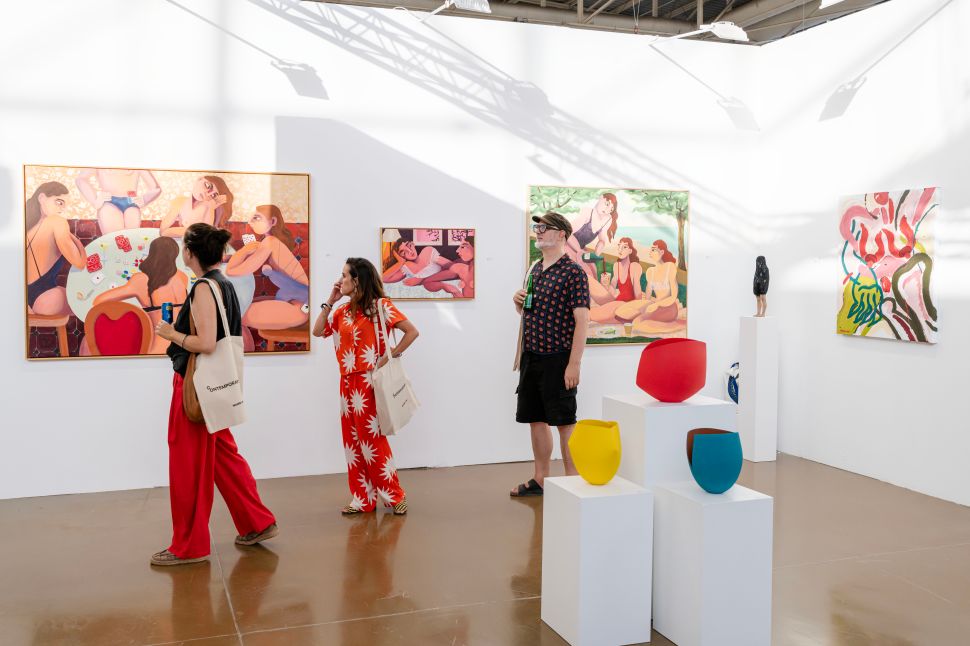
Tell someone you are traveling to Ibiza for the art, and they might not believe you. Pushing against that skepticism is Contemporary Art Now, or CAN, a small boutique art fair that invites art lovers to dip a toe in the pristine waters of the beach clubs of Talamanca, perhaps grab lunch in the quiet northern harbor of Portinatx, then pull a sopracostume over one’s bikini before buying some art. The fair’s selection is colorful, positive and catchy without being kitsch. Participating galleries aim to catch the eye of the Ibiza public, which, of course, wants to decorate their beach homes, without sacrificing attention to industry trends or art that’s meaningfully engaging with the issues of the day.
“When you’re outside the fair, you’re in such a holiday mode, everything is beautiful, you’re so relaxed,” fair curator Saša Bogojev told Observer. “Then you come inside, and I like to think of these works being some sort of a mental workout, because a lot of these works are speaking of certain subjects, some of them are not maybe that pleasant. I like to create this kind of contrast with the environment outside.”
It’s not just CAN. In a world where art fairs are multiplying by the day and being involved in the industry, whether one is selling or buying, has come to feel like a combat sport, some fair organizers are experimenting with a different model: one that adapts to the lifestyle of the most coveted collectors, rather than asking them to scramble to keep up with a sometimes frantic art fair calendar. Or to put it another way, if the collector won’t go to the art fair, the art fair will go to the collector.
The growing roster of destination art fairs extends from St. Moritz to Gstaad, from Capri to the Berkshires, from Punta del Este to Joshua Tree. That growth can be linked to the post-pandemic development of the so-called “experience economy”—how and where you collect art is, for some, as important as the purchase itself. That aligns with a boom in luxury travel, a market now valued at $1.59 trillion and projected to nearly double to $3 trillion by 2033. Notably, the art fair circuit is also expanding beyond established resort destinations, from NOMAD and 74th Arts’s itinerant fairs, to VIMA, which launched two years ago in Limassol, Cyprus, and is contributing to the cultural visibility of the touristic island.
Nazy Nazhand, a collector who attended this year’s CAN Art Fair, is an Ibiza regular: “I’ve been coming here for years,” she told Observer. “It has always attracted people who think differently: artists, musicians, architects, designers, collectors… I’ve never been particularly interested in what the art world considers the ‘right’ place to be. Once we start measuring cultural value by prestige or social currency, we’ve already lost sight of what makes art compelling.”
This is exactly the thinking by which Becca Hoffman—former director of the Outsider Art Fair in New York and Paris, and of Andrew Edlin Gallery—builds pop-up art fairs in places as different as Aspen, Marseille and Singapore via 74th Arts. “I’m drawn to places where there’s already a je ne sais quoi—a certain energy—off the major art world circuit, but with engagement, interest, and connection,” she said. “The question I always ask is whether the event could exist anywhere. If the answer is yes, then it is not our sort of event—each of our events is uniquely tailored to the region.”
When asked whether she encounters the same collectors around the world, from Aspen to Marseille to Singapore, Hoffman said that it’s mixed, with a core group of collectors and others at her one-day events. “But in each location, there’s a deliberate effort to bring in people who are not necessarily going to the major art fairs, because they are in search of something different.” She added that she is looking for the gap between what a place is and what it could hold, and her approach is always relational before it’s logistical. “I start by thinking about who the connective tissue is in a given place. From there, the flow, scale, scope and event follow.”
In terms of size, most destination art fairs settle on roughly the same ceiling. CAN Ibiza caps itself at 30 galleries, by design. “A small format fair allows for being focused on something,” Bogojev explained.
Hoffman discussed the same restraint, but in economic terms: “At the boutique level, I think about participation terms differently. The fee is lower, but the bar for who’s invited is higher, and that selectivity is part of the value proposition for everyone involved.”
Bogojev offers a caveat worth considering: CAN Ibiza launched in 2022 “at the kind of peak of the art market activity,” a moment that has since cooled considerably. “We were lucky that we started small, so we can remain small at this time when the market is tougher globally.”
In Ibiza, gallerists registered a strong level of satisfaction and reported engaging with collectors who happened to be visiting the island and picked up a piece almost as a souvenir before flying home, alongside Spanish collectors—regulars at Arco Madrid—who came specifically to do business. CAN also has a VIP program that flies in roughly 50 collectors a year, with studio visits and gallery tours built around the fair days. “If we just opened the door for the local people, it wouldn’t work out,” Bogojev admitted.
The numbers at VIMA, the contemporary art fair in Limassol, Cyprus, suggest that traction of this kind can be built from scratch. In its second edition, visitor figures reached over 5,000—more than 1,000 up on the year before—sales rose by 1.8 times, and the highest price paid for a single work hit €90,000. “What has moved most clearly is confidence,” says Lara Kotreleva, one of VIMA’s three founders. “In the beginning, we were introducing not only a new fair, but also the idea that Cyprus could become a meaningful place for contemporary art exchange. Now the conversation is more concrete.”
Bogojev’s own language leans toward discovery rather than acquisition. “The collectors who are most enthusiastic about this format are not necessarily the youngest,” he said, “but they’re the ones who’ve already done Basel a dozen times and are looking for something that doesn’t feel like a trade show. They want to be moved, not just informed.” He also pointed to a second cohort, “younger, in their late thirties, early forties, often with wealth that isn’t inherited, who are drawn to the intimacy and the curation precisely because they find the mega-fair overwhelming.”
The question of whether any of the buzz around the destination art fairs contributes to the development of local art scenes is answered differently by each of these events. A general practice involves holding an “off program” with galleries on the ground. CAN Ibiza has a public sculpture program meant to leave something behind once the booths come down; this year, it was a permanent piece by internationally renowned Stefan Brüggemann, who also had a show in the local museum.
But VIMA Cyprus’s founders are quick to resist the destination fair label. “I would be reluctant to use the term,” Edgar Gadzhiev, another VIMA co-founder, told Observer. “Our mission is more structural: to help build a market, an ecosystem, and a reason for galleries, collectors, institutions, and cultural actors to meet in Limassol.”
Kotreleva added that the absence of heavy luxury-tourism branding on the island gives them more space to define the cultural narrative. “There is less noise, less over-coded glamour, and fewer fixed expectations about what an art event in Cyprus should be.” But the same blank canvas demands more work. “We cannot rely on an existing luxury mythology to bring people in. We need to create confidence.”
On whether VIMA is competing with the major fairs or sidestepping the comparison entirely, co-founder Nadezhda Zinovskaya said that they are not trying to be a smaller version of a larger fair: “We are trying to be precise about what Cyprus can offer: a regional bridge, a concentrated meeting point, and a platform where galleries can access collectors and communities that are not always reached through the traditional Western European fair calendar.”
Meanwhile, Bogojev is careful in his response when asked if destination art fairs can influence the larger art system in a significant way. “I don’t think the traditional fair model or art system would be challenged any time soon,” he said. “But I do think these kinds of fairs have the potential to be considered as a valid option.”
But collector Nazy Nazhand sees destination art fairs as not just a smaller alternative but something better. “I’m far more interested in looking ahead than following established circuits for contemporary art,” she concluded, headed for a dinner overlooking the sea, followed, perhaps, by a late-night party. “I think the future of the art world lies less in hierarchy and more in curiosity, connection and a willingness to challenge convention.”
