
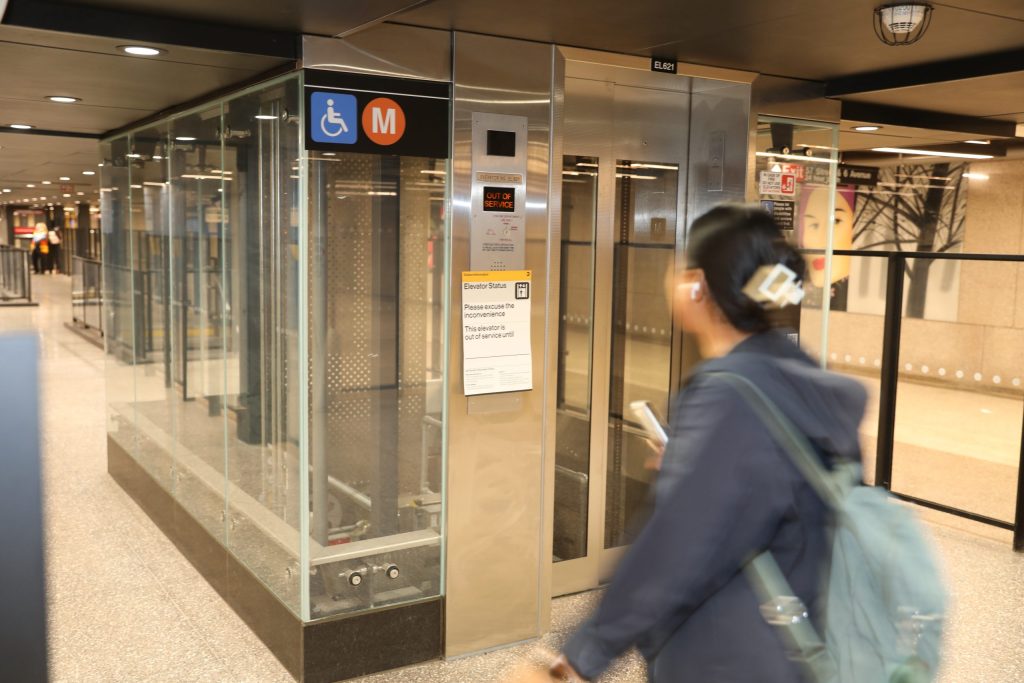
Even before another “Billionaires’ Row” tower pierces the Manhattan skyline, the developer of the planned skyscraper is leaving a mark underground.
Two new subway elevators at the 57th Street stop beneath Sixth Avenue are fully funded by the real estate firm Sedesco, which plans to build a high-rise at 41 W. 57th St., a long-empty plot between Fifth and Sixth avenues. The project is part of an initiative in which companies pick up the tab for Americans with Disabilities Act transit improvements while being granted permission by the city to construct larger buildings.
After lugging a 60-lb. suitcase down 18 steps to the station platform, Sonny Bhatia said a working elevator to the platform would have been “a blessing.”
“It’s a pain to carry the whole suitcase,” said Bhatia, 38, who was visiting from New Delhi. “Today, I just have one, but if you’re carrying two, that will be two trips.”
The station along the M line is the first to become fully accessible on a developer’s dollars under Zoning for Accessibility, a city and MTA program which provides real estate companies with bonuses to pay for the construction and maintenance of elevators in or near the transit system.
“Zoning for Accessibility is a way of us accelerating this tremendous commitment that we’ve made to making as many of our stations accessible as possible as quickly as possible,” Jamie Torres-Springer, president of MTA Construction & Development, told The City Reporter. “And in a city as frenetic and real-estate driven as New York, a great opportunity for us to do that is to leverage the power of public-private partnership.”
Approved by the City Council in 2021, the initiative is seen by the transportation authority as a way to help fast-track its federal court-mandated goal of making 95% of the nearly 500 subway and Staten Island Railway stations accessible to people with disabilities by 2055.
“It will make a big difference,” Jay Patel, 25, said after carrying a nearly 50-lb. metal table frame to the platform at 57th Street. “This is heavy.”
The MTA last week announced that the 50th Street station along the No. 1 line will get elevators and other improvements through a deal with the real estate giant Extell, which will build a more than 1,000-foot Manhattan tower at 871 Seventh Ave.
That came on the heels of the City Planning Commission’s approval earlier this month of developer-funded ADA upgrades at the Nevins Street stop on the 2, 3, 4 and 5 lines in Downtown Brooklyn.
“It’s a great deal for the MTA, it’s a great deal for the riding public and the city of New York,” Torres-Springer said. “It’s harnessing the value of density to improve transit and to make it accessible to more New Yorkers.”
Previously, just one new station entrance and elevator at the sprawling Queensboro Plaza complex in Queens were paid for by the developer of a Long Island City tower, with the MTA covering the construction costs for two other station elevators.
In the past, transit officials have been critical of developers whose privately maintained subway elevators and escalators had significantly lower availability rates and broke down more frequently than those maintained and operated by its own workforce.
Torres-Springer said the previous agreements often “didn’t have enough teeth in them to be enforced.” In some cases, those disputes have ended up in court.
“We are enforcing them with whatever means we have,” he said. “But as we move forward and we have privately operated elevators, it’s a whole different ballgame, there’s much more teeth involved.”
One measure is requiring developers to post a bank letter of credit that essentially functions as a financial guarantee to keep the elevator performance up to the MTA’s standards.
The authority’s own elevator-availability data shows that the reliability of the machines maintained by developers climbed to 96% month after falling as low as 81% in February 2023. In contrast, those elevators that belong to the MTA had a 97% availability in February 2023, a figure which has since climbed to 98%.
“That’s simply by staying on top of those private entities and ensuring that those elevators are kept in a state of good repair or that they’re fixed quickly,” Torres-Springer said.
Sedesco was the first company to sign on with the 2021 zoning-law change in exchange for upgrades to the station closest to its planned hotel-and-residential development. The development firm received a 20% bonus of buildable space on its project. It will be built on the stretch where luxury high-rises labeled “supertalls” have altered the skyline along what’s known as Billionaires’ Row.
“We’ve been working on completing this work on the [57th Street] station before we’ve even put a shovel in the ground on our development,” said Derek Gilchrist, partner and general counsel at the firm.
A subway rider carries suitcases down the steps at the 57th Street subway station along the M line, June 29. 2026. Credit: Alex Krales/THE CITY
The development at one point was projected to be a 63-story, 1,100-foot-high tower, according to city records, though those plans are still in flux.
Meanwhile, the work continued underground.
In addition to the two new elevators, Sedesco paid for other ADA upgrades such as new fare gates and eight nearby curb cuts at street level.
The deal calls for the company to cover the costs of eventually replacing both elevators. One links the street level with the station mezzanine, while the other moves riders between the platform and mezzanine.
Including 57th Street, there are 160 accessible subway stations, close to 34% of all stations in the transit system. The MTA has made 60 stations accessible since 2020, with another 38 projects currently in construction.
As part of its nearly $70 billion capital program for 2025-2029, the MTA is spending more than $7 billion to make 60 stations ADA-compliant and to modernize 45 more subway elevators.
The MTA has hopes of expanding Zoning for Accessibility and has additionally secured eight easements — a legal right of way through private space — at developments where elevators connecting to the transit system could eventually be paid for by companies erecting buildings near or on top of the transit system.
“That’s important because it means that developers are required to come and ask us whenever they’re building close to a station if we want the volume carved out so that we can come back and do a project in the future,” Torres-Springer said. “That’s going to lead to a lot more accessible stations in the future.”
Advocates for riders with disabilities said they simply want increased access to subway elevators.
“The MTA made an agreement to get elevators built,” said Joe Rappaport, executive director of Brooklyn Center for Independence of the Disabled. “If there’s more elevators coming, we’re not going to object.”
Jessica Murray of the Rise and Resist Elevator Action Group, a frequent critic of subway elevator maintenance, said having developers pick up the construction costs should be a plus for the traditionally cash-strapped authority.
“Either way is good for me,” said Jessica Murray of Rise and Resist’s Elevator Action Group, which advocates for more reliable subway elevators. “It would be nice if the MTA put the money it’s saving into other accessibility projects — signage is a huge issue they haven’t really addressed.”
Before rolling his hard-shelled suitcase onto a Queens-bound M train, Bhatia said he welcomed the new privately funded elevators at 57th Street.
“At least someone’s doing it,” he said. “That’s really great.”
Our nonprofit newsroom relies on donations from readers to sustain our local reporting and keep it free for all New Yorkers. Donate to THE CITY today.
The post First Subway Elevators Fully Funded by Developer to Open in Midtown appeared first on The City Reporter.
