
Mayor Zohran Mamdani says his $125.8 billion budget for the fiscal year beginning July 1, which closed a gap which was a large as $12 billion last year, shows that democratic socialists “not only understand economics just as well as the capitalists” but “can solve their years of mismanagement through an embrace of our principals.”
Fiscal experts ranging from city Comptroller Mark Levine to the Citizens Budget Commission have a very different take, since the budget relies on some $8 billion in “one shots” — measures that provide money only for the 2027 fiscal year — and a stretching out of pension payments which will cost billions more in future years.
When the final numbers are released in the coming days, the adopted budget is expected to forecast a deficit for the 2028 fiscal year of more than $7 billion — much larger than is typical and one that could grow substantially if there is any downturn on Wall Street or a recession.
“Yes, next year is balanced, but closing most of the gap with one-shots, short-term savings, and a pension stretch-out which shifts costs to future taxpayers leaves the city facing a gaping hole next year,” said Andrew Rein, president of the Citizens Budget Commission.
“Groundhog day was a great movie, but it’s no way to manage a budget,” he said.
Attention in recent days focused on resolving a standoff between the mayor and the City Council over the city’s increasingly expensive housing voucher program, whose cost has increased four-fold in the last four years to almost $2 billion. The closing of the huge $12 billion gap is primarily the result of a Wall Street boom which is boosting income taxes, additional state aid and a new tax on expensive second homes.
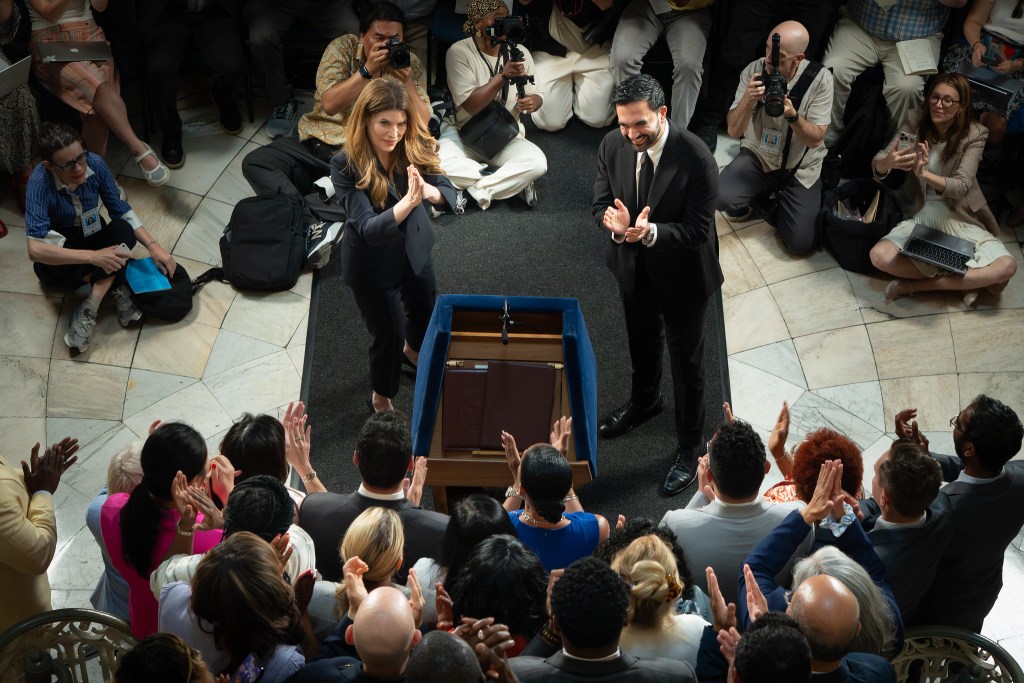
Mayor Mamdani and Council Speaker Julie Menin announce a budget handshake agreement at City Hall on Tuesday, June 29, 2026. Credit: Michael Appleton/Mayoral Photography Office
But along with those steps are a series of short-term savings that have raised the ire of fiscal watchers.
“This agreement gets the city through an exceptionally difficult year, but it does not resolve the structural challenges ahead,” said Levine. “With large out-year gaps, limited reserves, and significant economic uncertainty, next year’s budget could be even more difficult.”
The moves that make it likely next year will see another budget crunch include $5 billion in so-called one-shots, which means revenue the city found for 2027 to support ongoing programs that won’t exist next year. Actions like a delay in a state mandate to reduce class sizes were worth almost $3 billion in the new budget, but those costs can’t be held off forever..
For example, state aid to help the mayor expand the city’s child care programs is only guaranteed for two years.
Also controversial is a pension maneuver which delays payments required to bolster the retirement funds for city employees. The administration argues that its plan merely smooths out those payments, but the Citizen Budget Commission notes that the effect will be to lower contributions by $11 billion through 2032 but then increase payments by $15.6 billion for the following five years.
“This costs more in the long run and unfairly requires New Yorkers in the 2030s to pay for services delivered over the next six years,” the commission noted in a report headlined “How He Did It.”
The mayor may also have to find money for raises for city workers as he negotiates new contracts with all of its unions. The financial plan includes money for annual increases of less than 2%, which are unlikely to be acceptable to the unions.
Most mayors make the most politically difficult budget moves in their first year when they can blame their predecessor. But a big budget deficit for the 2028 fiscal year is likely to be a key talking point when the mayor and his allies resume their effort for tax increases on the wealthy and corporations when the state legislature reconvenes in Albany.
For example, the Fiscal Policy Institute, a left-leaning group, on Tuesday, quickly pivoted to the need for higher taxes.
“Future expansions of public services — especially childcare and housing — that are central to the Mayor’s affordability agenda must be funded sustainably through new recurring revenue. This revenue must be authorized by Albany as part of the next state budget,” it said in a statement.
Mamdani supporters sent the same message last week when democratic socialists won a series of key races for Assembly and state Senate seats.
On election night, Gustavo Gordillo, a DSA co-chair in New York, said that his organization was already casting its attention to next year’s budget fight in Albany and beyond. “We’re going to start thinking about 2028 and what comes next,” he said
How Gov. Kathy Hochul will respond to the pressure isn’t clear if, as expected, she wins a new term in November. A few weeks ago she made it clear she thinks restraining spending, not more revenue, should be the priority.
Gov. Karthy Hochul has said that Mamdani must now get the city’s finances in order after receiving significant state aid. Credit: Ben Fractenberg/The City Reporter
“He inherited a financial shortfall that could hurt the bond rating of the city and result in a loss of confidence of investors as well as the business community, and I couldn’t let that happen — that was my motivation this year,” Hochul said in an interview with POLITICO. “Now they have their own team in place. They control the budget. They need to look hard at spending.”
Meanwhile, the fate of the city’s finances depend on economic factors beyond his control.
Because Wall Street profits are soaring as the stock market continues to show gains and AI spurs its lucrative initial public offerings and business arranging corporate mergers, the city since November has increased revenue for the 2027 budget by $5.5 billion and for 2028 by a little more than $4 billion.
“Recession remains the number one risk for the city, particularly given current revenue projections,” said Rahul Jain, state deputy comptroller for New York City. “The additions made to the budget during the adoption process underline the importance of monitoring policy choices to expand affordability to ensure they are reaching those who need it in a cost-efficient manner.”
Our nonprofit newsroom relies on donations from readers to sustain our local reporting and keep it free for all New Yorkers. Donate to THE CITY today.
The post ‘Groundhog Day’ for Mamdani’s Big Budget One-Shots appeared first on The City Reporter.
