
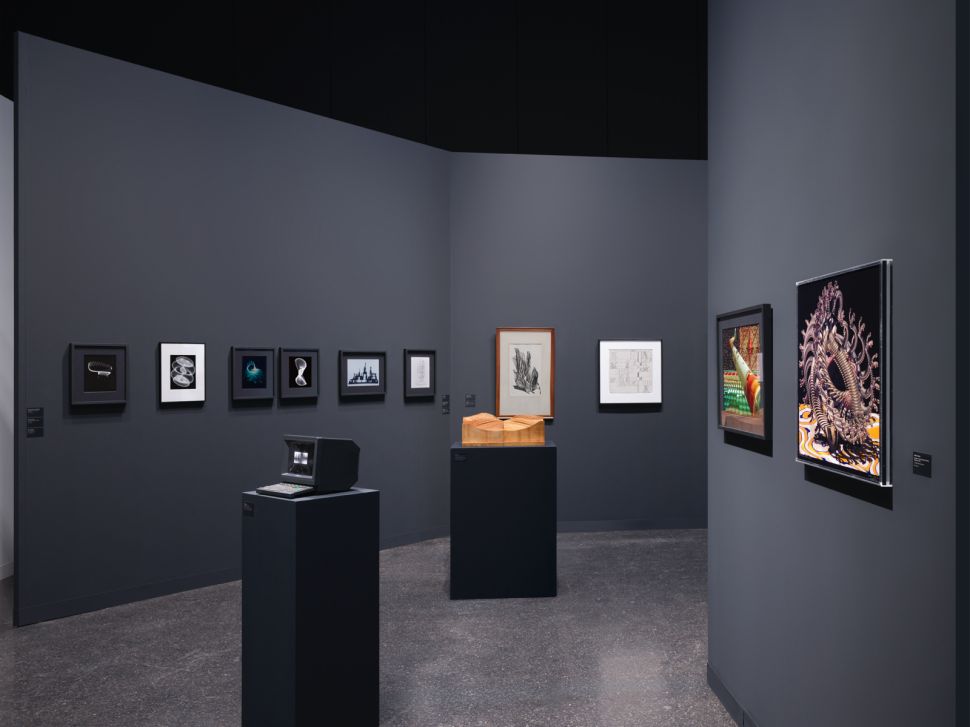
Those who ventured beyond the main halls of Art Basel to explore Zero10, the mega’s digital art initiative presented this year for the first time at its Swiss flagship edition, likely paused to take in one particularly museum-like display featuring works ranging from vintage-look prints to code-generated abstracts displayed on screens. Titled “From Code to Canon: Celebrating 70 Years of Digital Art,” ArtMeta’s booth had a lot to offer anyone wanting to learn about the history of digital art. The presentation traced computer and electronic image-making back to the 1950s, beginning with works such as the oscilloscope imagery of Ben F. Laposky, Mary Ellen Bute and Desmond Paul Henry. Structured in seven chapters—SIGNAL, SYSTEM, GRAPHIC, NETWORK, GENERATIVE, INTELLIGENCE and PROTOCOL—the booth connected early electronic signals and algorithmic graphics to contemporary A.I. and blockchain-based practices. Emerging alongside early mainframe computers, cybernetics and information theory, these experiments positioned digital art as something born from light, signal and machine-mediated perception before the digital image existed as a file. Among the booth’s historical gems was Charles Csuri’s Numeric Milling (1968), one of the earliest physical 3D sculptures created using a computer algorithm, priced at $200,000.
ArtMeta launched around 2021 as a curatorial platform for digital art, aiming to contribute to its historical, critical and cultural contextualization. Co-founders Georg Bak and Roger Haas worked in art and culture, including in the traditional gallery system, for more than 25 years. Over time, they realized that, despite living in the age of the internet, blockchain and A.I., digital art was still largely neglected by art fairs and institutions. “The art world has been struggling to reinvent itself with never-ending post-isms, although the obvious postmodern art movement was digital art, and it has been there since the 1950s,” they told Observer. “We felt that this huge gap had to be filled and the history of digital art had to be told properly and contextualized within a larger framework of art history.”
Bak and Haas describe ArtMeta as a “forum” dedicated to the history and future of digital art through exhibitions, publications, conferences, community and institutional collaborations. “Our position sits between scholarship, curatorial practice and the art market. We are interested in building the cultural vessel that allows digital art to be understood, collected and ultimately integrated into the broader art system.”
The presentation at Zero10 focused on the intersection of the technological evolution of computing systems and their artistic appropriation, revealing a broader and more entangled history of collaboration among art, technology and science. Taken as a whole, it pointed to an enduring human desire to engage creatively with technē: to use technology not only for its conventional functions but also as a tool, a medium and a space for artistic invention. “The early pioneers worked with machines developed for science, engineering, military research or administration. By using them to create images, movement and aesthetic systems, they transformed instruments of calculation into instruments of imagination.”
That impulse continues today. “Artists do not merely illustrate technological change; they investigate how technology reshapes perception, authorship, labor, identity and power. Artificial intelligence is the latest example, but the underlying questions are not new.” For Bak and Haas, the history of digital art is a reminder that our relationship with technology has always been as much cultural as functional. “Technology does not simply shape society; we continually redefine it through creativity. Artists often reveal the implications of new technologies long before society fully understands them.”
Across three editions in three cities, Zero10 credibly demonstrated that digital art extends far beyond art presented on screens. It often includes physical or phygital dimensions and engages broadly with technology, science, systems and perception. When asked to define digital art and explain how it has evolved, the pair pointed out that in its early days, terms such as computer art and generative art were in circulation. With the development of digital graphics and programming tools, alongside the rise of installation-based art, terms such as new media art and digital art entered art theory. Today, the spectrum of practices available to artists ranges from generative art, immersive digital art and digital painting to crypto art, A.I. art and code-based art.
In their view, categorizing digital art depends less on how it is displayed than on the role digital technology plays in its conception, production or operation. “A digital artwork may appear on a screen, but it may equally exist as a print, sculpture, installation, robotic system, networked artwork or biological process. What matters is whether computation, code, data or digital systems are fundamental to the work itself,” they asserted.
The definition has also expanded as digital technology has become embedded in almost every aspect of contemporary life: “Earlier generations often worked with identifiable machines or programming environments. Today, artists engage with distributed infrastructures, artificial intelligence, networks and increasingly invisible computational systems.”
Bak and Haas believe that, in the long term, the distinction between digital and non-digital art may become less important. For now, however, they consider that distinction useful, since the history of digital art is still underrepresented and digitally native works raise specific questions around preservation, ownership, display and interpretation. “The goal is not to isolate digital art permanently, but to ensure it becomes fully integrated into art history.”
Bak and Haas have been actively involved in advancing the discussion around new practices and their history. Before Art Basel introduced Zero 10, they organized the Digital Art Mile in 2024 and 2025—the first global fair dedicated exclusively to digital art—featuring presentations across venues along the historic Rebgasse in Basel during Art Basel week. “We created the Digital Art Mile out of necessity because we believed digital art deserved a dedicated platform during Basel,” they say. “Our aim was to bring together the international digital art community through a format that combined exhibitions, a fair and a conference.”
The conference was not merely part of the public program but central to the project. “Digital art still requires historical context and critical discussion alongside the market. We wanted artists, collectors, curators, museums, galleries, technologists and thought leaders to come together, exchange ideas and contribute to the development of the field.” The fair’s distributed format gave the project a distinctive character. “It became a place where different parts of the international digital art community could meet and where visitors could experience the field from multiple perspectives.”
The Digital Art Mile also confirmed that there was a global community willing to come to Basel specifically for digital art, and Bak and Haas said they’re “pleased to see Art Basel continue this momentum through Zero10. The more opportunities there are for digital art to become integrated into the broader art world, the stronger the field will become.” Digital art, they added, is no longer an emerging niche but rather becoming an integral part of contemporary art and cultural history. At ArtMeta, they’ve created a platform where the future of human creativity can be experienced, discussed and better understood, while also ensuring that digital art is recognized not only for technological innovation but also for its artistic, cultural and historical significance.
Admittedly, ArtMeta’s collector base still hails largely from within the digital art ecosystem. “These are collectors who have been supporting the field for many years, alongside those who entered through generative art and blockchain-based art over the past decade,” according to Bak and Haas. “They have played an important role in building the market and supporting artists during a formative period.”
Recently, however, they have seen increasing interest from traditional collectors, museums and cultural institutions. Digital art appears especially well-suited to attracting the new wealth accumulated by technology entrepreneurs, a constituency the art world still struggles to engage with. Silicon Valley figures seem less interested in collecting art, possibly because they no longer need to flaunt it as a marker of social status in the manner of earlier generations of American entrepreneurs and financiers, from the Gilded Age through the hedge fund era.
Bak and Haas don’t think the technology sector is fundamentally uninterested in art; instead, they point to a traditional art world that has not developed the language, relationships or formats needed to engage this audience. “Tech millionaires are questioning why the discourse surrounding digital art is being sidelined in the age of digital art,” they argued. “Many people working in technology are deeply interested in creativity, systems, experimentation and the future. Digital art naturally resonates with these interests because it engages with the same materials that increasingly shape our world: code, networks, artificial intelligence, data and computation.”
Persistence might just be the key to inspiring cultural patronage. “The art world must continue to provide historical context, build trust and demonstrate why these works matter beyond technological innovation.” Digital art, they added, represents an important opportunity for the art world to bring a new generation of collectors and patrons into the arts. “As the field matures and becomes increasingly grounded in history rather than novelty, we believe this audience will continue to grow.”
Meanwhile, more institutions are engaging seriously with digital and new media art. But while progress has been made, much more remains to be done to fully integrate and institutionalize these practices, especially as they are already shaping the cultural heritage of our time. (Even UNESCO has begun to embrace the notion of data heritage.) Bak and Haas see this institutional shift as encouraging. “More museums are acquiring digital works, presenting historical exhibitions and investing in curatorial expertise dedicated to digital and media art,” they said. More importantly, institutions increasingly recognize digital art as part of history rather than simply as passing innovation. “Many of these works are now more than 50 years old and deserve the same scholarly attention and conservation efforts as any other artistic movement. As the history of digital art becomes better understood, more people recognize that this is not simply a new medium but an important chapter in postwar and contemporary art.”
They also believe that digital art should not remain confined to specialist departments or occasional technology-focused exhibitions: “It needs to become fully integrated into permanent collections, museum narratives, conservation strategies and academic research.” Preservation remains one of the greatest challenges. “Conserving digital art often means preserving software, code, behaviour and technological environments rather than only physical objects. This requires new expertise and long-term institutional commitment.”
Ultimately, with digital technologies defining so much of contemporary society, the artworks created using that tech must be considered part of our cultural heritage. “Preserving, studying and exhibiting them is essential if we want future generations to understand the culture of our time,” Bak and Haas concluded.
