
Just before the art world sailed off for its summer break, the two biggest auction houses posted record half-year results, with Christie’s leading at $4.5 billion in revenue, followed closely by Sotheby’s at $4.4 billion. The week before, Phillips posted a solid $507 million spring season, up 60 percent from the previous year. According to ArtTactic’s 2026 H1 review, global auction sales across the three auction houses totaled $6.77 billion, including buyer’s premium, marking a 69.8 percent year-on-year increase and the highest first-half result since 2022. Yet those numbers mostly reflect the very top end of the art market and are not necessarily indicative of its overall health, particularly when we look at the gallery sector and the mid-tier.
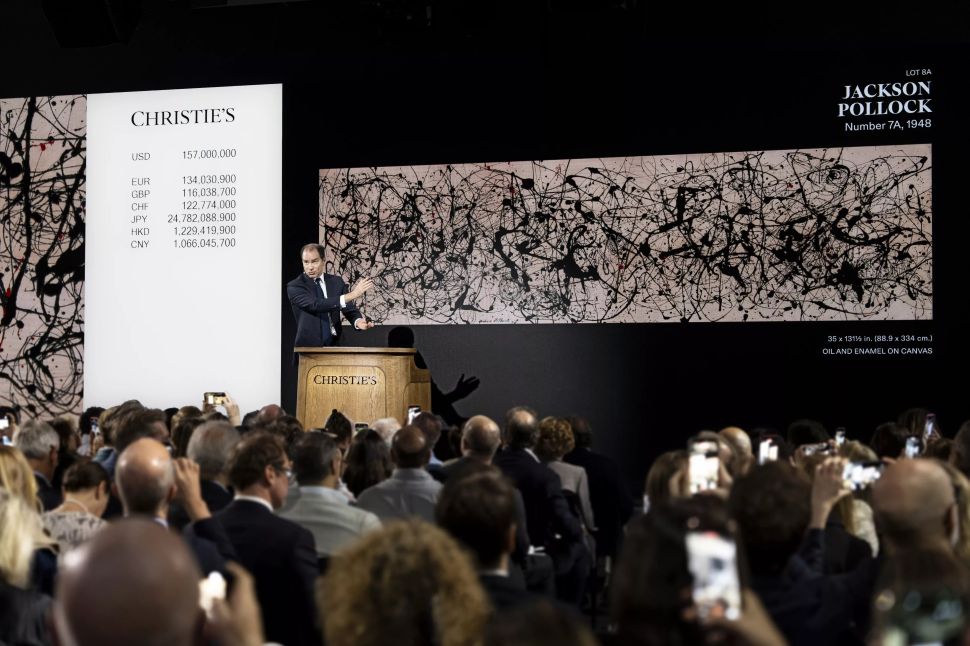
ArtTactic’s analysis also confirms that single-owner collections were a key driver of auction sales growth in H1, bringing in $2.17 billion in total sales and accounting for 32 percent of total auction sales value this season. Christie’s sold the highest-value collection with the $630.8 million S.I. Newhouse sales in May, along with the top three works at auction this year, all of which set auction records: Jackson Pollock’s seminal Number 7A from 1948, which sold for $181.2 million; Constantin Brancusi’s Danaïde, which sold for $107.6 million; and Mark Rothko’s No. 15 (Two Greens and Red Stripe), which achieved $98.4 million.
At Sotheby’s, single-owner collections with storied provenance achieved a strong sell-through rate of 96 percent, led by the $406.2 million Joe Lewis collection—the highest-value single-owner sale ever staged in the U.K. and the highest-value sale of Impressionist & Modern and Contemporary art ever staged in Europe—with the $173 million Robert Mnuchin sale in May and the $96 million record design sale of the Jean and Terry de Gunzburg collection contributing significantly.
High sell-through rates and the number of bidders per lot suggest buyers are feeling more confident. According to ArtTactic, overall auction sales value rose 69.8 percent year-on-year to $6.77 billion in H1 2026, with a 4.6 percent increase in the number of lots sold.
Phillips (Billions USD). ” width=”970″ height=”496″ data-caption=’Single-owner collections drove much of the reported growth, accounting for nearly a third of total auction sales value. <span class=”media-credit”>Copyright © 2026 ArtTactic</span>’>
Sotheby’s reported a 90 percent sell-through rate, the strongest since at least 2010, with an all-time high of 4.9 bidders per lot sold, 6 percent more than in the first half of last year. Christie’s posted a still-satisfying 91 percent sell-through rate across categories, with a 124 percent hammer price relative to the low estimate, meaning most lots exceeded expectations. This was particularly strong in online sales, where the index of hammer price to low estimate for lots in the lower price tier—between $20,000 and $100,000—reached 148 percent, up 21 percent from last year.
ArtTactic’s review confirmed that, across all three auction houses, online-only auctions reversed a four-year decline, achieving 22 percent growth, with lots sold increasing 23.8 percent year-on-year. Hong Kong saw the strongest growth, with online sales rising 39.8 percent, followed by New York, where online sales reached $176 million. Though not included in the press release, Sotheby’s online-only sales increased 31.2 percent year-over-year, reaching $188 million in H1 2026 and accounting for 47.5 percent of its entire market. Online sales are also one of the best channels for acquiring new and younger clients: 63 percent of all new bidders and buyers online are new to Christie’s, and 47 percent of new clients acquired by the auction house across all its sales in the first half of the year were millennial or Gen Z. These figures suggest that, overall, the market is broadening—at least at the auction level.
These results come against the backdrop of Wall Street banks also reporting record quarters on the same days: JPMorgan, Goldman Sachs, Citigroup and Bank of America posted a combined $19.3 billion in revenue from equities trading this quarter, far more than analysts expected and 72 percent higher than at this time last year. Despite the war in Iran—or perhaps because of the temporary pause that held until a few days ago—U.S. inflation, after rising for several months, also ticked down in June, and by considerably more than investors were anticipating. These broader economic factors likely contributed to the auction houses’ record highs, at least in the latter part of the season.
This is particularly relevant given that New York maintained its role as the main market hub, reaching $3.79 billion across the auction houses in the first half of the year, up 75.9 percent—figures that can be combined with the $7.74 million generated on the West Coast, up 29.5 percent. London came next with a $1.42 billion total and a remarkable 131 percent growth, following a record season led by single-owner collections that generated $568 million alone, 1,548 percent more year-on-year. Hong Kong remains the third-largest market by size and volume, with $764 million in total auction sales, 29.7 percent higher than last year, while Singapore contributed to the APAC market with an additional $13.1 million in sales, also up 32 percent from last year.
Asian buyers were notably active during last May’s sales—particularly at Sotheby’s—chasing and often winning many of the top lots, and the half-year reports confirm renewed attention for and from the region, both in terms of bidders and the art itself. Sales of Asian art at Christie’s were up 60 percent in the first half, while Sotheby’s achieved a white-glove $22.1 million result for Modern & Contemporary South Asian Art in New York in March. Both auction houses appear particularly interested in tapping into the vast potential of the fast-rising Southeast Asian region: this month, Christie’s is hosting a show in collaboration with the Kiran Nadar Museum of Art, “The Meeting Ground: Scenes from the KNMA Collection,” at its London location, with selected works from the holdings of New Delhi mega-collector and patron Kiran Nadar. In July and August, Sotheby’s is staging “The South Asia Edit,” a series of exhibitions celebrating six distinct voices in the history of South Asian modern and contemporary art.
The first-half reporting also confirmed the importance of the luxury segment for auction houses seeking to continue expanding their business volume and bidding base. Luxury auction sales at Christie’s, Sotheby’s and Phillips reached $1.01 billion, including buyer’s premium, in H1 2026, up 25.4 percent year-on-year, marking the third-highest first-half sales total on record.
The increase in auction sales of luxury collectibles was driven primarily by the watches category, which reached $437.5 million, representing 72.6 percent growth from last year. The top result in the first half was F.P. Journe’s Chronomètre à Résonance “Souscription, No. 007,” which sold at Phillips New York for $13,922,000 in June 2026. Jewels & Jewelry nonetheless remains the largest category, generating $454.9 million in this first half, up 8.3 percent from last year, with online sales accounting for 19.3 percent of total sales value and 59.3 percent of the volume sold.
Memorabilia also emerged as one of the strongest-performing and fastest-growing categories, with sales reaching $96.1 million, up 308.1 percent from last year—1.4 percent of the overall auction market. The market for fossils is growing too: earlier this week, a 67-million-year-old Tyrannosaurus rex fossil named “Gus” sold for a record $50.1 million at Sotheby’s as part of its Geek Week in New York.
For Christie’s, the luxury segment—including sales of automobiles through Gooding Christie’s—accounted for $539 million, with a more modest 15 percent growth this half, though still the third-highest sales total in the last 10 years. Watches saw some of the strongest growth, with sales increasing 25.5 percent year-on-year, followed by Jewels & Jewelry, which rose 4.4 percent. Luxury collectibles are also increasingly essential pillars of Sotheby’s business as the auction house pursues its transformation into a luxury concierge serving clients across different levels. Luxury sales at Sotheby’s reached $334 million, accounting for 33.1 percent of its market and representing 28.1 percent growth from $260.8 million last year.
While Christie’s held a total of 14 live and 25 online luxury auctions, Sotheby’s first half included 57 luxury auctions, with the sell-through rate increasing to 95.5 percent from 2025. Josh Pullan, global head of Sotheby’s Luxury Division, acknowledged strength across a remarkable breadth of categories and geographies, confirming particular strength this half in the watches market, up 64 percent from the previous year, boosted by the record sale in Hong Kong this April, which alone delivered $52.9 million. Jewelry remains important for the auction house, up 13 percent year-on-year, with a 90 percent sell-through rate, led by the white-glove $17.2 million The Shapes of Cartier sale.
For most of these luxury collectibles, Hong Kong remains the primary market. Sotheby’s Hong Kong High Jewelry sale saw the highest sell-through rate in the category in the region, at 89 percent, led by an Impressive Colored Stone and Diamond Cartier Tutti Frutti Pendant Necklace, which achieved $2.8 million.
Global sales of Wine & Spirits also saw a combined 94 percent sell-through rate at Sotheby’s, led by the most valuable American whiskey collection ever sold at auction, The Great American Whiskey Collection, which achieved $2.5 million, setting a record for the most valuable bottle of American whiskey ever sold: Old Rip Van Winkle 20 Year Old Single Barrel “Sam’s” (1982), sold for $162,500.
Cars are another segment growing at both Christie’s and Sotheby’s. For RM Sotheby’s, this was a record six months, with 61 percent growth over last year, fueled by several landmark auctions. The sale of a 1961 Ferrari 250 GT SWB California Spider for €16.7 million, in particular, helped the €87 million Monaco sale become the highest-grossing collector-car auction ever held in Europe.
Sotheby’s announcement also highlighted the role of its new experiential locations, in particular the Breuer, which successfully drew crowds of more than twice as many visitors as its former York Avenue location.
Private sales remain important for both auction houses, with Christie’s generating over $1 billion privately in the first half. Sotheby’s, meanwhile, reached an all-time high of $826 million, a 52 percent increase from the prior year. Sotheby’s also continues to successfully offer its financial services, completing a new $900 million securitization issuance in January—a significantly oversubscribed transaction reflecting strong investor demand.
Yet fine art remains the cornerstone of success at both houses. Across the main auction houses, Post-War & Contemporary Art generated $1.92 billion (+56.9 percent), Impressionist & Modern Art $2.31 billion (+133.4 percent) and Old Masters $271.8 million (+59.3 percent), while Luxury accounted for $1.01 billion (+25.4 percent) and Design, Decorative Arts & Furniture brought an additional $281 million (+63.3 percent). At Christie’s specifically, the 20th & 21st Century department brought the auction house $2.313 billion (+79 percent), while Old Masters and Classics reached $183 million and $241 million respectively, both showing remarkable growth, with increases of 232 percent and 168 percent from the same period last year.
Overall, results in the first half of the year confirm a strong auction market that continues to find its way out of the recent downturn by broadening bidding bases across categories, services and experiences while retaining existing clients across seasons, sales and geographies. How the second half of 2026 will unfold remains to be seen, as a shifting geopolitical and economic landscape will no doubt continue to add a measure of uncertainty to the market.
