
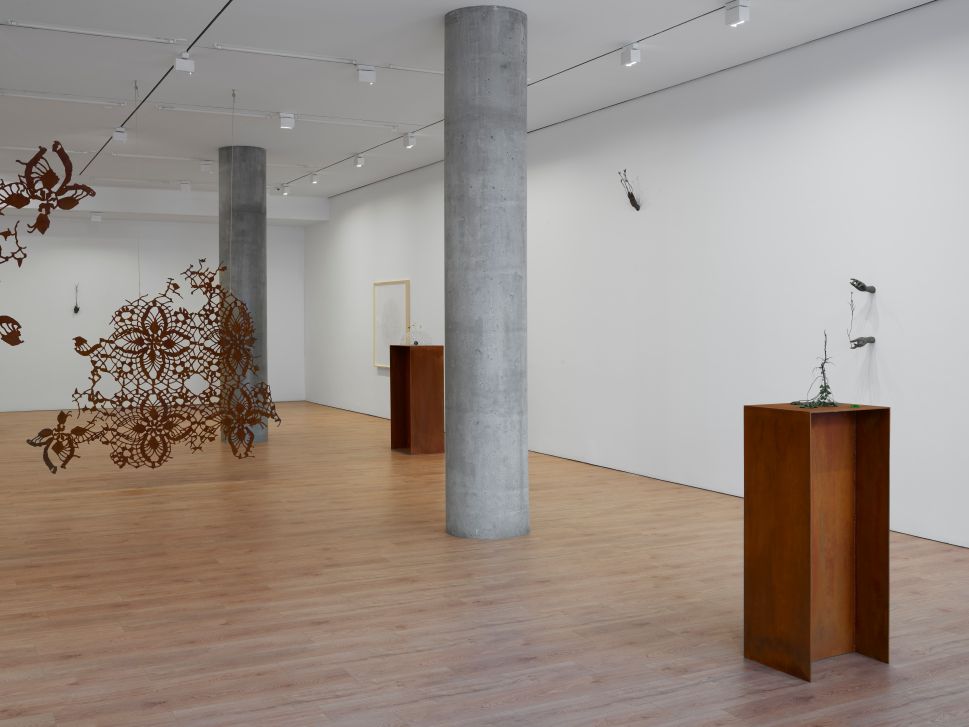
Lisson Gallery, showing suspended corten steel forms resembling enlarged lace or botanical structures alongside delicate glass and plant-like sculptures on rust-colored pedestals.” width=”970″ height=”727″ data-caption=’Installation view: Kelly Akashi’s “Heirloom” at Lisson, New York. <span class=”lazyload media-credit”>© Kelly Akashi, courtesy Lisson</span>’>
Following a much-celebrated L.A. debut with Lisson Gallery, Kelly Akashi is presenting a new body of sculptural work in New York that reflects on how loss and memory are carried and transformed over time. What Akashi has created in the West 24th Street space is a sequence of evocative moments in a reflection that is both deeply personal and universal. Delicate presences inspired by nature and traditional craft, rendered in bronze, Corten steel, flame-worked glass and stone, offer fragile moments of beauty, care and endurance—the artist’s transient forms maintaining a sense of organic vulnerability and change.
Inspiring this body of work is Akashi’s recent engagement with the site of her former home and studio, destroyed by the L.A. wildfires in 2025. There, she observed nature returning, resiliently, amid the destruction. “This work”—a delicate glass sculpture of a plant—”began with a weed growing on my property, a mallow plant, which tends to take root on disturbed land. After destruction, when the soil has been broken apart, it spreads very aggressively,” she told Observer, as we walked through “Heirloom” ahead of the opening.
She immortalized that weed in sculpture, which stands upside down over a Corten steel plinth, as if just uprooted from the soil. “I became interested in that contradiction: on one hand, the plant is regenerative and restorative, enriching the soil and helping it recover, but at the same time it takes over in a way that can feel invasive or difficult to control,” she explained. By presenting it upside down, she wanted it to feel unearthed, emphasizing roots, subterranean systems and what remains hidden beneath the surface.
On another pedestal, a reticular glass dome protects a fragile form, suggesting both containment and permeability, exposure and fertile contamination with the accidental events that keep matter in motion. “A lot of my work is about crystallizing fleeting forms or moments in time, but I approach that through different technologies,” Akashi added. Originally trained in photography, she sees sculpture as another way to create relationships with a subject through different degrees of proximity and material engagement.
The work at Lisson employs borosilicate glass, which allows her to engage not only with material experimentation but also with historical lineages, as the medium recalls 19th-century lampworked botanical models. “I’m interested in tracing those material histories and lineages through the work,” she emphasized. “I also love the tension between fragility and structure. A lot of these forms appear delicate, but they find their own balance.”
Recently, she has become interested in how human-made decorative traditions—embroidery, lacemaking and ornamentation—developed in dialogue with natural systems, often replicating their patterns and rhythms. Corten steel panels hang in the space, translating the embroidered tablecloths once in her home, but now lost to the fires, into something more monumental and solid in shape and scale. “Some of these works incorporate the same patterns of the lace tablecloths that belonged to my grandmother. Only partial fragments of them survived the fire, so the sculptures try to hold both the presence of the object and the absence of what was lost.”
Framed on the wall, articulated compositions flocked in book ash recall the entangled, repetitive structures already present in nature, from the microscale of snowflakes to the macroscale of geological or coral formations. “I recently learned that one of the leading bobbin lace pattern designers is actually a scientist in Antarctica, because lace design depends on understanding mathematical structures,” Akashi said. “That relationship between mathematics, science, beauty and nature is deeply compelling to me.”
Throughout the show are attempts to attune to a nonhuman time frame, resynchronizing the power of human creation with that of nature. “Geological time is very important in my work. I’m interested in being outside of human time,” Akashi explained, sharing how, since being displaced after the fires, she has experienced time differently, returning to her home intermittently and observing changes more slowly. “Gardening especially taught me something about recovery and duration. There’s a slower process of transformation that exists beyond our immediate perception.”
Akashi translates doily patterns into materials like quartz and steel to connect intimate inheritance with monumental sculptural traditions. “Stone-based works carry geological associations, while the lace motifs carry familial and cultural memory,” she reflected. “By combining them, I can think through what we inherit, what we preserve and what we don’t know how to carry forward.”
In connecting geological and human memory, she embarks on an exercise in mending today’s most drastic fracture—between human and natural life, between human time and the broader cosmic order—reestablishing a soulful connection between the two that can help us understand the eruptions in nature and disruptions in culture at the heart of today’s crises.
In both process and materiality, Akashi’s new works serve as symbolic and oracular reminders that nature is always in motion, simultaneously devolving and evolving. Her sculptures register time and transformation in every material, as she allows traces of erosion, oxidation and change to remain visible, embracing the ongoing processes through which matter records duration and undergoes continuous transformation. Having witnessed destruction and regeneration herself, she creates powerful symbolic metaphors: reminders that nature means change, that change is the essence of life, and that whatever fails to change will eventually dissipate or die. But destruction and loss can also mean transformation.
Many of the processes she employs depend on artisans who have spent decades mastering specialized techniques passed through generations. “Collaboration and embodied knowledge are very important to me. Many of the techniques I work with come from deep craft lineages that I could never master on my own. I often collaborate with people who have practiced these traditions for decades,” she said. “Their knowledge is embedded in their bodies through repetition and time. I’m interested in how cultural knowledge is transmitted physically and materially across generations.”
At the back of the gallery is a monumental ring sculpture—a reconstruction of a jewel passed down to Akashi by her grandmother and lost in the fires. A psychologically monumental form carved largely from memory, it transcends the personal, oscillating between ornament and raw geology, situating intimate memory within a broader sense of geological and historical time. It’s a universal reflection on what endures, part of Akashi’s attempt to defy an anthropocentric perspective, embracing through this show a sense of time and meaning that transcends the individual.
This alchemy and transformation recur throughout her practice, and she links these concerns to her earlier experiments making candles, where she first became fascinated by fire, heat, illumination and the transformation of materials from one state into another. “I often work directly from plants by casting them from life. In a way, it’s another form of crystallization—preserving something transient. But I’m also interested in collaborating with nature itself,” she shared, recalling how some earlier bronze works were designed for plants to grow through them.
The exhibition feels choreographed, in that its design creates a rhythm of contemplation and distance between the works. This may derive from Akashi’s photographic training. “Photography always contains a distance, but sculpture allows people to move around it, experience it bodily and continue forming relationships with it over time,” she argued. “I can create the conditions for those relationships, but then the work keeps changing through viewers’ encounters with it. I want the works to create experiences rather than simply objects. Different materials, scales, and techniques allow overlapping ideas to emerge in ways I can’t always fully explain.”
Ultimately, the exhibition is a reflection on what it means to inherit and protect fragile forms of knowledge, memory and material culture in the face of loss. “Heirloom is about something precious that has been passed down,” Akashi said, “and about the question of how we protect it, how we preserve it, and how we live with the possibility of losing it.”
