
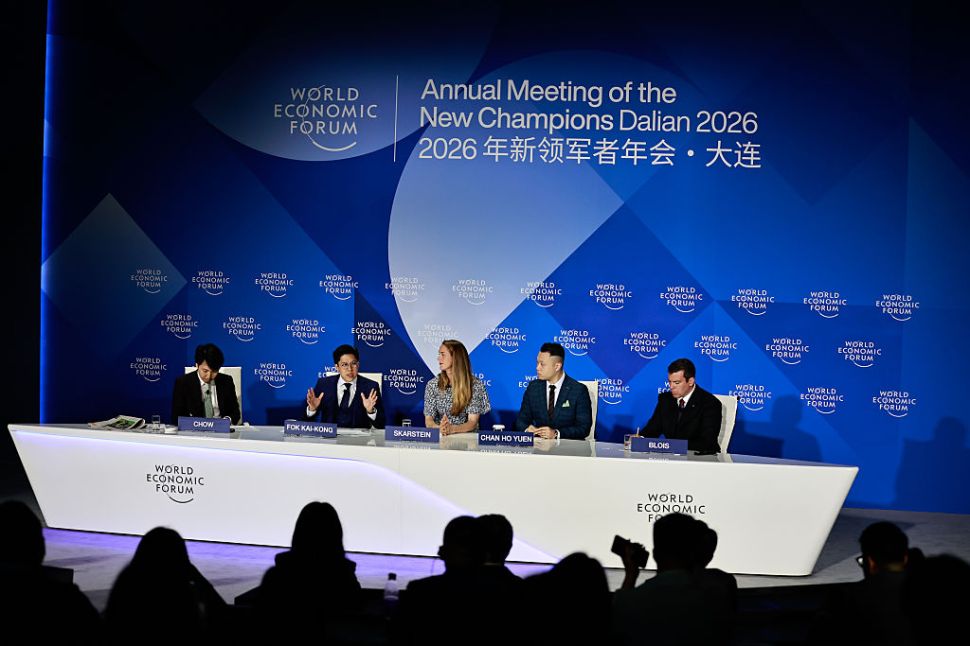
Every January, the World Economic Forum turns Davos, Switzerland, into a snow-covered stage for global power. Its summer gathering in China serves a different purpose: to signal where the forum believes innovation, capital and influence are heading next. Formally known as the Annual Meeting of the New Champions—more commonly called Summer Davos—this year’s meeting runs June 23 to June 25 in Dalian, China. Under the theme “Innovating at Scale,” WEF’s second-largest annual gathering is expected to draw more than 1,700 policymakers, corporate executives, entrepreneurs and academics. They will convene for high-level discussions on international commerce, A.I., energy systems, technological innovation and the evolution of the Chinese market.
“The DNA of this meeting is around innovation,” WEF managing director Mirek Dušek, said on the Radio Davos podcast last year. “And since we are in Asia, in China, this meeting has also always been quite useful in terms of deciphering the fast-evolving landscape on the innovation front in Asia and in China.”
In Switzerland, China and the broader Asian market can sometimes feel like part of the backdrop. In Dalian, they are central to the agenda. While January Davos is defined by heavy snow and a tightly packed calendar, Summer Davos trades the Alps for China’s coast and focuses more on entrepreneurs, industrial growth and emerging technologies.
The gathering is smaller and less famous than the January Davos, but attendees often describe it as unusually intimate. “You’ll casually end up in the same room as Premier Li Qiang and Tony Blair,” Sarah Tong, co-founder of Big Bang Academy, wrote on LinkedIn after attending last year’s meeting as part of Hong Kong’s delegation. The entrepreneurship panels, she wrote, “hit differently when you realize you’re actually part of the global innovation conversation.”
WEF founder Klaus Schwab’s long courtship of China
Summer Davos grew out of WEF founder Klaus Schwab’s long courtship of China. The January Davos hosted its first Chinese delegation in 1979, during its ninth edition, as China began opening its economy after decades of a closed, state-planned system. Seeing an opportunity, Schwab soon traveled to Beijing with a European business delegation that included 20 CEOs, beginning what WEF has described as a longstanding relationship. By the 1990s and early 2000s, China had become a major destination for Western companies, culminating in its 2001 entry into the World Trade Organization.
Schwab proposed bringing the Davos model to China in 2005. After touring several cities, the forum selected Dalian, a port city known for trade and maritime commerce, and Tianjin, an industrial hub near Beijing, as rotating hosts. The first Summer Davos opened in Dalian in 2007.
“Countries such as China and India have emerged as the new global players and partners,” Schwab said in his opening remarks that year. “Above all, companies are suddenly driving the global economy as the new champions.”
Nearly two decades later, that same global shift is unfolding under more strained conditions. This year’s meeting opens as Washington and Beijing remain at odds over tariffs, supply chains, A.I. chips and software, while the U.S. expands scrutiny of Chinese companies it says are tied to China’s military.
Against that backdrop, China’s Vice Premier He Lifeng used the Davos stage in January to argue for more global dialogue and cooperation. “We are committed to building bridges, not walls,” he said.
Li Qiang (R) and World Economic Forum (WEF) founder and executive chairman Klaus Schwab attend the opening ceremony of the World Economic Forum Annual Meeting of the New Champions (AMNC24) in Dalian, in China’s northeastern Liaoning province, on June 25, 2024.” width=”970″ height=”647″ data-caption=’WEF founder Klaus Schwab (L) China’s Premier Li Qiang (R) attend the opening ceremony of the World Economic Forum Annual Meeting of the New Champions (AMNC24) in Dalian in 2024. <span class=”lazyload media-credit”>PEDRO PARDO/AFP via Getty Images</span>’>
Who’s attending this year’s Summer Davos?
This year in Dalian, the gathering remains sizable, though public figures suggest it has not returned to the conference’s pre-pandemic levels. The 2018 meeting in Tianjin drew more than 2,000 participants; last year’s gathering drew more than 1,700, and this year’s is expected to attract a similar number from more than 90 countries.
Political participation appears smaller than last year. In 2025, WEF said more than 160 senior political leaders were expected, compared with more than 90 this year. Chinese Premier Li Qiang, who opened last year’s meeting, will deliver a special address this year. China’s Foreign Ministry said the prime ministers of Bangladesh, Guinea, Kazakhstan, South Korea, Mongolia and Montenegro will attend.
This year’s co-chairs offer a window into the leaders shaping the discussion. They include Robin Zeng, founder of Chinese EV battery giant CATL; Ester Baiget, CEO of Danish biotech company Novonesis; Giovanni Caforio, chair of Swiss pharmaceutical giant Novartis; Margery Kraus, founder and executive chair of Washington, D.C.-based APCO; and Jonas Prising, CEO of Milwaukee-based ManpowerGroup.
At least 130 founders have registered for Dalian, according to Verena Kuhn, WEF’s head of Innovator Communities. Many are building “physical things,” including new materials, A.I. and energy infrastructure and robotics, she wrote on LinkedIn. Kuhn also pointed to a wave of companies focused on infrastructure for A.I. agents—a “clear signal that the agentic economy is going mainstream,” she wrote.
This year’s agenda is organized around five core questions for executives and policymakers: how trade is shifting, where China’s economy is headed, whether A.I. and other technologies can deliver real productivity gains, how growth translates into jobs for the next generation and how energy becomes a competitive edge.
“At a time of economic uncertainty, geopolitical tension and rapid technological change, this meeting is an opportunity to focus on practical solutions,” WEF President and CEO Alois Zwinggi said in a statement.
