
The epic feeling that runs through the oeuvre of Pierre Huyghe (b. 1962) invites one to make superlative statements about his reputation. It’s clear that he’s among the most significant artists of his generation, and he may be the most beloved. I didn’t know anyone who didn’t rave about his exhibition “Liminal” at the Punta della Dogana two years ago in Venice. Maybe this was because it could be enjoyed by anyone, in any state of mind. I stumbled into its darkness after a boozy poolside lunch at Hotel Cipriani. My eyes took a while to adjust, but upon entry I was struck by a featureless sci-fi mask in gold that appeared to be hanging on the wall. I shot right to it for examination only to feel a light touch on my chest. In fact there was a person in all black wearing this mask, and I was too close to her. From the mask emerged a garbled admonishment in some non-language that sounded like an aggressive droid in Star Wars.
“Pierre Huyghe“
Artist: Pierre Huyghe
Venue: Fondation Beyeler
Address: Baselstrasse 101, 4125 Riehen, Switzerland
Through: September 13, 2026
This was Idiom (2024) and it’s featured in “Pierre Huyghe” at the artist’s recently opened show at Fondation Beyeler. His first solo exhibition in a Swiss museum, it arrives as the successor to “Liminal,” with new additions like an artificial breathing organ called Apnea that sets the rhythm for the whole building, a murmuring robotic worm and an A.I.-generated gate, all threaded among the Venice veterans. Curated by Mouna Mekouar, curator at large at the Beyeler, and Anne Stenne, who curated the Venice show, with one non-Huyghe interloper: Max Ernst’s The Witch (1941), on loan from the Princeton University Art Museum.
Magic does seem to be a necessary element of his surrealist practice. The Idiom masks are golden resin, helmets worn over the face that house sensors, speakers and LED lights, but the experience of them is mysterious and transcendental. They are affected by “subtle signals—some beyond human perception,” according to the Beyeler. The Venice catalogue claimed the masks would over time form “a community,” “an entity without body,” speaking “an unprecedented form of language.” A more didactic artist would say this piece is about how social media is the new Tower of Babel, but to be near them is to consider them as more evolved entities than ourselves.
Evolution is a concern in Human Mask (2014), which I rewatched recently at the New Museum. In this a macaque wears a schoolgirl’s uniform and a Noh-style mask as she explores an abandoned restaurant in some kind of post-apocalypse. When I first encountered this in Venice I found myself wondering how he’d managed to find such realistic monkey arms for his child actor. The uncanny sensation is so strong, the evocation of a Japanese horror film so strong, that my mind could not accept the simpler solution, which was that I was looking at a monkey not a human.
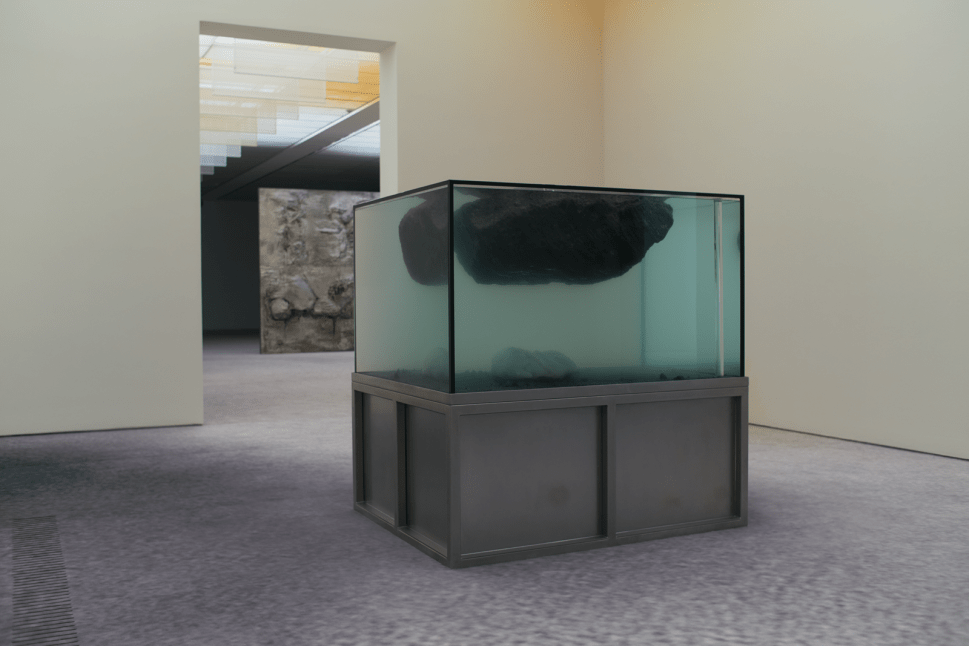
For further experiences with the uncanny there’s Cambrian Explosion 19 (2013), in which a volcanic rock floats in an aquarium. They not only feel both alive and dead, but ancient and futuristic at the same time. In a moment when writers love to praise a cultural object’s relevance for our time, Huyghe makes art that implies our current moment is maybe a little too stupid to be engaged with, unless through several layers of substances, technology and irony. I’ll drink to that.
