
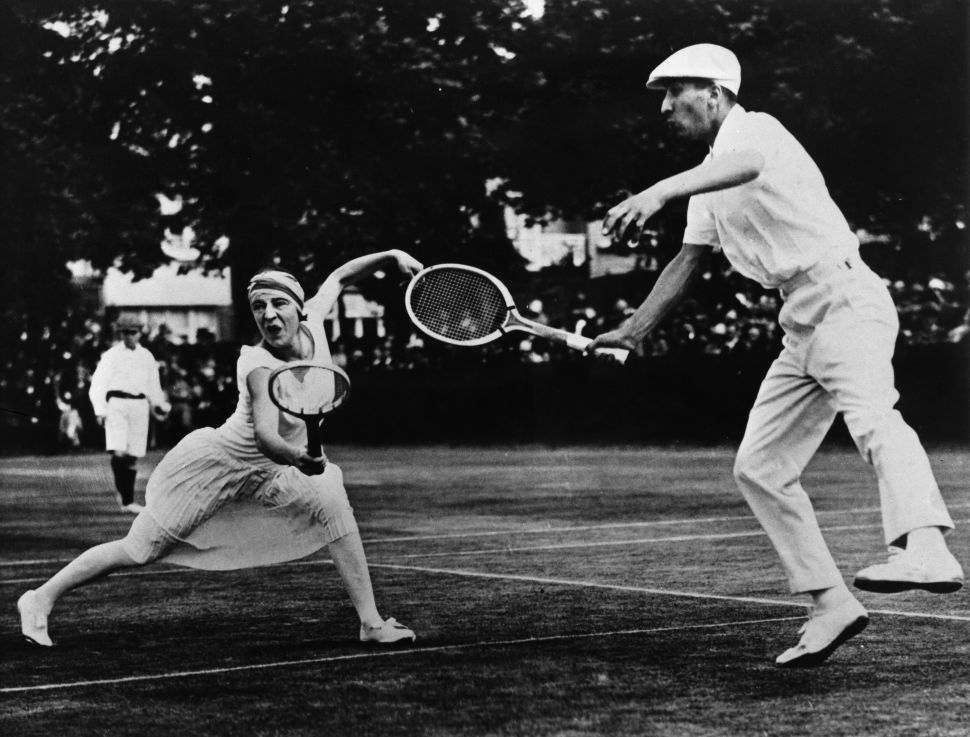
Before Naomi Osaka, before Serena Williams, before Billie Jean King, there was the French tennis star Suzanne Lenglen. When she died in 1938, at the age of 39, Reuters declared her “the greatest woman lawn tennis player of all time.”
She was born on May 24, 1899, in Paris, though her family moved shortly thereafter to the provincial town of Compaigne. She came from a well-to-do family—her father inherited a horse-drawn omnibus company—who loved tennis. Her father bought her first racket from a toy store when she was age 11, and she played on a makeshift court on their back lawn. The children of the household staff were called in to compete against Suzanne when no one else was available. She was so clearly talented that her father bought her a new professional racket within the month.
People would often claim that her father, Charles, deliberately tried to raise a prodigy on the court, a role which might bring to mind the Williams sisters today. People claimed that Charles Lenglen developed extensive training programs, marking the court into specific squares and demanding that Suzanne send the ball to a section he named; she was deprived of dessert if she did not hit the squares. This was a story he disputed. Charles agreed that he did offer her advice regarding her play and would watch opponents practicing and report back on their style of play. But he also claimed that “the women, not the sportswoman,” was his interest as a father.
He met his competitive match very early in Suzanne’s life. Newspapers noted that, while the family all enjoyed tennis, “Charles Lenglen is as bad a player as one can be. He stopped facing his daughter in the courts long ago, after receiving a pitiless drubbing at [Suzanne’s] hands.” At the time of this merciless defeat, Suzanne had three months of experience.
Suzanne went on to defeat others nearly as easily as she did her father. When she was only 15 years old in 1914, she became the youngest majors champion, winning the World Hard Court (the precursor to the French Open) singles championship in Paris. During the war years, she was an inspiration to the French people, playing on the Riviera at matches for the benefit of the French Red Cross.
After the war ended, in 1919, she won the first of six women’s singles titles at Wimbledon, defeating the Englishwoman Dorothea Lambert Chambers. The British press claimed that people were “for a moment, filled with sadness at their champion’s downfall, but this was followed by a full and generous recognition of the audacity and triumphant gracefulness of this young foreign girl . . . the popularity of Suzanne Lenglen was unprecedented and universal.”
Part of this victory might have been her willingness to eschew the constraints on dress that female players had to deal with. In 1919, for instance, it was a subject of conversation that she had chosen not to wear a corset or long skirt. Doing so allowed her to leap gracefully to reach the ball in a way that more sartorially hindered players simply could not. The designer Teddy Tinling, who dressed Suzanne, recalled, “before her tennis had been starched cottons, cinches, and distorting corsets. She wore silk pleated dresses, which staggered the whole world. She always understood the power of sexual appeal—the men were having orgasms by the hour, and the women were spitting blood.”
Another feature was her bandeau headwear. To see her on the court was to see a vision of what a new, more liberated, physical woman might look like.
Her star only continued to climb. In 1920, she won gold medals for singles and mixed doubles at the Olympics in Antwerp. In between matches, she was seen “taking shots of brandy from a flask.” Her success here and at other tournaments inspired many young women. It seems notable that she made playing tennis look, well, cool, or at least like something a fun, free-spirited person would do. The Daily Telegraph noted that, “The success of Suzanne Lenglen and the popularity which she enjoyed had an extraordinary development on feminine tennis in Europe.” Other players from this period, like Kitty McKane, would attempt to follow Lenglen’s example.
While the Telegraph claimed in 1928 that England loved her more than anyone (as “England is the nation most completely devoted to sport”), in the French Press, she was called “La Divine—The Goddess.”
In 1921, when she was only 22, she came to America. The New York Herald declared that she was “the comet of France—a female comet and therefore the most dazzling of all comets.” To the surprise of the reporter, and perhaps anyone who has watched any tennis movie where the players perfect their form long into the night, she stated that she did not practice all that often. She claimed she played for 30 minutes every other day. She devoted 10 minutes a day to calisthenics, usually jumping rope. She also made a point to stretch for five minutes before going out on the court.
This is in question. The reporter who asked previously believed that “contests for the world’s supremacy could only be won after serving a long self-sentenced term at hard labor,” which certainly seems to be the modern sentiment. Venus Williams, for instance, spends around three hours a day on the court followed by two in the gym. Lenglen might very well have been lying so that her opponents were more inclined to underestimate her.
Whether it was a falsehood or if she just genuinely had a comparatively casual approach to practice, this strategy worked. She was the inaugural world’s number one player from 1921 to 1926. She won six Wimbledon titles, five in a row from 1919 to 1923. Her most notable defeat came in 1921, shortly after the infamous interview. She was so sick at the U.S. National championships in Forest Hills, New York, that she lost the first set against Molla Mallory. When she was stricken by a coughing fit, she began to sob, then retired. People would claim that she did this because she did not think she could win the match; the phrase “cough and quit Lenglen” was frequently sneered. It would be the only time she lost a singles match after WWI. She competed against Mallory again in 1922 at Wimbledon and demolished her (6-2, 6-0) in the shortest final on record—a mere 26 minutes. After the match, she said, “I could have said something to her; instead, I decided just to have a little cough.”
While that was a good joke, illness would prove to be a problem throughout Lenglen’s career. Often, tragically, they were illnesses that would not have so strongly afflicted her had she lived a hundred years later. She was stricken by jaundice in 1924. She consequently withdrew from Wimbledon and could not attend the Olympic Games.
1926 would be her last year playing amateur tennis, and by then it was clear that her star was at least somewhat fading. She played in “the match of the century” against Helen Wills. She won, but barely. Then, at Wimbledon, she attempted to reschedule a match, which meant the Queen of England, who was excited to see her play, was kept waiting an hour and a half. When match officials confronted Lenglen about this, she, rather petulantly, said she would not play at all.
Following that year, she signed a $50,000 contract to play professionally for four months in the United States. Until then, she claimed she had never earned more than $5,000 in her life. People complained that she had forsaken the amateur world, but she quite accurately pointed out that even being the best amateur sports player in the world could render a person destitute unless they came from a wealthy family.
In 1936, she founded a lawn tennis school where she coached. As always, she seemed to take a fairly blasé tone, declaring, “I don’t aim to make champions. I try above all to see that thousands of children amuse themselves, and at the same time get a taste for sport and learn self-discipline.” She would be appointed the inaugural director of the French National Tennis School in Paris in 1938.
But her health, which had always been difficult, was in severe decline. In mid June of 1938, Lenglen became extremely weak. She died less than a month later, in what was said to be a response to anemia that resulted from a neglected case of measles. Today, it is largely understood that she had leukemia. Until the day she died, she followed reports of the play at Wimbledon. Upon her death, the president of the French Lawn Tennis Association declared, “Mademoiselle Lenglen was the greatest woman player who has ever lived.”
She won eight Grand Slam titles in singles and 21 in total, including doubles play. She was posthumously inducted into the International Tennis Hall of Fame. The second court at the French Open Roland-Garros stadium is named after her. Whether she was the greatest player of all time may no longer be true. But between the brandy, the half hour of practice and the outfits, she was certainly one of the chic-est.
