
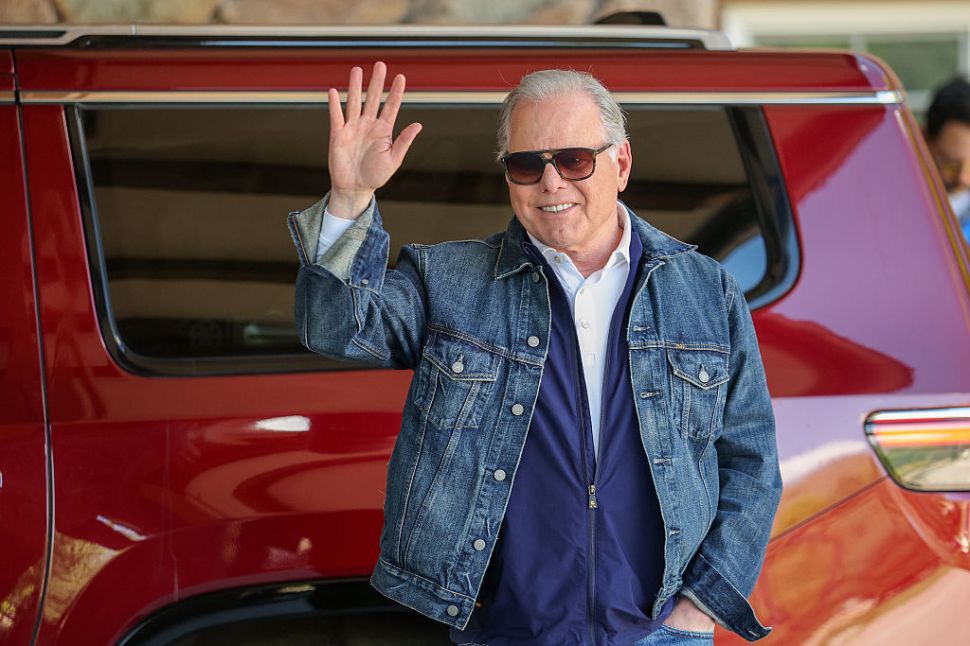
David Zaslav arrives at the Sun Valley Lodge for the Allen & Company Sun Valley Conference on July 7, 2026 in Sun Valley, Idaho. Every year, some of the world’s wealthiest and most powerful figures from the media, finance, technology, and political spheres converge at the Sun Valley Resort for the exclusive week-long conference hosted by boutique investment bank Allen & Co. ” width=”970″ height=”647″ data-caption=’Warner Bros. Discovery CEO David Zaslav at the Sun Valley Lodge for the Allen & Company Sun Valley Conference on July 7, 2026 in Sun Valley, Idaho. <span class=”lazyload media-credit”>Kevin Dietsch/Getty Images</span>’>
It’s unnerving to think how hundreds of thousands of jobs and hundreds of billions of dollars are at the whims of chance meetings and golf course conversations. But that’s billionaire summer camp for you. Entire industries change the moment the right person has a lightbulb flicker of an idea. And if that flicker is validated by any semblance of an uptick in share price? Watch out.
This is the buzzy outcome of the annual Allen & Co. conference in Sun Valley, Idaho, the unofficial breeding ground of Hollywood dealmaking. Every travel log, handshake and non-invite is scrutinized by the media with the frenzied intensity of Homeland’s Carrie Mathison. How could they not be? AOL-Time Warner, Google–YouTube, Comcast–NBCUniversal, Warner Bros. Discovery-Paramount Skydance; practically every consequential media merger and acquisition of the last quarter century owes its roots to this annual luxury getaway.
For years, expectations have held that Hollywood would contract to just three to five major entertainment players. But following Wall Street-driven streaming disruption, colossal debt financing, increased regulatory skepticism, and rapid audience movement, a more calculated equation has emerged. The industry’s power brokers are no longer asking whether consolidation is necessary, but what kind of assets are actually meaningful contributors.
Consolidation is no longer a given
Historically, deals at the highest levels don’t have the rosiest ROIs. It’s hard to integrate different businesses, no matter how much overlap there is. It’s hard to manage a Jenga tower of a balance sheet laden with crushing debt. So is major consolidation an absolute certainty moving forward?
“No, but that doesn’t mean it won’t happen,” media analyst Entertainment Strategy Guy, who has previously worked at studio conglomerates, a major streamer, and independent production companies, told Observer. “I do think some executives in town want it to be inevitable, and some executives understand consolidation will strengthen the survivors with both more supply and buying power, but it’s not inevitable.”
Regulatory approval has become an expensively time-consuming headache. Antitrust concerns from the Federal Communications Commission (FCC) and the Department of Justice (DOJ) haven’t made it easy. Federal judges killed Penguin Random House’s $2.2 billion acquisition of Simon & Schuster in 2022, and more recently, the $6.2 billion Nexstar–Tegna merger. Paramount Skydance is still working to get its WBD acquisition signed, sealed and delivered.
That deal was made possible in part because of WBD’s inability to fully operate under the crushing weight of debt accumulated in the initial Warner Bros. and Discovery mash-up. Even then, the combined assets never turned their flagship streaming service, HBO Max→Max→HBO Max, into a true Netflix competitor. Even Disney’s more fruitful (but highly expensive) acquisition of FOX limited the Mouse House’s ability to invest in streaming innovation initially due to debt.
The big takeaways: mergers are expensive, integration is hard, capital is best positioned when flexible, and profitability is vital. Scale at all costs is as outdated as the tastes of these 60-something CEOs.
Theatrical’s comeback changes the math
As of this writing, the annual U.S. box office is on pace to surpass $10 billion for the first time since 2019. Project Hail Mary, Obsession, Backrooms—the enthusiasm around new-to-screen stories and storytellers is palpable. But many wonder if a healthier theatrical business expedites or reduces the urgency to consolidate.
“Probably neutral,” Entertainment Strategy Guy surmised. “The regulatory forces impacting mergers have a bigger impact on dealmakers’ minds. If they can’t actually close a deal, that makes them much more hesitant.”
Joel Roodman, former senior Miramax executive and current CEO of Modern Uprising Studios Immersive, believes the current momentum helps stay any potential executions for the moment. “When theatrical is working, studios get some breathing room. A stronger theatrical market gives studios more confidence in the value of premium storytelling, which could reduce the urgency for larger mergers.”
Improving studio financials may make for a more attractive target while emboldening internal confidence. But it is regulation that truly directs traffic. In the meantime, a succession of box office hits can enable a studio to be more selective. Rather than scouring quarterly reports to try to figure out who is in desperate need of a life raft to survive, some companies may be embracing a modicum of discernibility. Finding the deals that are actually worth doing can be the new north star.
The next media deal may look more like gaming
Studio-on-studio consolidation hasn’t always worked out as hoped. Those types of misses often become financial albatrosses. So what should savvy movers and shakers be looking for instead? We have enough evidence to suggest that younger audiences in particular are responding to different forms of content. Relying on long-running existing brands and franchises may be running out of runway.
“Maybe you buy some form of other business. But it’s not so easy to learn another business. We’ve seen this time and time again in the past,” Simon Pulman, partner and co-chair of Pryor Cashman’s Media + Entertainment group, told Observer. “You could see different types of deals as companies look to acquire new media and gaming businesses, particularly in areas with Gen Z-friendly brands. Maybe Roblox…Ultimately, it’s all driven by content and the desires of audiences. What do people under 30 want?”
Smart folks who keep an eye on Wall Street for a living are already speculating along similar lines. Instead of barking up the same old traditional studio merger tree, LightShed Partners recently laid out an argument for the future spun-off NBCUniversal to go after Nintendo, Riot Games or Take-Two Interactive. These are interactive gaming companies that could bolster NBCU with IP that stretches into every corner of its entertainment ecosystem.
Conversely, despite a spotted track record, some wonder if atypical buyers can benefit from acquiring more audience reach. “Does retail media like Walmart need to match their investment in ad tech with a content play?” Simon Andrews, publisher of the Mobile Fix newsletter, mused to Observer. “They need eyeballs to unlock the value of their proprietary data. Everyone has seen Amazon leverage its Prime Video.”
The game has changed. It isn’t enough to only command attention on film and TV screens. Disney has led all studios in domestic box office market share every year from 2021 to 2025 and accounts for the second-largest total U.S. TV usage by any company, per Nielsen. Its stock is still down around 46 percent over the last five years.
Modern media companies need to extend beyond the typical screens to be a common touchpoint on laptops and mobile devices while building connective tissue between all of the above. Gaming, sports, direct-to-consumer creator economy business models—it’s a potluck of assets and approaches. Easier said than done, of course.
Netflix is the canary in the coal mine
Ups-and-downs, push-and-pull, give-and-take. Few things are obviously one-sided in modern Hollywood. But Netflix is the obvious case study to demonstrate the pros and cons of consolidation.
There’s a clear argument to be made that moving into selective theatrical distribution, acquiring a backlog of engagement-driving programming, gaining sports rights and reducing the number of competitors makes sense. Yet Wall Street punished Netflix’s stock price upon reports of its interest in WBD.
Overpaying for an asset, muddying free cash flow and expanding into new businesses are all very real challenges with tangible strengths and weaknesses. “Netflix does not need a splashy acquisition, but they did say the Warner process made them build their M&A muscle,” Hernan Lopez, founder of media research firm Owl & Co, told Observer.
It’s a perfect encapsulation of the industry-wide dilemma. Strategically, acquisitions can shore up weak points and/or compound strengths. But financially, Wall Street doesn’t always see the wisdom (fair or not), which may hurt share prices. Catch-22 incarnate. Netflix may be the current poster child for this tension, but no one is immune.
The next power play may not be a studio merger
“Executives float ideas at Sun Valley,” Smart Investors Daily CEO Ian Skjervem told Observer. “However, in my observation of these cycles, Idaho’s July words seldom make it to New York’s December doorstep.”
Anything can happen at Sun Valley. But in reading the tea leaves and talking to insightful industry professionals, blockbuster game-changing deals don’t seem to be the modus operandi coming out of this year’s sessions. Sexy, enticing, and legacy-making? Sure. But sensible and valuable? That’s another question entirely. Whether it’s newfound prudence or old-fashioned fear, the biggest companies appear to be reevaluating the genetic components of industry power.
The next deal that shakes the Hollywood hierarchy to its core may not involve a standard content company at all. Instead, whichever company has the best grasp of where the next generation allocates its income and attention may be best positioned for the future.
