
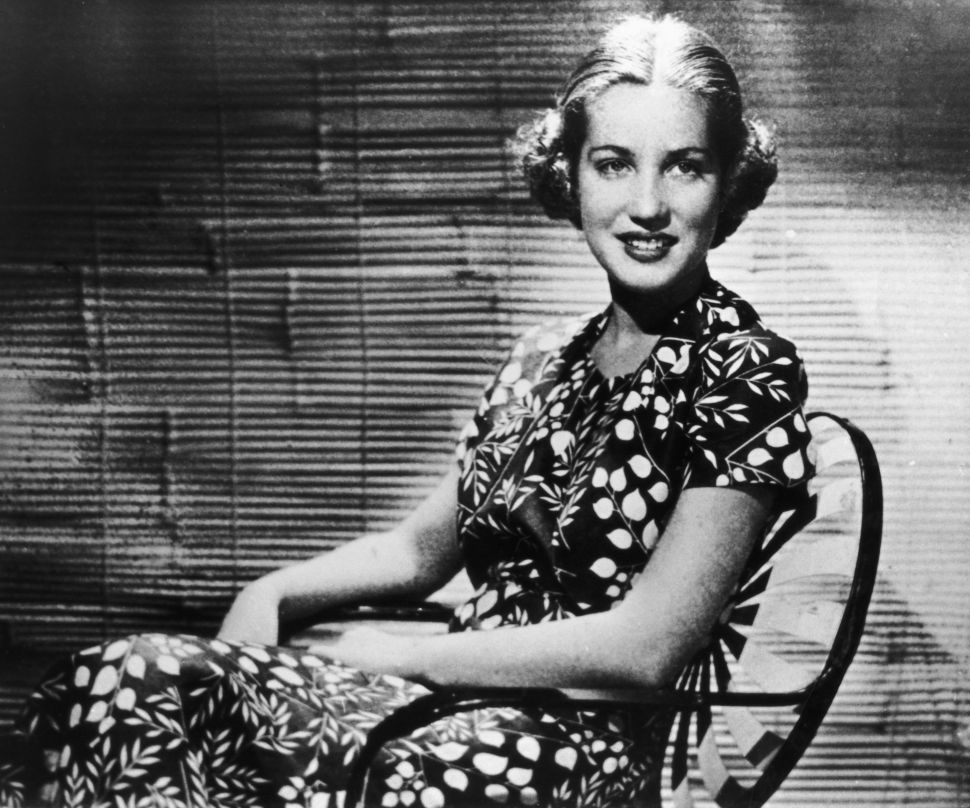
How does one of the most glamorous, genteel women in America end up in a “garbage-ridden, filthy, 28-room house with eight cats, fleas, and no running water?” A place where, according to the Washington Post in 1976, “the smell assaults and dominates.”
The predictable answer would probably be “drugs” or “a really bad man.” But Edie Bouvier Beale’s descent from the society page to Grey Gardens infamy owed far more to her mother, “Big Edie.”
This fall did not seem likely when Edith Bouvier Beale was born in 1917. Her mother was Jack Bouvier’s sister, making Little Edie Jacqueline Bouvier Kennedy’s cousin. And, like Jackie, Little Edie seemed to be born with every opportunity. Their home, Grey Gardens, had been bought for Big Edie by her husband, Phelan Beale, four years after their marriage at St. Patrick’s Cathedral. The East Hampton mansion served as a perfect home for Big Edie to host parties, at which, as an amateur singer, she frequently serenaded the guests with tunes like As Time Goes By and Tea for Two. Little Edie was educated at Spence and then Miss Porter’s, where she enjoyed a lively social life. And then she stepped into a world of Hamptons parties, which her brother, Phelan Jr., said resembled The Great Gatsby revelries. There she was known as “Body Beautiful Beale.” She was written about in the Social Spectator alongside a picture of “a full-lipped blonde shamelessly vamping through the brim of her beach hat.” There, she recalled that she “stopped the Princeton Prom. That’s when you’re the one they want to dance with, and rings of men form around you.”
After bringing the men of Princeton to a standstill, she began a career as a model in New York City while also hoping to make it as a professional dancer. Her family was not overjoyed. Little Edie recalled, “I modeled for Bachrach while I was waiting for the summer to audition. Someone squealed to my father. Do you know, he marched up Madison Avenue and saw my picture and put his fist right through Mr. Bachrach’s window?”
Younger men were more enthusiastic. During her youth, Little Edie was courted by J. Paul Getty and (perhaps) Joe Kennedy Jr, who she met at one of those aforementioned Princeton dances. Howard Hughes reportedly asked her to marry him, but Edie turned him down because he was “too eccentric.”
“France fell,” quipped Edie’s mother in the 1975 Grey Gardens documentary, “But Edie never fell.”
In 1952, although she reportedly had an offer from MGM to come to Los Angeles and dance in movies, Little Edie returned to Grey Gardens. By this time, she had been afflicted with alopecia, causing her hair to fall out and prompting the wearing of her signature headscarves. That was six years after her father divorced her mother; he let the family know via a telegram from Mexico. Phelan Beale took with him much of the funds that had maintained the mansion, and the home quickly began to fall into disrepair. But Big Edie, who felt she had her happiest memories there, would not consider moving.
As for why she gave up what seemed to be a promising life in New York, Little Edie would later claim, “Mother got the cats. That’s when she brought me down from New York to take care of them.” While she said this, a New York Magazine reporter claimed that in Little Edie, “We had come to the dead end of a human life.”
Phelan Jr., Edie’s brother, certainly felt that Edie’s return to Grey Gardens was something of a tragedy—and that her devotion to Big Edie meant that she would never be able to go out and lead her own life. To this, Edie replied, “Oh God, I never saw a man I’d marry . . . People couldn’t understand that I cared for my mother. They were very rude about my mother. Finally, I said, “Everyone can go to Hell.”
Still, this commitment did not stop Little Edie from accusing her mother of stopping her from ever getting married. It was—as love and devotion often are—complicated.
Phelan Jr. desperately hoped that the two would move to another place, somewhere in Florida, or East Hampton or “anyplace nice”. One relative considered kidnapping the duo, drugging them, and transporting them to a “nice rest home.”
But they did not move. And they would come to have over three hundred cats while the house fell into shambles around them.
“Shall I tell you what I’ve done for twenty years?” Edie told New York Magazine in 1971. “Fed cats. Mother wouldn’t let me go around with American men; they were too rich and fast. She was afraid I’d get married. Nothing has happened in twenty years, so I haven’t changed in any way.”
That same year, public health officials were camped out on the lawn of Grey Gardens, reminding the Beales that they had no heat. No running water. No food except what they were eating from cans. The Town’s mayor stated, “The house is unfit for human habitation—animals don’t live like this.” When sanitarians and an ASPCA member investigated the house, they found human fecal matter on the stairs and tins of empty dog food strewn about. The house had no working bathrooms and was overrun with fleas. Sanitation was privately provided in East Hampton, so rather than paying to have their garbage disposed of, the pair just began storing it in the basement and empty cupboards. The smell did not remain hidden.
But still, the Beales refused to leave. In the end, it was Jacqueline Kennedy Onassis who provided $25,000 to the town to clean up the property, on the condition that the pair would be allowed to remain in the home.
The tragedy for Little Edie and the home the pair lived in was that of stagnation. They never moved into the future. To nearly every reasonable person’s mind, Edie should have had a career, been married and had a family of her own. Her mother should have accepted old age gracefully and moved into… wherever her sons picked out. They did nothing. And the result seemed to be catastrophic. Until.
The duo came to attention when, in 1975, the Maysles brothers began filming the documentary that would be Grey Gardens. The story first came to their attention when the brothers were working on a film about Jackie Kennedy and wanted to meet her reclusive cousins. The result would be the film that was not only one of the most influential documentaries of the 20th century but would also launch countless fashion collections (and spreads in Italian Vogue and Harper’s Bazaar). From the moment Little Edie descended the staircase in a one-piece bathing suit, high heels, and a sweater slung about her head, declaring that it was her “costume for the day,” the Beales became icons. Critics claimed that the movie exploited the Edies, but Little Edie replied, “To my mother and me, Grey Gardens is a breakthrough to something beautiful and precious called life.”
But that new life was never more than a novelty act. After Grey Gardens was released, Little Edie again took to performing in a cabaret act, singing numbers like “As Time Goes By.“
Big Edie passed away in 1977 at the age of 80. Two years later, Little Edie sold the house. As her brother had long suggested, she moved to Florida.
